On this page
Towards the end of 1816, a young Church of Scotland minister in Kilmarnock applied for a patent on an 'Economiser'. He was Robert Stirling, and his engine still carries his name. Its central idea surprises most students: the fuel never touches the gas that does the work.
Who was Robert Stirling?
Stirling was born on 25 October 1790 near Methven in Perthshire and died in Galston, Ayrshire, on 6 June 1878, according to Grace's Guide. In 1818 he built a 2 horsepower engine to pump water from an Ayrshire quarry. A bicentenary history of the patent by physicist John S. Reid of the University of Aberdeen gives the patent as No. 4081. Reid adds that the engine his brother James ran at a Dundee foundry produced about 40 horsepower, but its cast iron burnt out.
How does a Stirling engine work?
A Stirling engine is an external combustion engine: a fixed amount of gas is sealed inside, and heat reaches it through the wall from a flame, the sun or any hot source. Unlike a petrol engine, which burns fuel inside and throws out exhaust, it keeps the same gas and runs it between a hot reservoir and a cold one, as Reid explains.
Stirling's 1816 cylinder had a hot top, a cooled bottom, a tight-fitting power piston and a loose-fitting 'plunger' (now called a displacer). Here is the cycle:
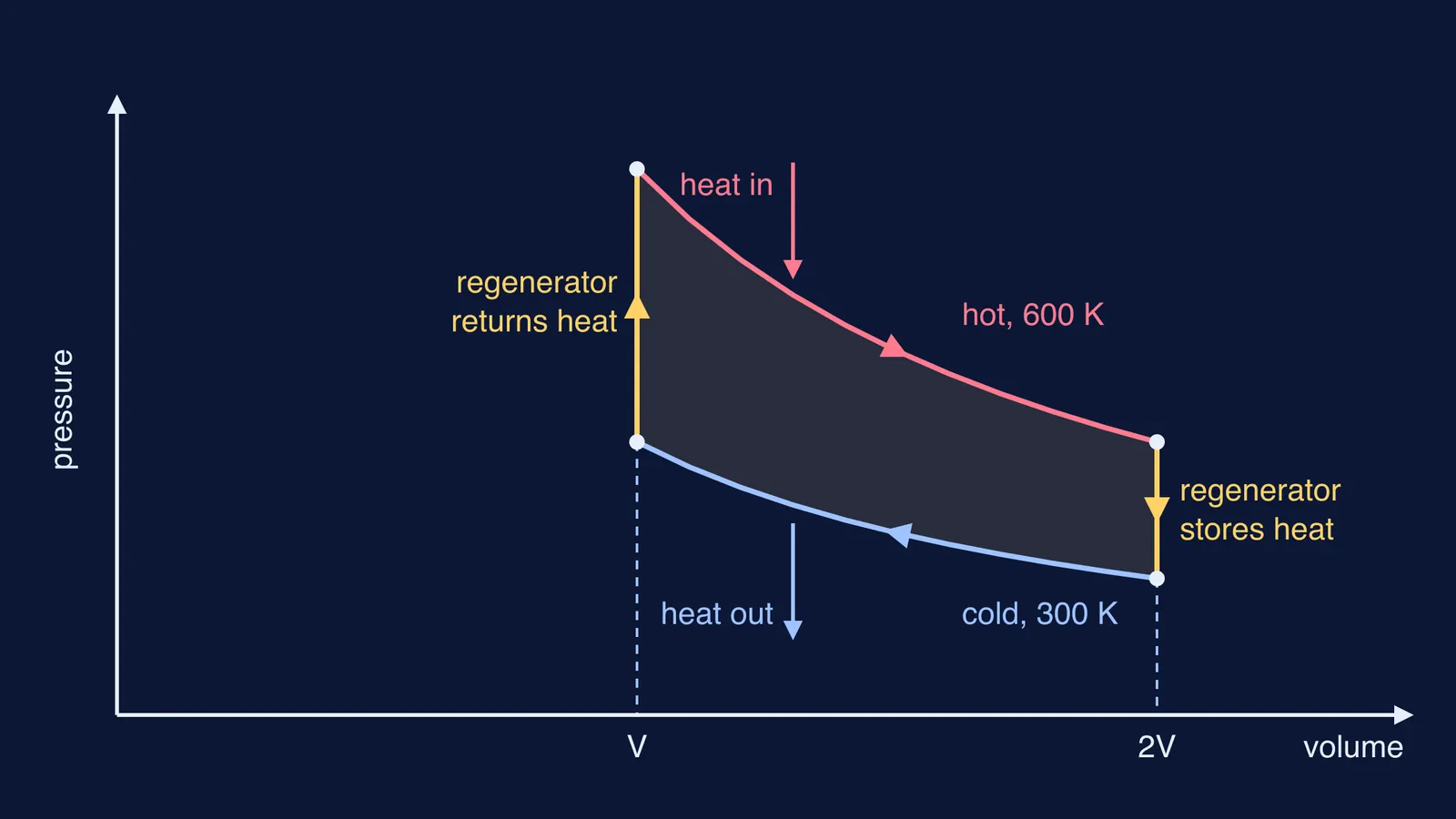
Hot expansion: the gas at the hot end takes in heat, expands and pushes the piston.
Shift to cold: the displacer moves the gas to the cold end, so its pressure falls.
Cold compression: the flywheel pushes the piston back. This takes less work than the hot gas gave out.
Shift to hot: the displacer moves the gas back, its pressure rises, and the cycle repeats.
In the ideal version, steps 1 and 3 happen at constant temperature, and steps 2 and 4 happen at constant volume.
What does the regenerator do?
In step 2 the gas must lose a lot of heat, and in step 4 it must gain the same amount back. Dumping that heat into the coolant and taking it from the fire again wastes fuel.
Stirling made the gas pass over something that stores heat. His plunger was made of iron plate so that it “would quickly take in heat and give it out”, Reid writes. Reid compares it to a heat sponge and says Stirling called this action 'regeneration'. In later engines, a separate regenerator sits in the passage between the hot and cold spaces.
Reid notes that the ideal Stirling engine has the same efficiency as a Carnot engine working between the same two temperatures: 1 − T_C/T_H. Real engines leak heat and lose energy to friction, and Reid writes that they “usually can't manage half the efficiency of the ideal engine.”
How much heat does the regenerator save?
This worked example tests Reid's Carnot point. Take 1 mole of air, treated as an ideal diatomic gas (C_v = 5R/2), with the hot end at 600 K and the cold end at 300 K, and let the volume double. Use R = 8.314 J/(mol K).
Heat in during hot expansion: R T_H ln 2 ≈ 3,458 J.
Heat out during cold compression: R T_C ln 2 ≈ 1,729 J.
Net work: about 1,729 J.
Heat needed to warm the gas from 300 K to 600 K at constant volume: C_v ΔT ≈ 6,236 J.
Without a regenerator, the flame supplies steps 1 and 4, which comes to about 9,693 J, so the efficiency is about 17.8%. With a perfect regenerator, step 4's heat comes back out of the store, so the flame supplies only 3,458 J. The efficiency is then 50%, exactly 1 − 300/600. The regenerator moves about 1.8 times as much heat per cycle as the flame does.
Why didn't Stirling engines replace steam?
The Linda Hall Library notes that the Stirling engine never successfully competed with steam or internal combustion engines in industry. Reid adds that engines above about 10 kW are hard to build. Their power grows with the cube of their size, but the surface that lets heat in grows only with the square.
NASA reports that a free-piston Stirling convertor at its Glenn Research Center ran for 14 years without maintenance. Convertors like it are designed to turn heat from decaying radioisotope fuel into electricity.
To practise, redo the example with the cold end at 350 K and check against 1 − T_C/T_H. Then try our heat engines and Carnot cycle problems, or read about Sadi Carnot's 1824 book. If PV loops are hard to picture, try reading work from a PV loop in a simulation or the Fermi Simulation Lab. If your answer doesn't match, the Fermi Problem Library has a step-by-step solver that explains the reasoning.