On this page
A petrol engine burns fuel, yet the textbook formula for its efficiency has no fuel in it. The ideal Otto cycle depends on just two numbers: how hard the engine squeezes the mixture (the compression ratio r) and the gas's heat capacity ratio γ. Below we trace the strokes on a pressure-volume (PV) diagram, derive η = 1 − 1/r^(γ−1) in five lines, and work it for r = 8.
What happens in the four strokes of an Otto cycle?
NASA's Glenn Research Center describes the ideal Otto cycle as intake, compression, combustion at constant volume, the power stroke, heat rejection at constant volume, and exhaust. Intake and exhaust run along the same constant-pressure line in opposite directions, so the analysis keeps the closed loop of four processes, with air as the working gas:
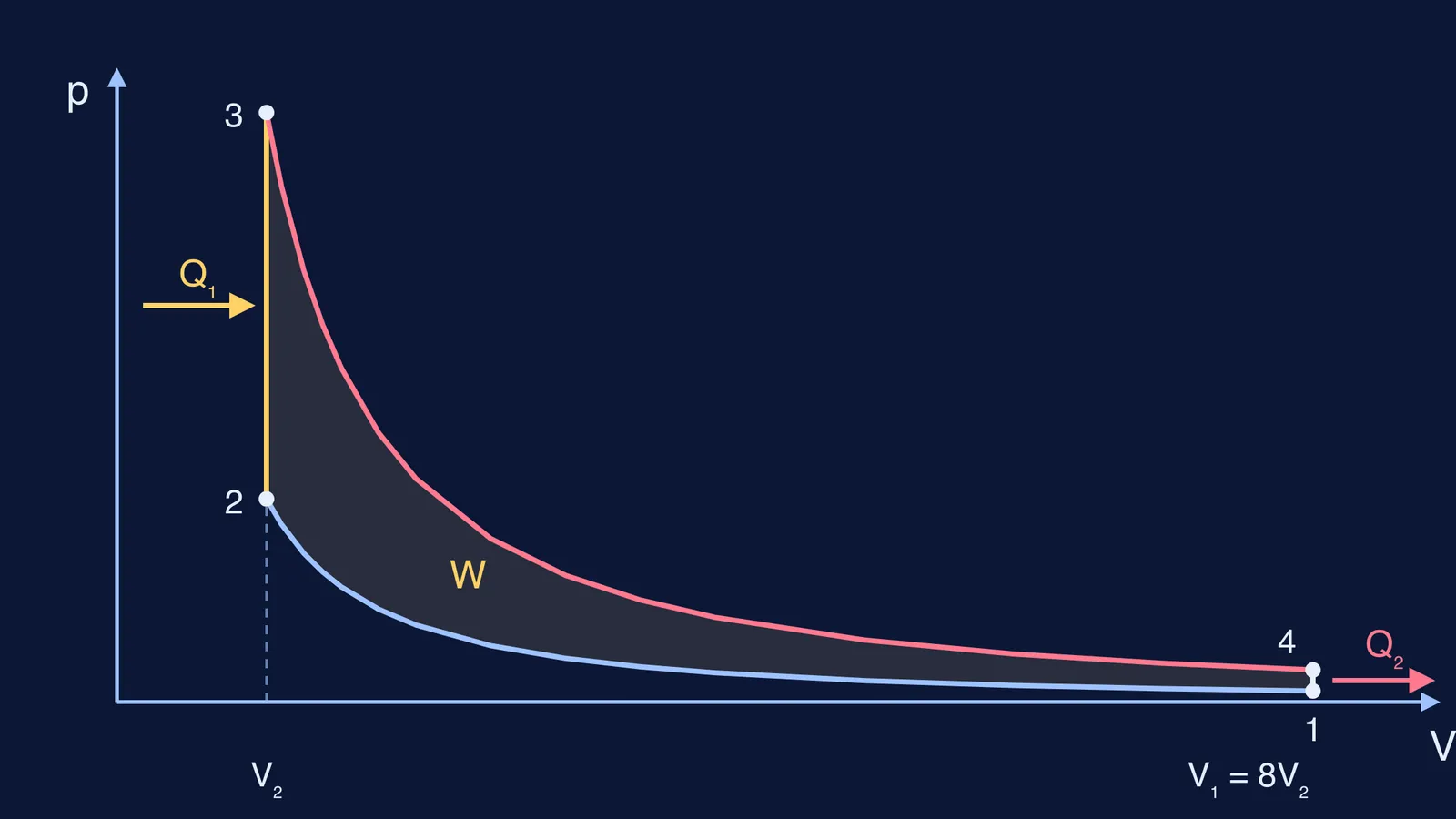
1 → 2, compression stroke: the piston squeezes the gas from volume V1 to V2 adiabatically (no heat in or out), so pressure and temperature both rise.
2 → 3, spark: the fuel burns so fast that the volume stays at V2, and heat Q1 = nCv(T3 − T2) goes in.
3 → 4, power stroke: the hot gas expands adiabatically back to V1 and pushes the piston.
4 → 1, exhaust valve opens: heat Q2 = nCv(T4 − T1) leaves at constant volume.
The compression ratio is r = V1/V2, the largest cylinder volume divided by the smallest. On the PV diagram the loop is two steep adiabats joined by two vertical lines, and the area inside is the work done per cycle.
How do you derive the efficiency of the Otto cycle?
Efficiency is work out divided by heat in, and for any cycle the work is W = Q1 − Q2 (our worked example of heat-engine work, W = Q1 − Q2 covers that step). The same derivation appears in MIT's thermodynamics notes on the Otto cycle.
Write η = 1 − Q2/Q1 = 1 − (T4 − T1)/(T3 − T2), because nCv cancels.
On an adiabat, TV^(γ−1) stays constant. For 1 → 2 that gives T2 = T1 r^(γ−1).
Process 3 → 4 spans the same two volumes, so T3 = T4 r^(γ−1).
Subtract: T3 − T2 = r^(γ−1)(T4 − T1).
Substitute: η = 1 − 1/r^(γ−1).
The ideal Otto cycle efficiency is η = 1 − 1/r^(γ−1), where r = V1/V2 is the compression ratio (MIT notes).
If the shape of those adiabats is fuzzy, why an adiabatic curve is steeper than an isothermal one walks through it.
What is the efficiency of a petrol engine with r = 8?
For air at standard conditions γ = 1.4, according to NASA's page on isentropic compression. So γ − 1 = 0.4.
8^0.4 = 2.297
1/2.297 = 0.435
η = 1 − 0.435 = 0.565, or about 56.5%
Now check it the long way with 1 mol of air, Cv = (5/2)R = 20.79 J/(mol·K). Take T1 = 300 K and, as an example value, a peak temperature T3 = 2000 K.
T2 = 300 × 2.297 = 689.2 K
T4 = 2000 ÷ 2.297 = 870.6 K
Q1 = 20.79 × (2000 − 689.2) ≈ 27.25 kJ
Q2 = 20.79 × (870.6 − 300) ≈ 11.86 kJ
W = Q1 − Q2 ≈ 15.39 kJ, and W/Q1 ≈ 0.565
Same answer, and the 2000 K never mattered. The same NASA page gives p2/p1 = (V1/V2)^γ, so the pressure at the end of compression is 8^1.4 ≈ 18.4 times the starting pressure, before the spark even fires.
Why don't engines just use a higher compression ratio?
The formula rewards a higher r, but slowly. With γ = 1.4 from NASA:
r = 6 gives 51.2%
r = 8 gives 56.5%
r = 10 gives 60.2%
r = 12 gives 63.0%
Wikipedia's Otto cycle article gives about 10:1 as the standard ratio for typical cars and explains the ceiling: squeezing harder heats the mixture until it can ignite before the spark, which is called knock. The same article notes that combustion products have γ closer to 1.3; with that value, r = 8 gives 1 − 1/8^0.3 ≈ 46.4%. NASA adds that the ideal cycle does not occur in reality and that every process has losses. Treat 56.5% as the model's ceiling, not a reading from a real car.
Which mistakes cost marks on Otto cycle problems?
Flipping the ratio: r = V1/V2 is always greater than 1.
Writing γ instead of γ − 1 in the exponent.
Using nCp for the spark and exhaust steps; both happen at constant volume, so it is nCv.
Putting Celsius into T2 = T1 r^(γ−1); use kelvin.
Missing that a question giving clearance volume Vc and swept volume Vs means r = (Vs + Vc)/Vc.
To practise on fresh numbers, the Fermi Problem Library has worked problems with a step-by-step solver that explains the reasoning rather than printing an answer.
Next time r appears in a question, write the five steps from memory before you reach for the formula.