

On this page
A heat engine takes in heat at a high temperature, turns part of it into work, and throws the rest away at a low temperature. Class 11 and JEE heat-engine questions build on that idea. Below: two equations, two worked examples and a check for impossible answers.
How do you find the work output of a heat engine?
OpenStax University Physics defines a heat engine as "a device used to extract heat from a source and then convert it into mechanical work" (OpenStax, Heat Engines). The working substance goes round a cycle and ends where it started, so its internal energy does not change. The first law then says all the heat that went in must come out as work or as rejected heat.
That gives the work equation, written in NCERT's notation (NCERT Class 11 Physics, Chapter 11: Thermodynamics):
Q1 = heat absorbed from the hot reservoir (source) per cycle
Q2 = heat rejected to the cold reservoir (sink) per cycle
W = net work done by the engine per cycle = Q1 − Q2
OpenStax writes the same thing as W = Qh − Qc and notes that the symbols stand for amounts only. Treat Q1, Q2 and W as positive amounts; the arrows on your diagram show direction.
What is the efficiency of a heat engine?
Efficiency is what you get out (work) divided by what you paid for (heat from the hot reservoir). OpenStax gives it as e = W/Qh = 1 − Qc/Qh (OpenStax, Heat Engines), and NCERT writes the same ratio as η = W/Q1 = 1 − Q2/Q1 when it works out the Carnot engine (NCERT Chapter 11).
The rejected heat Q2 is not a flaw better engineering can remove. NCERT's Kelvin-Planck statement of the second law reads: "No process is possible whose sole result is the absorption of heat from a reservoir and the complete conversion of the heat into work." Put simply, η can never equal 1, so Q2 is never zero.
Worked example: 1000 J in, 600 J out
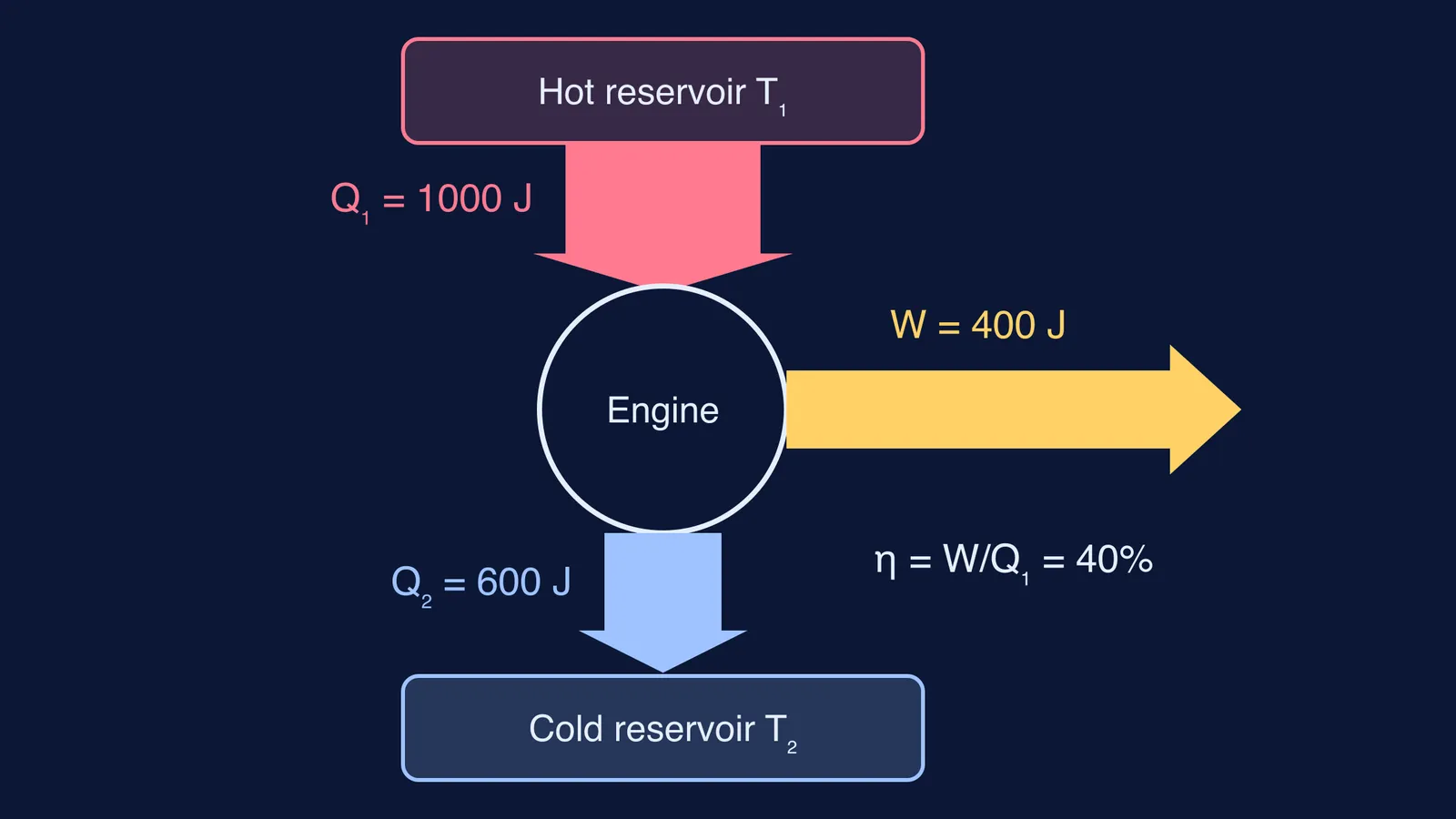
An engine absorbs 1000 J from a hot reservoir at 600 K and rejects 600 J to a cold reservoir at 300 K in each cycle.
Work per cycle: W = Q1 − Q2 = 1000 J − 600 J = 400 J.
Efficiency: η = W/Q1 = 400/1000 = 0.40, or 40%.
Cross-check: 1 − Q2/Q1 = 1 − 600/1000 = 0.40. Same answer.
Is it possible? The Carnot limit is η = 1 − T2/T1 = 1 − 300/600 = 0.50. Since 40% is below 50%, this engine is allowed.
Worked example: from efficiency back to the heats
Often you are given η and the work, and asked for the heats. OpenStax works through a lawn mower with 25.0% efficiency and an average power of 3.00 kW running for one minute (OpenStax, Heat Engines). The work in that minute is W = P × t = 3.00 × 10³ W × 60 s = 180 kJ. Then:
Heat absorbed: Q1 = W/η = 180 kJ / 0.25 = 720 kJ.
Heat rejected: Q2 = Q1 − W = 720 kJ − 180 kJ = 540 kJ, matching the 540 kJ OpenStax gets.
How do you tell if an engine claim is impossible?
NCERT states Carnot's theorem: working between two given temperatures T1 and T2, no engine can have efficiency more than that of the Carnot engine, whose efficiency is η = 1 − T2/T1 (NCERT Chapter 11). OpenStax gives the same limit, e = 1 − Tc/Th, with kelvin in its worked examples (OpenStax, The Carnot Cycle).
So compare the claimed η = 1 − Q2/Q1 with the limit 1 − T2/T1; if the claim is higher, the engine cannot exist. An inventor says their engine absorbs 800 J and rejects 200 J per cycle while working between 400 K and 300 K. The claimed efficiency is 1 − 200/800 = 75%. The Carnot limit is 1 − 300/400 = 25%. The claim breaks the second law.
What are the common mistakes in Q1 − Q2 problems?
Giving Q2 a minus sign and then subtracting it again, so you get W = Q1 + Q2.
Dividing by Q2 or by W instead of Q1 when finding η.
Mixing per-cycle energies with power (joules per second).
Using Celsius in 1 − T2/T1.
Forgetting that a real engine's η must sit below the Carnot value.
If you keep landing on the wrong option, find where your method split from the correct one. The Fermi Problem Library has worked problems with a step-by-step solver that explains the reasoning rather than printing an answer. If the idea of a reservoir or a cycle itself feels shaky, the Fermi Concept Library gives each physics concept its own lesson.


