

On this page
A familiar chemical thermodynamics question asks: above, or below, what temperature does this reaction go on its own? The answer takes one line of algebra. Most lost marks come from the steps around it: units, signs and deciding whether "above" or "below" is right.
What does ΔG = 0 tell you?
The Gibbs free energy change of a process is ΔG = ΔH − TΔS, and a process is spontaneous when ΔG is negative (OpenStax Chemistry 2e, section 16.4). The same section explains that ΔG = 0 at equilibrium. That is the point where the reaction is about to switch from "no" to "yes" (or the other way).
Set ΔG = 0 and rearrange:
0 = ΔH − TΔS
TΔS = ΔH
T = ΔH/ΔS
This treats ΔH and ΔS as fixed numbers that do not change with temperature. That is the usual textbook assumption, and it works well enough for exams. OpenStax tests it on water: T = ΔH°/ΔS° gives a boiling point of about 370.5 K, close to the real 373.2 K (OpenStax).
When is a reaction spontaneous above or below T = ΔH/ΔS?
The signs of ΔH and ΔS decide everything. OpenStax lists four cases:
ΔH negative, ΔS positive: spontaneous at all temperatures. Both terms make ΔG negative, and T = ΔH/ΔS comes out negative, which means there is no crossover.
ΔH positive, ΔS negative: non-spontaneous at all temperatures. Both terms push ΔG positive, and again there is no real crossover.
ΔH positive, ΔS positive: spontaneous at high temperatures. The −TΔS term grows with T until it beats ΔH, so the reaction goes above T = ΔH/ΔS.
ΔH negative, ΔS negative: spontaneous at low temperatures. Here −TΔS is positive and grows with T, so the reaction goes only below T = ΔH/ΔS.
How do you calculate it for limestone decomposition?
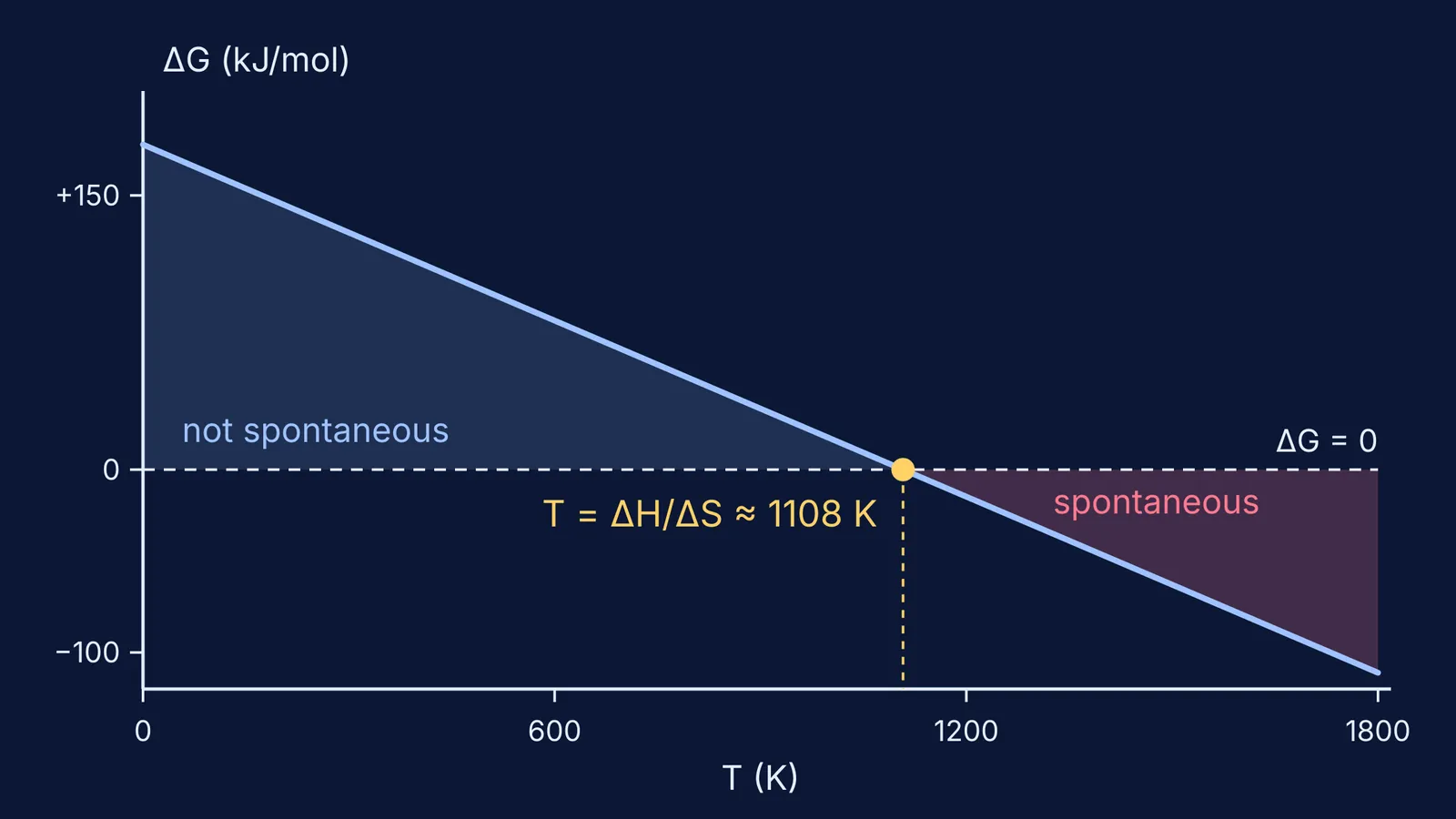
Heating limestone gives quicklime and carbon dioxide: CaCO3(s) → CaO(s) + CO2(g). Chemistry LibreTexts/20:_Entropy_and_Free_Energy/20.06:_Temperature_and_Free_Energy) gives ΔH° = 177.8 kJ/mol and ΔS° = 160.5 J/K·mol for this reaction. Here is the calculation, step by step:
Read the signs. ΔH is positive (it takes heat to break up the carbonate). ΔS is positive because a gas, CO2, is produced. That is case 3, so the answer will be a minimum temperature.
Match the units. ΔH is in kJ and ΔS is in J, so convert: 177.8 kJ/mol = 177,800 J/mol.
Divide: T = 177,800 ÷ 160.5 ≈ 1108 K.
Convert if asked: 1108 − 273 ≈ 835°C. LibreTexts gets the same answer, 1108 K or 835°C.
Check on both sides. At 1000 K, ΔG = 177.8 − (1000 × 0.1605) = +17.3 kJ/mol, so the reaction is not spontaneous. At 1200 K, ΔG = 177.8 − 192.6 = −14.8 kJ/mol, so it is spontaneous.
Step 5 takes half a minute and catches sign errors. If your "above" temperature gives a positive ΔG just above it, something has gone wrong.
If you want more problems like this, the Fermi Problem Library has worked problems with a step-by-step solver that explains the reasoning rather than printing an answer.
Which mistakes cost marks in this question?
Mixing kJ and J. Using 177.8 ÷ 160.5 gives about 1.1 K, which should look wrong straight away. Convert ΔH to J before dividing.
Using Celsius. In ΔG = ΔH − TΔS, T is always in kelvin. Convert to °C only at the end, and only if the question asks for it.
Forcing a crossover that does not exist. If the signs are opposite, T = ΔH/ΔS is negative. Write "spontaneous at all temperatures" or "at no temperature" instead of a number.
Saying "above" when the answer is "below". Look at the sign of ΔS. If it is negative, the reaction runs below the crossover.
Losing the sign of ΔH. For an exothermic reaction, write the minus sign in every line.
How should you practise this?
Take five reactions from your textbook exercises. For each, write only the signs of ΔH and ΔS and the case number before calculating anything. Then work out the crossover for the ones in cases 3 and 4.
If predicting the sign of ΔS still feels like guessing, the Fermi Concept Library has a lesson for every chemistry concept, including entropy and Gibbs free energy.


