

On this page
The question gives you ΔG° and asks for K. One equation connects them; the hard parts are units, signs and choosing between ln and log.
What is the formula linking K and ΔG°?
The NCERT Class 11 chemistry chapter on equilibrium starts from ΔG = ΔG° + RT ln Q (NCERT Chemistry, Equilibrium, Section 6.7). At equilibrium ΔG = 0 and Q = K, so ΔG° = −RT ln K. Rearranging gives ln K = −ΔG°/RT, and taking the antilog of both sides gives K = e^(−ΔG°/RT), equation 6.23 in the same chapter.
R is the gas constant, T the temperature in kelvin, and ΔG° the standard Gibbs energy change for the reaction as written, in J/mol. The molar gas constant is exactly 8.314 462 618... J mol⁻¹ K⁻¹ in the 2022 CODATA values (NIST). Using 8.314 is enough for board and entrance exam questions.
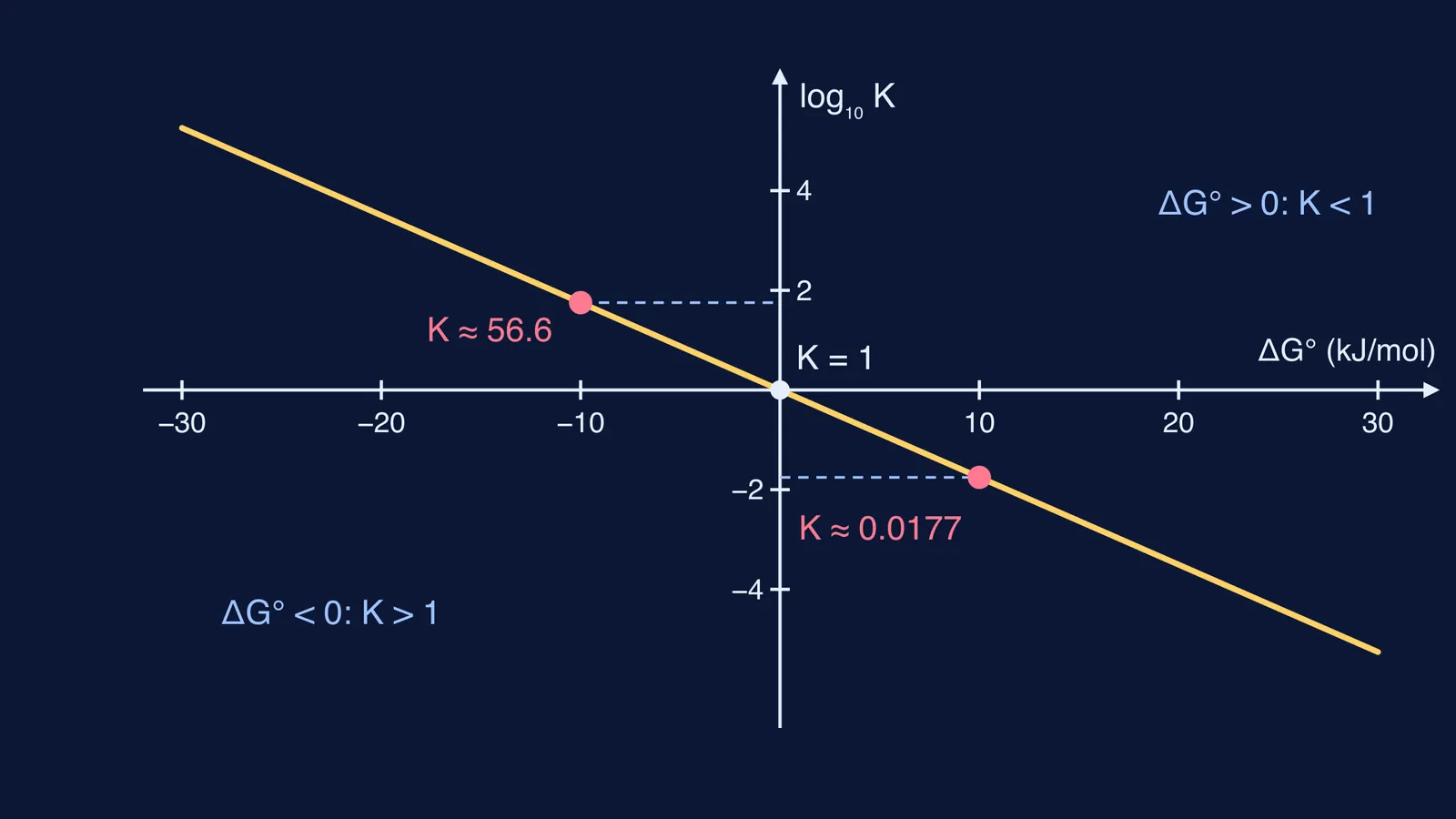
The sign of ΔG° tells you the size of K before you calculate anything. NCERT puts it this way: if ΔG° is negative, K is greater than 1 and products dominate at equilibrium; if ΔG° is positive, K is less than 1 and only a small amount of product forms. ΔG° = 0 gives K = e⁰ = 1.
How do you use the log form with 2.303?
If you prefer the log key to e^x: since ln K = 2.303 log K, the same equation becomes:
ΔG° = −2.303 RT log K, so log K = −ΔG° / (2.303 RT)
At 298 K, with R = 8.314 J mol⁻¹ K⁻¹ as in NCERT's Problem 6.10, RT = 8.314 × 298 = 2477.6 J/mol, and 2.303RT = 5705.9 J/mol, about 5.71 kJ/mol. That number gives you a quick rule: at 298 K, each 5.71 kJ/mol drop in ΔG° multiplies K by 10.
Worked example: what is K when ΔG° is positive?
Question: a reaction has ΔG° = +10.0 kJ/mol at 298 K. Find K using ln K = −ΔG°/RT.
Convert to joules: ΔG° = +10 000 J/mol.
Compute RT: 8.314 × 298 = 2477.6 J/mol.
ln K = −10 000 / 2477.6 = −4.036.
K = e^(−4.036) ≈ 0.0177, or 1.77 × 10⁻².
With logs: log K = −10 000 / 5705.9 = −1.753, so K = 10^(−1.753) = 1.77 × 10⁻². Both routes agree.
K is less than 1, as the positive sign predicted. For a simple reaction A ⇌ B, that means about 1.8 molecules of B for every 100 of A at equilibrium: the reactant side wins.
Worked example: what is K when ΔG° is negative?
Now flip the sign: ΔG° = −10.0 kJ/mol at 298 K, still using K = e^(−ΔG°/RT).
ln K = −(−10 000) / 2477.6 = +4.036.
K = e^(4.036) ≈ 56.6.
Log form check: log K = +1.753, so K = 10^1.753 ≈ 56.6.
Notice that 56.6 is 1/0.0177. Changing the sign of ΔG° is the same as writing the reaction backwards, so the two K values multiply to 1.
You can test your method against NCERT's own Problem 6.10: for ΔG° = 13.8 kJ/mol at 298 K, the book gets ln Kc = −5.569 and Kc = 3.81 × 10⁻³ (NCERT Chemistry, Equilibrium). If your working lands on the same numbers, your method is sound.
To practise more of these, the Fermi Problem Library has worked problems with a step-by-step solver that explains the reasoning rather than printing an answer.
What mistakes cost marks in K from ΔG° questions?
kJ against J. ΔG° usually comes in kJ/mol and R in J/mol K, as in NCERT's worked problems. Forget to convert and your exponent is 1000 times too small, so K comes out close to 1.
A lost minus sign. Before calculating, write down whether K should be above or below 1, and check your answer against it.
Celsius for T. 25 °C is 298 K. Putting 25 into RT gives nonsense.
Mixing ln and log. If you divided by 2.303RT, take 10^x. If you divided by RT, take e^x.
ΔG instead of ΔG°. ΔG° goes with K. ΔG without the degree sign goes with Q and changes as the reaction runs.
The wrong R. NCERT uses 0.083 bar L mol⁻¹ K⁻¹ for pV = nRT in Problem 6.8, but with energies in joules you need 8.314 J mol⁻¹ K⁻¹.
If the sign rules still feel shaky, start with our explainer on Gibbs energy and spontaneity. The same −RT ln K appears in electrochemistry as −nFE°, covered in from cell EMF to ΔG° and K. And if a question also asks about the units of K, see how Kc and Kp units depend on Δn.
If the gap is how Q, K and ΔG fit together, the Fermi Concept Library has a lesson for every concept in chemistry, so you can go back one step first.


