

On this page
When you first learn about chemical equilibrium, you might notice something odd: the units of the equilibrium constant seem to change from one problem to the next. In one question, Kc has units of mol/L. In another, it has no units at all.
This happens because the practical units of an equilibrium constant depend entirely on the stoichiometry of the specific reaction. If you are struggling with chemical equilibrium problems where the units do not seem to balance out, the key is looking at the change in the number of gaseous moles.
Why do the units of Kc and Kp depend on Δn?
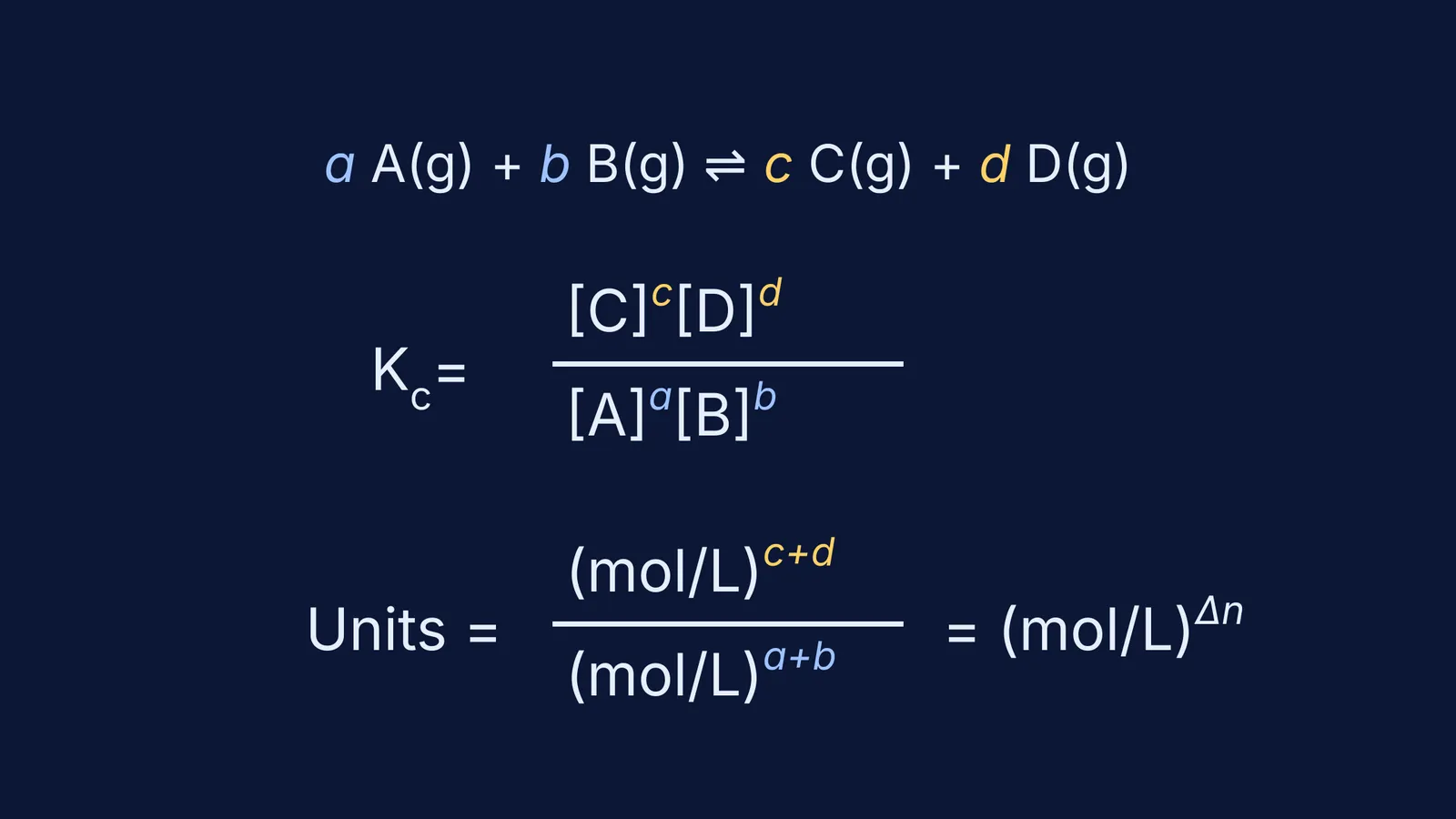
For any general reversible reaction in the gas phase, we can write the equation as aA + bB ⇌ cC + dD.
The concentration-based equilibrium constant, Kc, is the ratio of the product concentrations to the reactant concentrations, each raised to the power of their stoichiometric coefficients:
Kc = ([C]ᶜ [D]ᵈ) / ([A]ᵃ [B]ᵇ)
Since every concentration term is measured in moles per litre (mol/L), the units of Kc become:
Units of Kc = (mol/L)ᶜ⁺ᵈ / (mol/L)ᵃ⁺ᵇ
By combining the exponents, we get (mol/L)⁽ᶜ⁺ᵈ⁾⁻⁽ᵃ⁺ᵇ⁾. The term (c+d) − (a+b) is exactly the difference between the number of moles of gaseous products and gaseous reactants. We call this difference Δn. Therefore, the units of Kc are (mol/L)^Δn, as explained by LibreTexts/Equilibria/Chemical_Equilibria/The_Equilibrium_Constant).
The exact same logic applies to Kp, which is defined using the partial pressures of the gases. Since pressure is typically measured in atmospheres (atm) or bar, the units of Kp are (atm)^Δn.
Here is how Δn dictates the final units:
When Δn = 0: The reaction produces as many moles of gas as it consumes. For example, in H₂(g) + I₂(g) ⇌ 2HI(g), we have 2 moles of product and 1 + 1 = 2 moles of reactants, making Δn = 0. Both Kc and Kp are unitless.
When Δn > 0: There are more gaseous products than reactants. For PCl₅(g) ⇌ PCl₃(g) + Cl₂(g), we have Δn = 2 − 1 = 1. The units of Kc are mol/L and the units of Kp are atm.
When Δn < 0: The reaction reduces the amount of gas. In the Haber process N₂(g) + 3H₂(g) ⇌ 2NH₃(g), we have Δn = 2 − 4 = −2. The units of Kc are (mol/L)⁻² (or L²/mol²) and Kp is atm⁻².
When calculating how adding an inert gas to an equilibrium shifts the reaction, tracking these units and volume changes can save you from calculation errors.
Why is the thermodynamic equilibrium constant dimensionless?
While Kc and Kp are practically useful, the International Union of Pure and Applied Chemistry (IUPAC) defines the true thermodynamic equilibrium constant (K°) as a strictly dimensionless quantity, according to Wikipedia.
This definition is based on the concept of activity. In thermodynamics, a substance's activity is the ratio of its actual concentration (or pressure) to a defined standard state. For gases, the standard state is a hypothetical ideal gas at a pressure of 1 bar (10⁵ Pa). For a solution, the standard concentration is 1 mol/L.
Because activity is formed by dividing a concentration by a standard concentration (e.g. c / c°), the units cancel out. The activity is a pure number. When you calculate the standard equilibrium constant by multiplying these activities, the result is naturally dimensionless.
This is not just a convention, but a mathematical requirement for thermodynamics. The standard Gibbs free energy change relates to the equilibrium constant through the equation ΔG° = −RT ln K°. You can only take the logarithm of a dimensionless number, meaning the true thermodynamic K must never have units.
If you are working through thermodynamics and need to review standard states, you can look them up in the Fermi Concept Library, which covers the underlying principles for every concept in physical chemistry.
How to convert between Kp and Kc?
Because Kp and Kc have units that depend on Δn, they are not always equal to each other. They are related by the ideal gas law:
Kp = Kc (RT)^Δn
Where R is the universal gas constant (usually 0.08206 L atm K⁻¹ mol⁻¹) and T is the absolute temperature in Kelvin, as detailed by LibreTexts/Equilibria/Chemical_Equilibria/The_Equilibrium_Constant). You only get Kp = Kc when Δn = 0.
If you regularly build ICE tables for equilibrium constant problems and get stuck verifying your units, Fermi's AI tutor can help. Because it teaches rather than answers, it works out what you already know, builds a plan for the session, and notices where you are stuck—for example, if you forgot to convert Celsius to Kelvin or included a solid in your Δn calculation.


