

On this page
Over one full cycle, half of an alternating current flows one way and half flows back, so its plain average is zero. Yet a heater on AC still gets hot. NCERT's Class 12 Physics textbook, in Chapter 7, Alternating Current, explains that Joule heating depends on i², and i² is positive whether i is positive or negative. Below is the derivation as you would write it in a board exam, plus a check on a real bulb.
Why can't you just average the current?
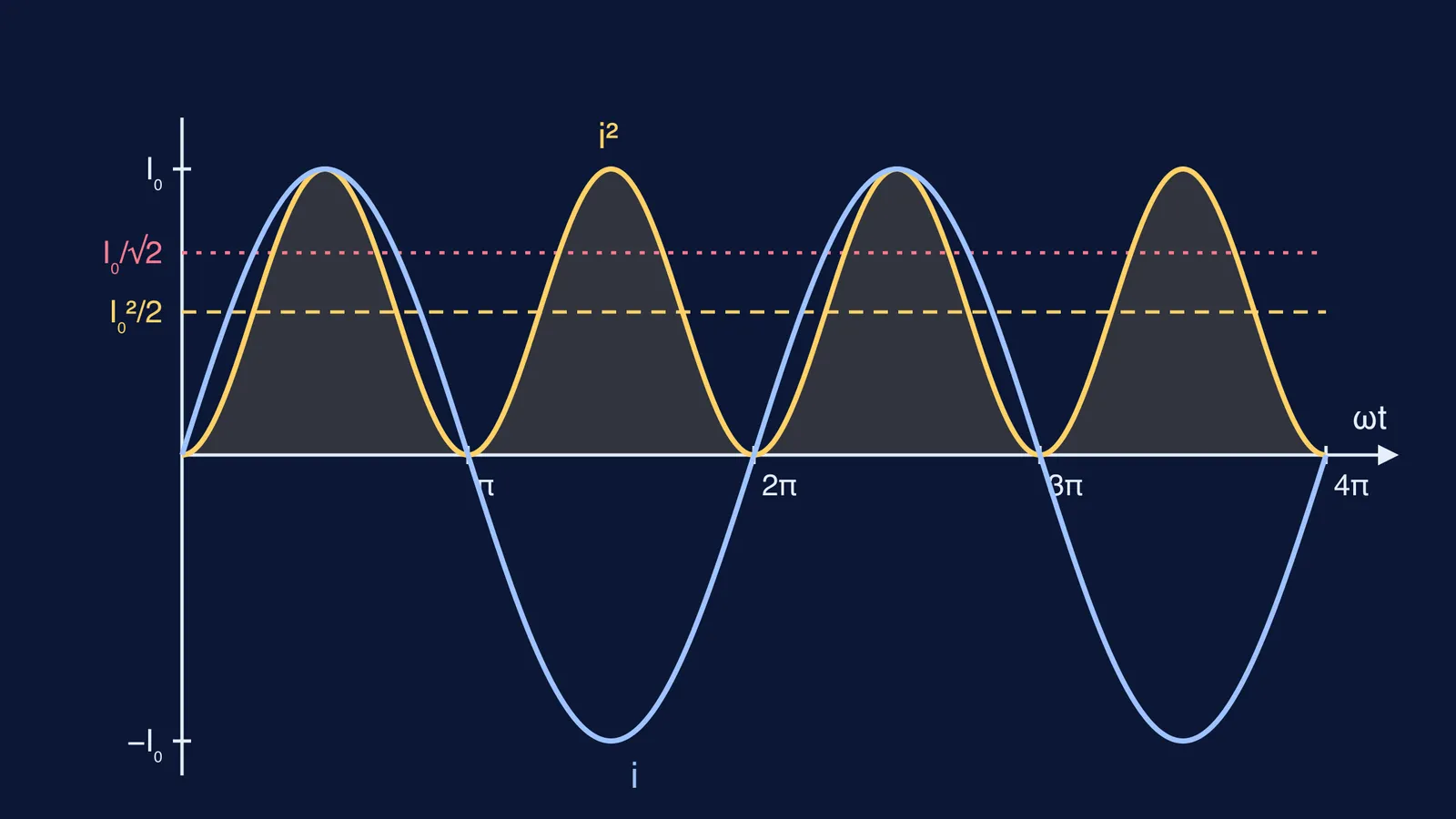
Take i = I₀ sin ωt, where I₀ is the peak current. The positive half-cycle cancels the negative one, so the average current is zero. The power in a resistor is p = i²R, and squaring gets rid of the sign. So the useful size of an AC current comes from the average of i², not the average of i.
The name is the recipe, read backwards: square the current, take the mean, then take the root.
How do you derive the rms value of alternating current?
These are the steps NCERT uses in equations 7.4 to 7.7 of Chapter 7, written with I₀ for the peak current (the book calls it i_m):
Instantaneous power in a resistor: p = i²R = I₀²R sin² ωt.
Average over one cycle. I₀ and R are constants, so p̄ = I₀²R ⟨sin² ωt⟩.
Use the identity sin² ωt = (1 − cos 2ωt)/2.
Over a full period, cos 2ωt averages to zero, so ⟨sin² ωt⟩ = 1/2.
That gives p̄ = ½ I₀²R.
Define I_rms as the steady current that gives the same average power: I_rms²R = ½ I₀²R, so I_rms = I₀/√2 ≈ 0.707 I₀.
The textbook puts step 6 in words: "the I or rms current is the equivalent dc current that would produce the same average power loss as the alternating current." The same argument for voltage gives V_rms = V₀/√2 = 0.707 V₀, which is equation 7.8 in the NCERT chapter.
Why does sin² average to exactly one half?
The identity. Write sin² ωt = ½ − ½ cos 2ωt. The constant ½ stays. The cosine term goes through two complete cycles in one period of i, so its positive and negative areas cancel. A footnote in the NCERT chapter does the integral: (1/T)∫cos 2ωt dt from 0 to T equals (1/2ωT)[sin 2ωT − 0], which is zero because ωT = 2π.
The symmetry. Over a full cycle, sin² and cos² are the same curve shifted by a quarter period, so they have the same average. Their sum is always 1. Two equal averages that add up to 1 must each be ½. OpenStax University Physics Volume 2, section 15.4 evaluates the same integral, (1/T)∫sin² ωt dt, and gets 1/2.
You can see this in the diagram at the top. The i² curve swings between 0 and I₀², and the humps above the I₀²/2 line exactly fill the dips below it. That is why you average over whole cycles (or half-cycles, since sin² repeats every half-cycle); over an arbitrary stretch of time the average is generally not ½.
Does 1/√2 work for every AC waveform?
No. The method works for any waveform, but the factor 1/√2 comes from the sine shape. Our guide on how to find the rms value of square and triangular waves works through two other common shapes.
How does the rms value show up in a real circuit?
NCERT's Example 7.1 in the Alternating Current chapter uses a 100 W bulb rated for a 220 V supply. The textbook says household 220 V is an rms value, and the peak is √2 × 220 V = 311 V. Here is the example; the last two lines are our own check:
Resistance: R = V²/P = 220²/100 = 484 Ω.
Rms current: I_rms = P/V = 100/220 ≈ 0.454 A.
Peak current: I₀ = √2 × 0.4545 ≈ 0.643 A.
Check with the derivation: ½ I₀²R = ½ × 0.413 × 484 ≈ 100 W, which matches the rating.
For more rms-to-peak practice, see our explainer on the peak voltage of 220 V AC mains.
On the third slip: as the NCERT chapter puts it, "it is customary to measure and specify rms values for ac quantities." When a question says 220 V or 5 A with no other label, assume it is rms.
What should you practise next?
Write the six steps from memory, then redo the bulb example without notes. After that, rms values carry straight into deriving LCR impedance and resonance.
If you can follow every line but get lost writing it out yourself, the Fermi Problem Library has worked problems with a step-by-step solver that explains the reasoning rather than printing an answer. If the trouble is further back, with averages or the trig identity, the Fermi Concept Library gives every concept in physics and mathematics its own lesson.


