

On this page
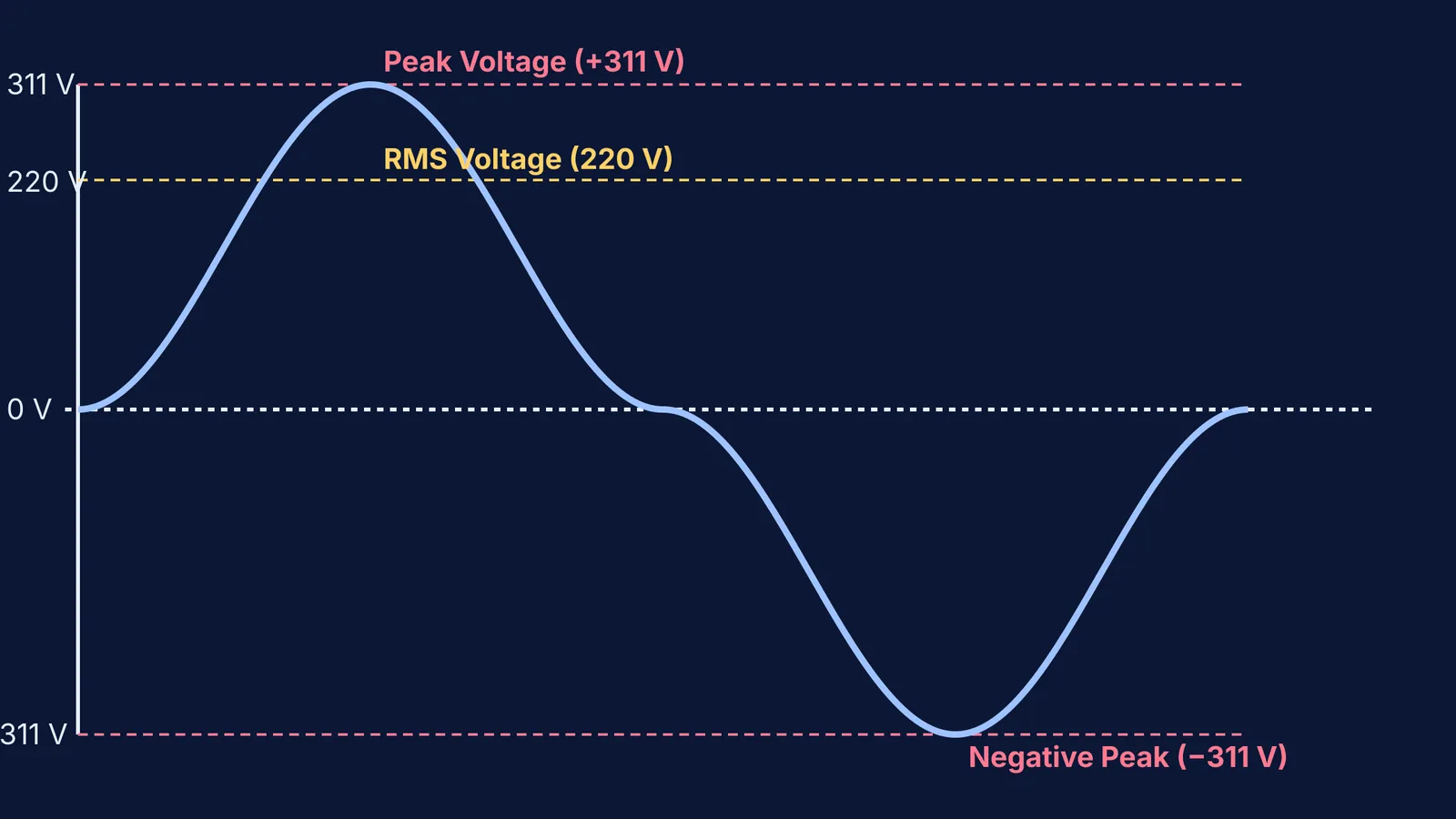
In a standard 220 V alternating current (AC) supply, 220 V represents the root mean square (RMS) voltage. The actual voltage is not constant; it rises and falls in a wave. According to physics principles for alternating current, the peak voltage is approximately 311 V, and the total peak-to-peak swing is roughly 622 V.
What is the peak voltage of 220 V AC mains?
For household electricity, the standard 220 V rating printed on appliances is its root mean square (RMS) value. Because it is an alternating current, the voltage is not steady; it is constantly changing in a smooth sine wave pattern. It starts at zero, rises to a maximum, falls back to zero, reverses direction to a negative maximum, and returns to zero again.
According to the mathematical formula for a sinusoidal alternating current, the peak voltage is calculated by multiplying the RMS voltage by the square root of 2 (OpenStax). For a 220 V supply, the peak voltage is 220 V × 1.414, which equals approximately 311 V. This is the highest instantaneous voltage reached at the very top of the wave's positive crest.
What does RMS voltage mean?
An alternating current swings back and forth, meaning its simple average voltage over a full cycle is exactly zero. However, the current still delivers power to appliances. The heating effect depends on the square of the current, so the negative half-cycles still produce positive power.
To make power calculations straightforward, engineers use the RMS value. The term stands for Root Mean Square: you square the instantaneous voltage, take the mean (average) over one cycle, and then take the square root. A 220 V RMS AC supply delivers the equivalent average power to a resistor as a steady 220 V DC supply (OpenStax). This "effective" value allows AC circuits to use the same basic power formulas as DC circuits.
If you want to know what happens when the waveform is clipped and no longer symmetrical, read our guide on the RMS and average value of half-wave rectified AC. In some countries, the standard mains voltage is slightly higher; you can see the math for that in our post on why RMS voltage is 230 V and peak voltage is 325 V.
What is the peak-to-peak voltage?
Because the current alternates, the voltage graph forms a full sine wave. During the first half of the cycle, it rises to a positive peak of +311 V. During the second half, it drops back through zero and falls to a negative peak of −311 V before repeating (OpenStax).
The total vertical distance on a graph from the top of the positive crest to the bottom of the negative trough is called the peak-to-peak voltage. For a 220 V mains supply, the peak-to-peak swing is 2 × 311 V, which equals 622 V. While RMS is useful for power calculations, peak-to-peak is the most practical measurement when looking at an oscilloscope, as it represents the total visual height of the wave on the screen.
A framework for AC voltage conversions
When solving AC numericals in physics, students often plug in the wrong voltage value. Use this three-step framework to ensure you are using the correct number:
Identify the given value: If a problem states "A 220 V AC supply", assume it is the RMS voltage unless the word "peak" is explicitly used. Standard appliance ratings are always RMS.
Determine what the formula requires: Use the RMS voltage when calculating average power, heat dissipation, or when using standard Ohm's law for the overall circuit. Use the peak voltage when evaluating insulation breakdown, maximum capacitor ratings, or plotting the instantaneous voltage equation.
Convert if necessary: To move from RMS to peak, multiply by 1.414 (which is √2). To move from peak to RMS, multiply by 0.707 (which is 1 / √2).
Why is a 220 V AC shock more dangerous than 220 V DC?
A common question in Class 12 physics is why 220 V AC is considered more dangerous than a 220 V DC supply.
While a 220 V DC supply provides a constant voltage of exactly 220 V, a 220 V AC supply reaches an instantaneous peak of 311 V twice in every single cycle. The human body experiences this higher maximum voltage, making AC shocks often more harmful than similar DC shocks (OpenStax). For more on the reasons behind the Indian grid standard, see our post on AC versus DC in Class 10: why India uses 50 Hz power.
If you find yourself stuck on why AC formulas look different from DC ones, the Fermi Concept Library breaks down the reasoning behind RMS, peak values, and alternating current circuits. And if you keep making calculation errors with √2 in numericals, the Fermi Problem Library has step-by-step solvers that explain the method instead of just printing the final answer.


