

On this page
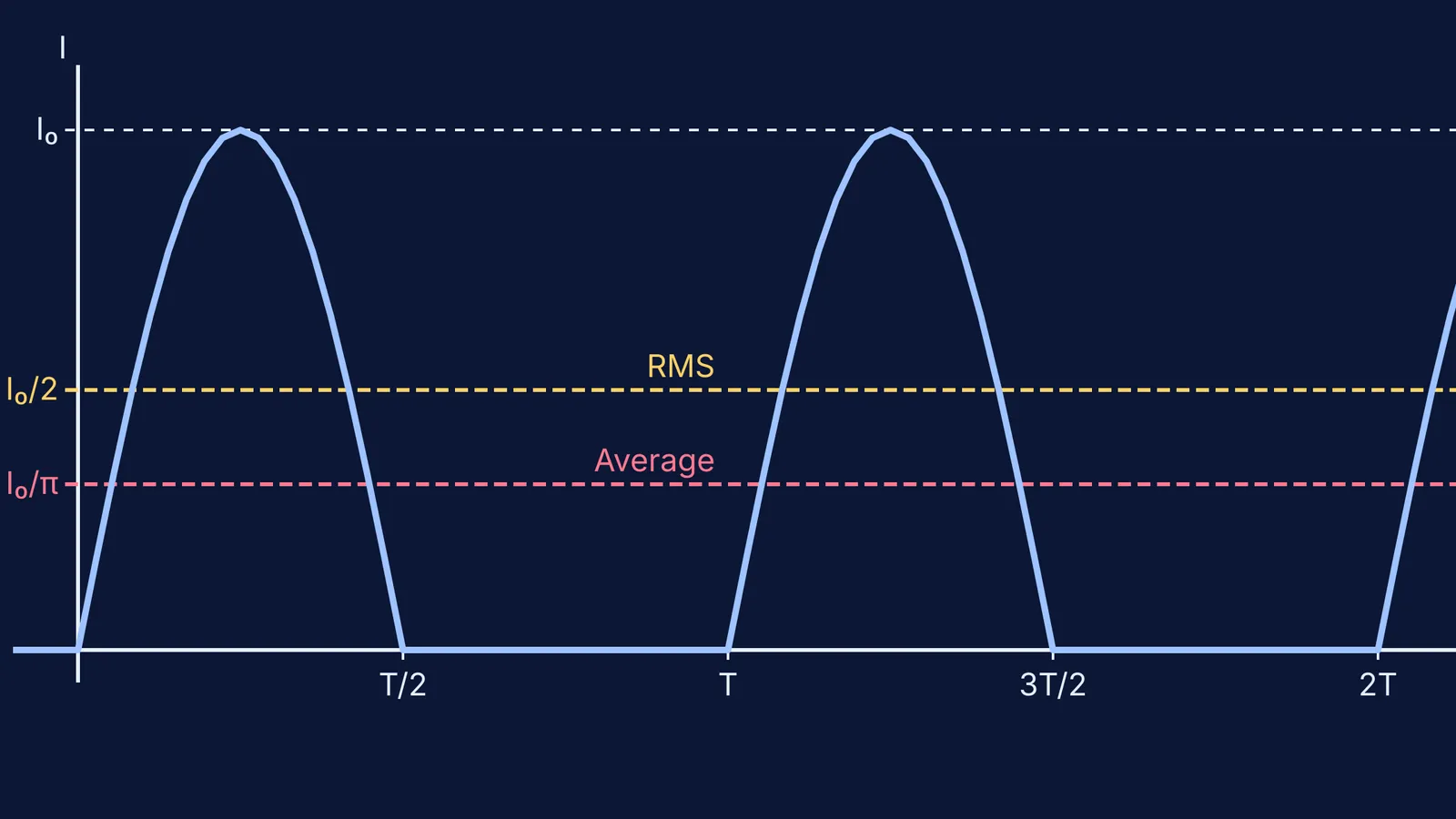
When you pass an alternating current (AC) through a single diode, it blocks the negative half of the cycle, allowing current to flow only when the diode is forward-biased. This creates a pulsing, one-directional current called a half-wave rectified signal. Because half the wave is completely missing from the output, the mathematics of its effective power and average values change completely compared to a full sine wave.
In many practical applications, such as basic battery chargers or signal detectors, understanding these values is critical for designing safe and efficient circuits. Whether you are calculating current (I) or voltage (V), the mathematical relationships remain exactly the same. Let's look at how to find the average and root mean square (RMS) values for a peak current of I₀.
What is the average value of a half-wave rectified AC?
The average value (often called the DC value) is what a standard direct-current ammeter or voltmeter will read when connected to the circuit. It is simply the mathematical mean of the current over one complete cycle (from t = 0 to t = T).
For a half-wave rectifier, the current is described by the function I₀ sin(ωt) for the first half of the cycle, and zero for the second half. To find the mean, you integrate this current over the full period T and divide by T. The integration of the sine function over a half cycle yields a factor of 2, but since we divide by the entire period (which corresponds to 2π radians), the 2 and the 2π simplify to 1/π. Integrating this over the full period gives exactly, as shown in standard reference materials:
Average = I₀ / π ≈ 0.318 I₀
This represents the equivalent DC value that would deliver the same net charge over time over the span of a complete cycle. It is a fundamental benchmark in electronics because it tells you how much steady current you can extract from the pulsating output.
What is the RMS value of a half-wave rectified AC?
The root mean square (RMS) value is a measure of the effective "heating power" of the current. It is the equivalent steady DC current that would produce the same amount of heat in a given resistor. Because power dissipation is proportional to the square of the current (I²R), the RMS calculation requires squaring the function before averaging it.
To find the RMS value, you square the current, take the average over a full period, and then take the square root. For a standard sine wave, the average of the squared wave is exactly half the squared peak. Because a half-wave rectifier delivers power for only 50% of the time, the mean square is exactly half that of a full sine wave. This means the mean square is I₀² / 4. The square root of 1/4 is 1/2, leading to a beautifully simple result:
RMS = I₀ / 2 = 0.5 I₀
This means a half-wave rectifier delivers exactly half the heating power of a full AC wave with the same peak value. It is crucial to remember that while the average current drops by more than a factor of two compared to a full-wave rectifier, the heating power drops by exactly a factor of two.
How does it compare to full-wave rectification?
Understanding the difference between half-wave and full-wave outputs is a classic trap in exams. When you analyze both configurations, you must remember how the missing half-cycle affects linear averages versus squared averages. Here is the comparison checklist you need, based on standard rectifier properties:
Unrectified (Full) AC Wave:
Peak: I₀
RMS: I₀ / √2 ≈ 0.707 I₀
Average: 0 (over a full cycle)
Full-Wave Rectified:
Peak: I₀
RMS: I₀ / √2 ≈ 0.707 I₀
Average: 2I₀ / π ≈ 0.636 I₀
Half-Wave Rectified:
Peak: I₀
RMS: I₀ / 2 = 0.5 I₀
Average: I₀ / π ≈ 0.318 I₀
Notice that a full-wave rectifier has the exact same RMS value as an unrectified wave. Squaring a negative half-cycle makes it identical to a positive one, so the heating effect is unchanged. But for a half-wave rectifier, blocking the negative half cycle cuts the power in half, which changes the RMS value drastically.
When you are first learning alternating current, keeping track of these different averages can be confusing. Many students struggle with the calculus required to switch between average and RMS values for different waveforms. If you want to see exactly how these values are derived, the Fermi Concept Library breaks down the calculus step by step. When you are ready to test yourself on circuit problems, Fermi's AI tutor will work alongside you, asking questions and checking your reasoning as you calculate the power delivered to a load.
For more practice with alternating current, read our guide to RMS values and power in AC circuits: why we use them or explore the details of Half-wave and full-wave rectifiers: average output, ripple and PIV.


