

On this page
In India, standard mains electricity is 230 V RMS, but the actual voltage swings up to a peak of 325 V. This happens because alternating current (AC) is a sine wave, and the RMS value is the peak voltage divided by the square root of 2.
Why is the standard mains voltage 230 V?
When you plug a laptop charger into a wall socket in India, the power grid supplies an alternating current (AC). According to international standards, the nominal voltage is 230 V at a frequency of 50 Hz.
But this 230 V is not the maximum voltage. It is the Root Mean Square (RMS) voltage. The RMS voltage is the "effective" voltage: a 230 V AC supply delivers the exact same heating power to a resistor as a steady 230 V Direct Current (DC) battery would. Because an AC wave is constantly rising to a peak, dropping to zero, and reversing direction 50 times every second, its voltage is always changing. Engineers use the RMS average so they can calculate power simply, without worrying about the constant fluctuations. When you buy a standard light bulb, its power rating assumes you are giving it an effective 230 V.
Why is the peak voltage 325 V for a 230 V supply?
If the effective average (RMS) is 230 V, the sine wave must reach a much higher peak to make up for the times when the voltage drops to zero. For any pure sine wave, the peak voltage is exactly √2 (about 1.414) times the RMS voltage.
Multiply India's 230 V standard by 1.414, and you get 325.2 V. This means the voltage in your wall socket is actually swinging from +325 V down to −325 V and back again. The insulation in your cables and the components in your appliances must be built to withstand 325 V, not just 230 V, to prevent sparks and short circuits.
Where does the square root of 2 come from?
To predict the peak of the AC mains, we have to look at how power is calculated over time. Electrical power is proportional to the square of the voltage, V².
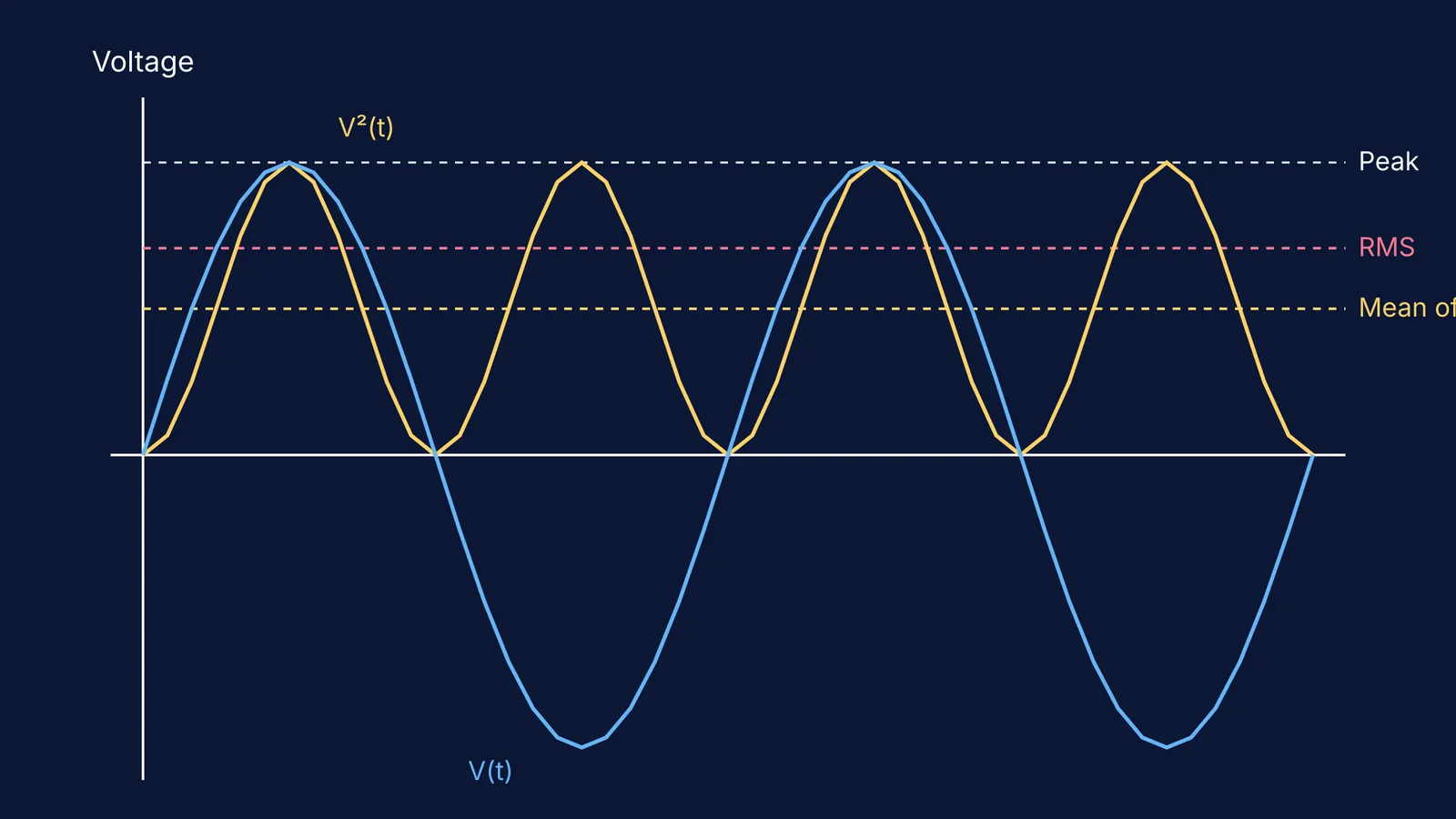
If you plot the voltage wave V(t) = V_peak × sin(θ), you get a curve that goes above and below zero. But power cannot be negative. When you square the voltage to find V²(t), the negative half of the wave becomes positive. You get a new wave that oscillates between 0 and the square of the peak voltage.
Because this squared sine wave is perfectly symmetrical, its average value sits exactly halfway between its minimum (0) and its maximum. So, the mean of the squared voltage is exactly half the squared peak voltage.
To find the effective voltage, we take the square root of this mean. The square root of a half is 1/√2. This is why we divide by 1.414 to go from peak to RMS, or multiply by it to go the other way.
When you are studying for JEE physics, visualising these two waves together — the voltage and its square — makes the mathematics obvious. If you struggle to picture how waves average out over time, the Fermi Simulation Lab has interactive simulations for the ideas that are easier to see than to read.
Why do we use alternating current instead of direct current?
You might wonder why we deal with RMS and peak voltages at all, instead of just using a steady DC voltage. The answer comes down to moving power over long distances.
To minimise energy lost as heat in the transmission wires, power companies must send electricity at extremely high voltages, often hundreds of thousands of volts. However, this is far too dangerous for household use. Alternating current allows transformers to easily and efficiently step the voltage up for long-distance travel, and then step it back down to a safe level for your home. Transformers rely on a changing magnetic field, which means they only work with AC.
How do you deal with AC circuits in exams?
In competitive exams like JEE Main and Advanced, examiners often test whether you know when to use RMS and when to use the peak voltage.
Power and heat: Always use the RMS voltage. Formulas like P = V² / R assume V is the RMS value.
Capacitor breakdown: Always use the peak voltage. A capacitor's maximum voltage rating will be exceeded if connected to an AC supply whose peak is higher than the rating, even if the RMS is lower.
If you hit a roadblock while working out phase differences in AC circuits, Fermi's AI tutor can work out what you already know and build a plan for the session. It holds a line of reasoning across the whole problem, drawing the figure and checking your understanding as it goes. For other circuit strategies, brushing up on solving circuits with the node potential method or the rules for inductors at t = 0 and t = ∞ is a reliable way to boost your score.


