

On this page
What is the difference between AC and DC in Class 10?
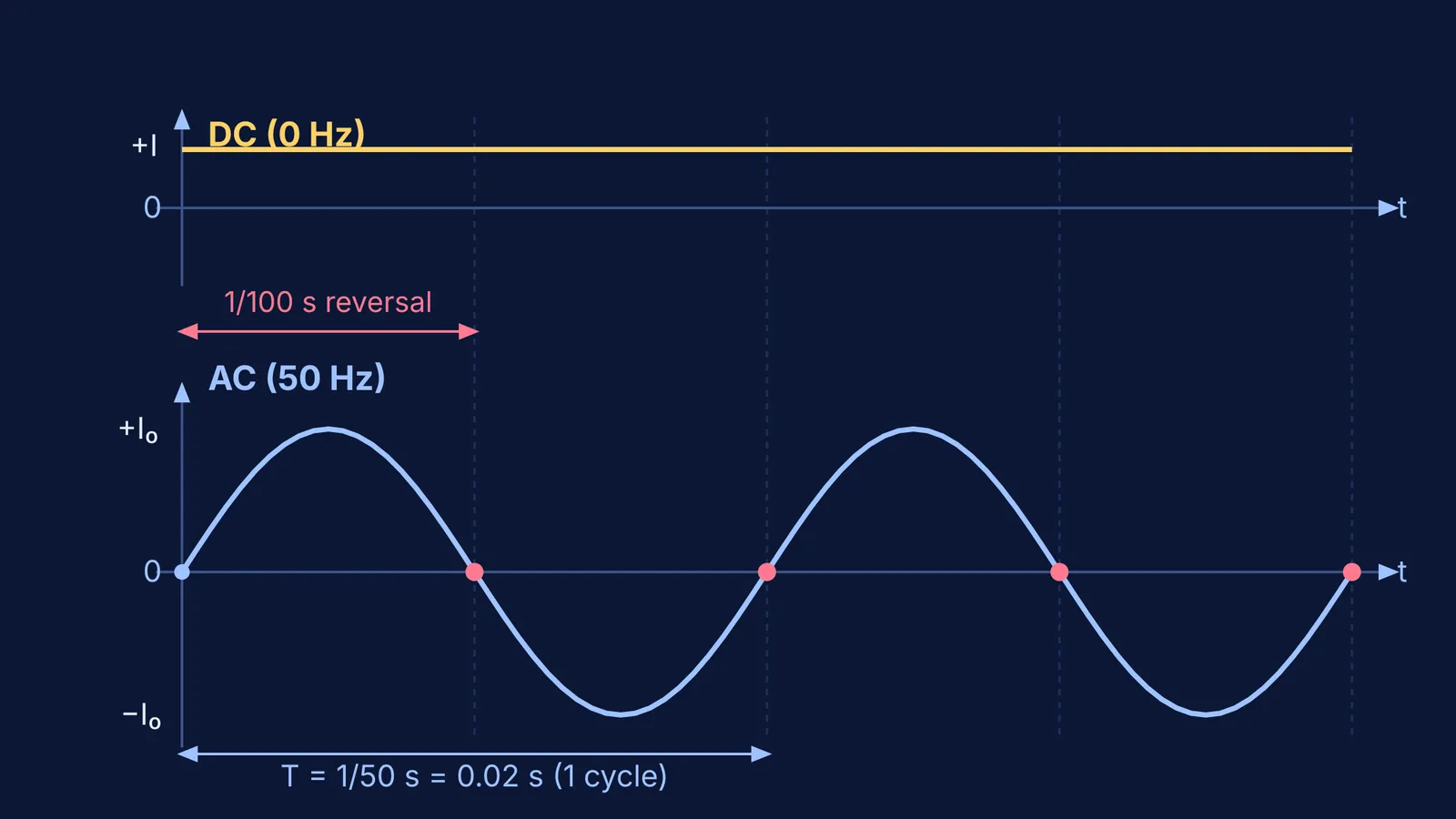
Direct current (DC) flows continuously in one constant direction without changing polarity, giving it a frequency of 0 Hz under the CBSE Class 10 Science curriculum. Standard direct current sources include chemical cells, storage batteries, and solar panels. In these DC circuits, the positive and negative terminals stay fixed, so electrons drift steadily in a single direction. You can review circuit fundamentals in our Class 10 overview of electric current and Ohm's law.
Alternating current (AC) reverses its direction of flow periodically. Conductor electrons do not drift in one direction; they oscillate back and forth about fixed mean positions. In India, domestic mains supply is alternating current with a standard frequency of 50 Hz, as regulated by the Central Electricity Authority. To build intuition for how oscillating charges differ from steady drift, the Fermi Simulation Lab offers interactive simulations for ideas that are easier to see than to read.
Why does AC in India change direction every 1/100 second?
Board examinations frequently test why Indian mains current reverses every 1/100 second. Frequency (f) is the number of complete cycles per second. Under official CBSE Class 10 guidelines, domestic electrical supply in India operates at a nominal frequency of 50 Hz. The time period (T) for one complete cycle is: T = 1 / f = 1 / 50 s = 0.02 s
Each complete AC cycle contains two equal halves: the current peaks positively and returns to zero, then reverses polarity, peaks negatively, and returns to zero. Because direction reverses once every half-cycle, the time interval between successive reversals is: Reversal interval = T / 2 = (1 / 50) / 2 s = 1 / 100 s = 0.01 s
Because the current reverses twice in each cycle, a 50 Hz supply changes direction 100 times every second. For students mapping how sinusoidal waveforms translate into periodic parameters, the Fermi Concept Library covers every concept in physics, each with its own lesson and its place in the map. In the national grid, the Central Electricity Regulatory Commission regulations enforce an operating band of 49.90 Hz to 50.05 Hz to ensure system stability.
Why is AC preferred over DC for long-distance power transmission?
The core practical advantage of alternating current is that electric power can be transmitted over long distances without much loss of energy. Power lost as heat in transmission wires of resistance R follows Joule's law, P_loss = I² × R. For a transmitted power P = V × I, the line current is I = P / V. Substituting this gives: P_loss = (P² × R) / V²
Because transmission power loss is inversely proportional to the square of voltage, stepping up voltage drastically cuts line losses. Simple electromagnetic transformers can step alternating voltage up or down with high efficiency, whereas stepping direct current required costly mechanical converters. You can explore electromagnetic induction in our Class 10 guide on magnetic effects of electric current and our guide on RMS values and power in AC circuits.
A worked calculation illustrates the magnitude of this saving under Central Electricity Authority standards. Suppose a generating plant delivers 2.2 MW (2,200,000 W) across a line of resistance 5 Ω:
At domestic voltage (220 V): Current is I = 2,200,000 / 220 = 10,000 A. Power loss is P_loss = (10,000)² × 5 = 500,000,000 W (500 MW), which exceeds total generated power.
At stepped-up voltage (22,000 V): Voltage increases by 100 times, so current drops to I = 2,200,000 / 22,000 = 100 A. Power loss becomes P_loss = (100)² × 5 = 50,000 W (50 kW).
Stepping voltage up by a factor of 100 reduces current by 100 times and cuts Joule heat loss by a factor of 10,000 (100²).
How do you solve Class 10 board exam questions on AC frequency?
To score full marks on AC and DC exam questions, follow this quick checklist aligned with CBSE academic guidelines:
Identify the requested quantity: Note whether the problem asks for frequency (f = 50 Hz), period (T = 1 / 50 s), or direction reversal time (T / 2 = 1 / 100 s).
Remember reversal count: In one second, 50 cycles produce 100 reversals. A current that changes direction twice per cycle changes 100 times in 1 second.
State terminal polarity clearly: DC terminals remain fixed (+ and -), whereas AC terminals alternate polarity every half-cycle.
Recall appliance conversion: Mains electricity arrives as 220 V AC, but battery-powered electronic devices use internal rectifiers to convert it into low-voltage DC.
If you are working through numerical problems on electrical heating and transformer ratios, the Fermi Problem Library has worked problems with a step-by-step solver that explains the reasoning rather than printing an answer.


