On this page
Electromagnetic Induction and AC look like two chapters of formulas, but they run on one idea: a changing magnetic flux drives an emf, and the circuit pushes back. Below: the official scope, worked problems, common traps and a two-week plan.
What does the JEE Main syllabus include for EMI and AC?
In the Syllabus for JEE (Main) - 2027 published by NTA (linked from jeemain.nta.nic.in), Unit 14 of Physics is Electromagnetic Induction and Alternating Currents. It lists:
Faraday's law, induced emf and current, Lenz's law, eddy currents, self and mutual inductance
peak and RMS values, reactance and impedance, the LCR series circuit and resonance
power in AC circuits, wattless current, the AC generator and the transformer
Your textbooks are NCERT Class 12 Physics Chapter 6, Electromagnetic Induction and Chapter 7, Alternating Current. The current Chapter 6 has no separate section on eddy currents, yet the NTA list names them, so study them from another source, such as our explainer on why a magnet falls slowly through a copper pipe.
How do you solve EMI problems step by step?
First ask what is changing (B, area or angle) and which way Lenz's law points.
Motional emf. A 0.40 m rod slides at 3.0 m/s on rails in a 0.50 T field, closing a circuit of total resistance 2.0 Ω. The emf is BLv = 0.50 T × 0.40 m × 3.0 m/s = 0.60 V, so the current is 0.60 V / 2.0 Ω = 0.30 A. The field pushes back on the rod with BIL = 0.50 × 0.30 × 0.40 = 0.060 N. Keeping it moving takes 0.060 N × 3.0 m/s = 0.18 W, exactly the heat I²R = (0.30 A)² × 2.0 Ω = 0.18 W, as Lenz's law requires. For what happens when the push stops, see how far a rod on rails slides before it stops.
Self-inductance. A 0.15 H coil carries 4.0 A, and the current falls to zero in 0.020 s. The average emf is L ΔI/Δt = 0.15 H × 4.0 A / 0.020 s = 30 V. Before the switch opened, the coil stored ½LI² = ½ × 0.15 H × (4.0 A)² = 1.2 J.
Mutual inductance. Two coils have M = 0.25 H. If the primary current rises by 2.0 A in 0.050 s, the secondary gets M ΔI/Δt = 0.25 H × 40 A/s = 10 V.
How do you solve AC and LCR circuit problems?
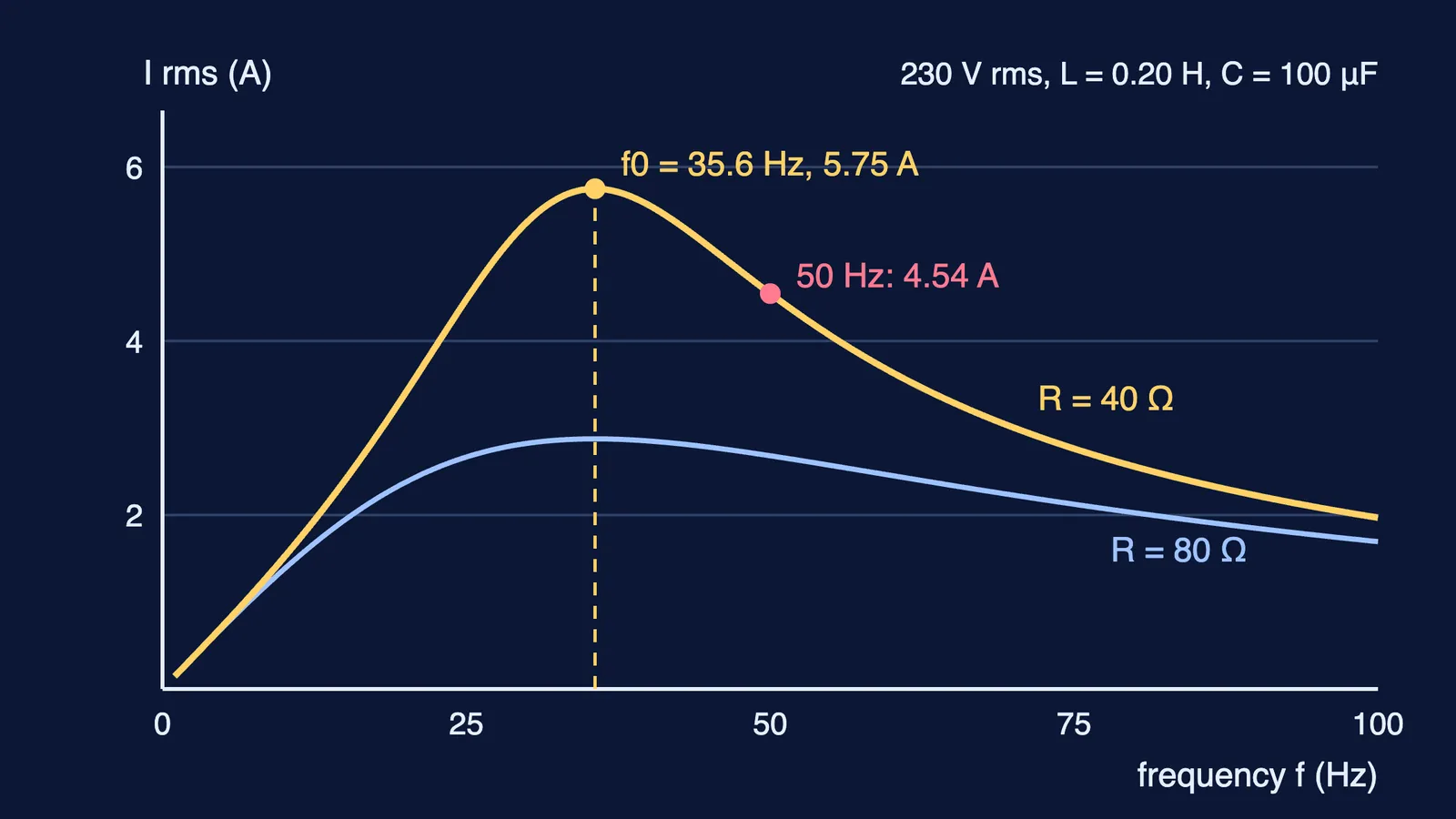
Take R = 40 Ω, L = 0.20 H and C = 100 μF on a 230 V rms, 50 Hz supply, so ω = 2π × 50 = 314 rad/s.
Reactances and impedance. XL = ωL = 62.8 Ω and XC = 1/(ωC) = 31.8 Ω. Then Z = √(40² + (62.8 − 31.8)²) = 50.6 Ω, and Irms = 230 V / 50.6 Ω = 4.54 A. The power factor is R/Z = 0.790, so P = 230 V × 4.54 A × 0.790 = 826 W, which equals I²R = (4.54 A)² × 40 Ω. The current lags the voltage by 37.8°.
LR only. Remove the capacitor: Z = √(40² + 62.8²) = 74.5 Ω, Irms = 3.09 A, and the lag grows to 57.5°.
Resonance. XL = XC when f0 = 1/(2π√(LC)) = 1/(2π√(0.20 H × 100 × 10⁻⁶ F)) = 35.6 Hz. There Z = R, so Irms = 230 V / 40 Ω = 5.75 A, the top of the curve in the diagram, and P = (230 V)²/40 Ω = 1,323 W. At R = 80 Ω the peak current halves to 2.88 A; f0 is unchanged.
LC energy swap. Charge the same 100 μF capacitor to 10 V and connect it to the 0.20 H coil with no resistor. It stores ½CV² = 5.0 mJ, the charge is CV = 1.0 mC, and the current peaks at q0ω0 = 1.0 mC × 224 rad/s = 0.224 A, where ½LI² is again 5.0 mJ.
If you can follow these but stall on a new problem, the Fermi Problem Library has worked problems with a step-by-step solver that explains the reasoning rather than printing an answer.
What are the common traps in EMI and AC?
Using peak values where the question gives RMS (230 V mains is RMS).
Adding XL and XC instead of subtracting them.
Writing P = Vrms × Irms in AC and forgetting the power factor cos φ.
Taking the Lenz direction from the field, not from the change in flux.
What does a two-week practice plan look like?
Days 1-3: read NCERT Chapter 6 fully; do flux and Lenz direction questions.
Days 4-6: motional emf, rotating rods, self and mutual inductance; add eddy currents.
Days 7-10: read Chapter 7; drill reactance, impedance, phasors and power factor.
Days 11-12: resonance, wattless current, generator and transformer.
Days 13-14: timed mixed sets, then previous year papers.
If Kirchhoff's rules feel shaky, revise them first with our guide to preparing Current Electricity for JEE Main.
If phase lag still feels abstract, the Fermi Simulation Lab has interactive simulations for the ideas that are easier to see than to read.