On this page
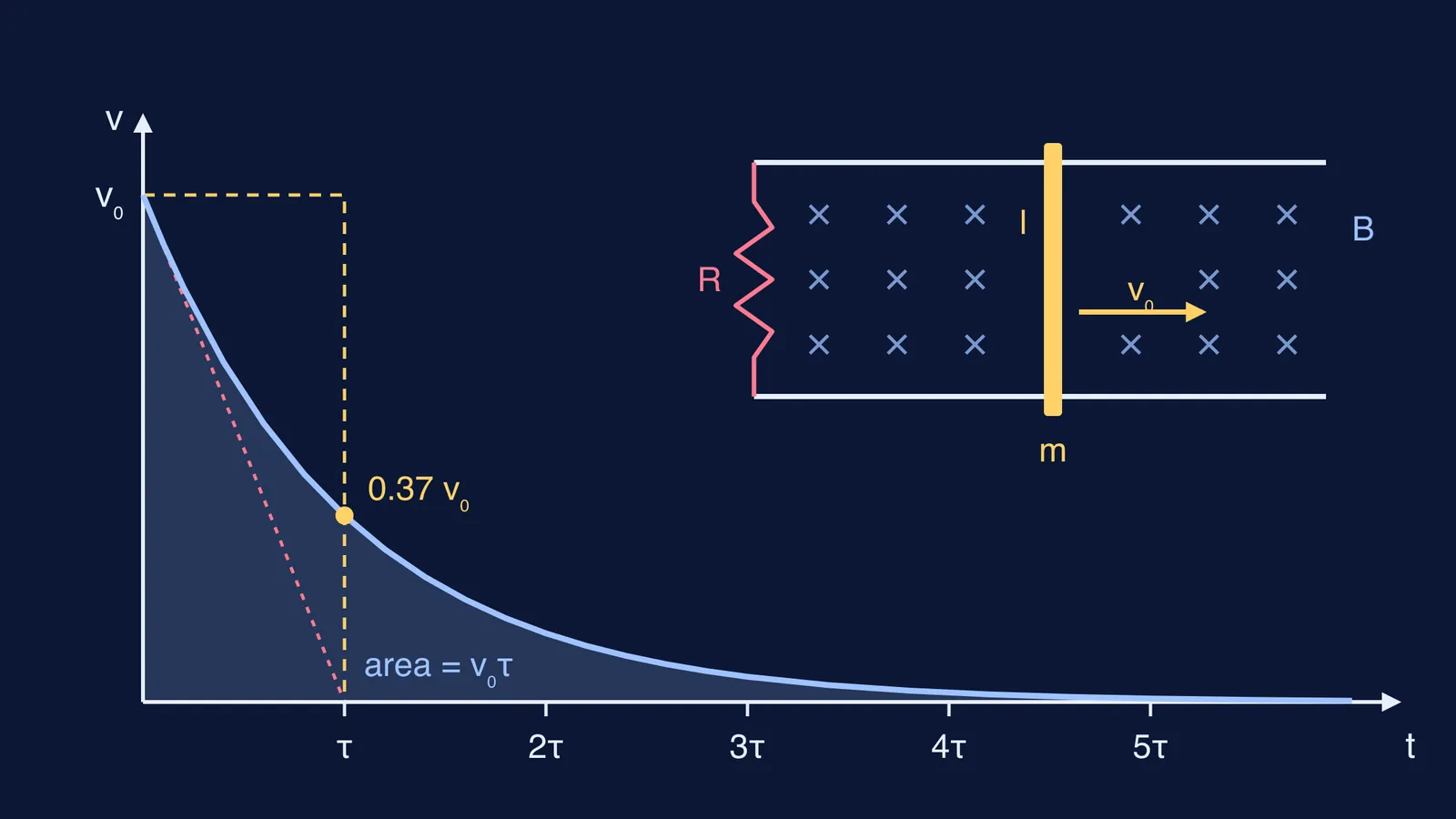
The set-up fits in one line. A rod of mass m slides on smooth rails a distance l apart, a resistor R joins the rails, a uniform field B points into the page, and someone flicks the rod so it starts at speed v₀. Nothing pushes it after that. How far does it go before it stops?
The sliding bar is one of the canonical examples of electromagnetic induction, appearing in virtually every introductory treatment of Faraday's law, as a 2026 paper on the moving-bar problem puts it. The answer comes out in a few lines once you see the trick, and the trick works on a whole family of rod-on-rails questions.
Why does the rod slow down at all?
Because the moving rod acts as a battery that powers its own brake. OpenStax University Physics gives each step: the motional emf is ε = Blv, the current is I = Blv/R, and the field pushes on the current-carrying rod with a force IlB.
Combine them and the braking force on the rod is F = B²l²v/R.
Lenz's law says this force opposes the motion. If direction is where you lose marks, read our guides to three common mistakes in finding induced current direction and which end of a moving rod is positive.
The key feature is that the force is proportional to speed. Halve the speed and the brake halves too. That one fact decides everything else.
How does the speed of the rod decay with time?
Newton's second law gives m dv/dt = −(B²l²/R) v. A quantity that falls at a rate proportional to itself decays exponentially. In the standard treatment, written out in Carlos E. Alvarez's paper on the moving-bar problem, the speed is v(t) = v₀e^(−t/τ), and the current follows the same curve.
The time constant of the rod is τ = mR/(B²l²).
After one τ, the speed is e⁻¹ of v₀, about 37%.
After 5τ, it is e⁻⁵ of v₀, under 1%.
Strictly, the speed never reaches zero in finite time.
How far does the rod travel before stopping?
You could integrate the exponential from zero to infinity. The faster route skips time altogether. Write the acceleration as v dv/dx:
m v (dv/dx) = −(B²l²/R) v
Cancel v: m dv = −(B²l²/R) dx
Integrate from v₀ down to 0: m v₀ = (B²l²/R) x
So the stopping distance is x = m v₀ R/(B²l²), which is the same as v₀τ. The position equation in the moving-bar paper tends to exactly this value as time grows. In the graph at the top, it is the shaded area under the speed-time curve, equal to the dashed rectangle of height v₀ and width τ.
The same algebra gives the total charge that flows. Since the impulse of the brake is Bl times the charge, m v₀ = Bl q, so q = m v₀/(Bl). As in why the magnet's speed does not matter for induced charge, time drops out.
Worked example: how far does a 200 g rod slide?
Take m = 0.2 kg, v₀ = 4 m/s, B = 0.5 T, l = 0.4 m and R = 0.5 Ω, and use the OpenStax relations from above.
B²l² = 0.25 × 0.16 = 0.04 T²m².
Time constant τ = mR/(B²l²) = 0.2 × 0.5/0.04 = 2.5 s.
Stopping distance x = v₀τ = 4 × 2.5 = 10 m.
Initial current I₀ = Blv₀/R = 0.5 × 0.4 × 4/0.5 = 1.6 A, so the initial braking force is BI₀l = 0.32 N.
Charge through the resistor q = m v₀/(Bl) = 0.8/0.2 = 4 C. Check with flux: Blx/R = 0.5 × 0.4 × 10/0.5 = 4 C. It matches.
Heat in the resistor is all the kinetic energy, ½mv₀² = 1.6 J, because the mechanical power lost equals the I²R power dissipated.
What changes when the question adds a twist?
Run this checklist before you plug numbers in:
The rod has its own resistance r: replace R with R + r everywhere.
A steady applied force F keeps pulling: the rod no longer stops; it settles at the speed where F balances B²l²v/R, that is v = FR/(B²l²).
Friction acts too: the force is no longer proportional to speed, so neither the exponential nor the distance formula holds. Write Newton's law again from scratch.
The question mentions inductance: textbook treatments assume the induced current's own field is negligible, and Alvarez's paper shows that keeping the self-induced field can turn the bar into a damped electromechanical oscillator. Unless a question says otherwise, use the standard model.
To practise variants of this set-up, the Fermi Problem Library has worked problems with a step-by-step solver that explains the reasoning rather than printing an answer. If the shaky part is motional emf itself, the Fermi Concept Library gives each concept its own lesson and its place in the map.
Next time a rod is flicked along rails, write m dv = −(B²l²/R) dx first. The distance falls out in one line.