

On this page
Push a bar magnet into a coil quickly and the galvanometer needle kicks hard. Push it in slowly and the needle barely moves. Yet if the magnet starts and ends in the same places, the same charge flows round the circuit either way.
What decides the charge flowing in a coil due to flux change?
NCERT's Class 12 Physics chapter on electromagnetic induction states Faraday's law for a closely wound coil of N turns as ε = −N dΦ/dt. The same chapter defines magnetic flux as Φ = BA cos θ and gives its SI unit as the weber (Wb), which is a tesla metre squared.
If the whole circuit has resistance R, the current at any instant is I = ε/R. Charge is current multiplied by time, added up over the whole event:
Current at each instant: I = (N/R) dΦ/dt, ignoring the minus sign, which only gives direction.
Charge in a tiny time dt: dq = I dt = (N/R) dΦ.
Add it up from start to finish: q = NΔΦ/R.
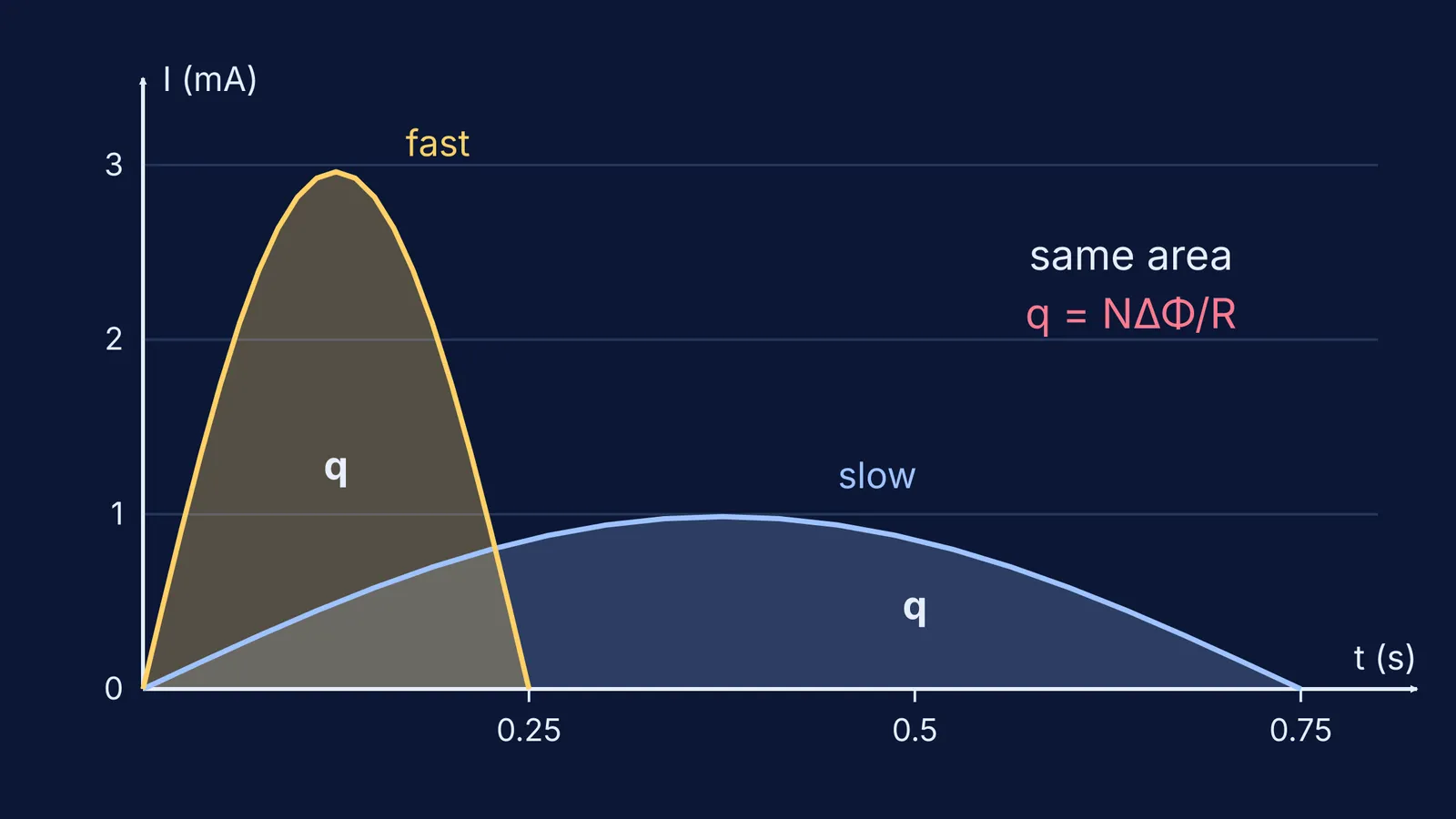
The dt cancels in step 2. The total induced charge depends only on the number of turns, the change in flux and the circuit's resistance, not on how long the change takes.
Why doesn't moving the magnet faster give more charge?
NCERT's description of Faraday's Experiment 6.1 notes that the deflection, and hence the current, is larger when the magnet is moved faster. The OpenStax University Physics text on Faraday's law says the same: the faster the motion, the greater the emf. Both statements are about emf and current, not charge.
Think of the current-time graph. Moving fast gives a tall, narrow pulse. Moving slowly gives a short, wide one. Charge is the area under that graph, and the two areas come out equal. This assumes R stays fixed and the current is zero at the start and end.
Worked example: NCERT's 500-turn coil, turned fast and slow
Example 6.3 in the NCERT chapter takes a circular coil of radius 10 cm, 500 turns and resistance 2 Ω, with its plane perpendicular to the horizontal component of Earth's field, 3.0 × 10⁻⁵ T, and turns it through 180° in 0.25 s. NCERT estimates an average emf of 3.8 × 10⁻³ V and a current of 1.9 × 10⁻³ A.
Now find the charge instead:
Flux per turn at the start: BA = 3.0 × 10⁻⁵ × π × (0.1)² = 3π × 10⁻⁷ Wb.
After a 180° turn the flux reverses, so ΔΦ = 2BA = 6π × 10⁻⁷ Wb per turn. Forgetting the factor of 2 is a common slip.
Charge: q = NΔΦ/R = 500 × 6π × 10⁻⁷ / 2 ≈ 4.7 × 10⁻⁴ C.
Check with NCERT's rounded numbers: 1.9 × 10⁻³ A × 0.25 s ≈ 4.8 × 10⁻⁴ C. They agree within rounding.
Repeat the turn at other speeds, using average values:
In 0.025 s: emf about 38 mV, current about 19 mA, charge 4.7 × 10⁻⁴ C.
In 0.25 s: emf about 3.8 mV, current about 1.9 mA, charge 4.7 × 10⁻⁴ C.
In 2.5 s: emf about 0.38 mV, current about 0.19 mA, charge 4.7 × 10⁻⁴ C.
The emf and current change a hundredfold across the list. The charge does not change at all.
What does change when the magnet moves faster?
Heat does. If the flux changes at a steady rate over time t, the heat produced is I²Rt, which works out to q²R/t. Using the charge from the NCERT example in that steady-rate picture, a 0.25 s change produces about 1.8 × 10⁻⁶ J, while a 0.025 s change produces about 1.8 × 10⁻⁵ J: ten times faster, ten times the heat, for the same charge. (A uniform rotation gives about 1.2 times as much heat, with the same tenfold ratio.) That energy comes from your work against the opposing force: see why Lenz's law follows from conservation of energy and why a magnet falls slowly through a copper tube.
The result is also useful in the lab. Schoolphysics describes a ballistic galvanometer as a sensitive meter whose maximum deflection is proportional to the charge flowing in a short time. Connect one to a small search coil, pull the coil quickly out of the field, and the deflection tells you the flux change. For more practice, see our post on charge flow from a change in flux.
A 30-second check for induction questions
Asked for charge? Use q = NΔΦ/R and ignore the time.
Asked for emf, current, heat or power? Time or rate matters.
Flipping a coil through 180° gives ΔΦ = 2BA, not BA.
R is the whole circuit: coil plus galvanometer plus anything else in series.
Units check: Wb/Ω = V·s/Ω = A·s = C.
When a problem mixes these quantities, the Fermi Problem Library has worked problems with a step-by-step solver that explains the reasoning rather than printing an answer, so you can see where the time drops out.


