

On this page
Drop a strong neodymium magnet down a thick copper pipe, and it seems to float, taking several seconds to emerge from a tube it should have fallen through in the blink of an eye. This striking demonstration is a classic physics experiment used in classrooms worldwide to show the unseen relationship between magnetism and electricity.
Why does the magnet slow down?
The slow fall is a real-world demonstration of electromagnetic induction. Although copper itself is not magnetic—you cannot stick a magnet to a copper pipe—it is an excellent conductor of electricity. This combination of high electrical conductivity and zero magnetic attraction makes it the perfect material to isolate and observe the effects of induction.
As the permanent magnet falls, the magnetic field moving through the pipe's cross-section is constantly changing. According to Faraday's law of induction, this changing magnetic flux induces an electromotive force (EMF) in the surrounding copper. Because the tube is a solid conductor, this induced voltage drives swirling, circular loops of electric current around the pipe walls. These loops are known as eddy currents. You can find more examples of this phenomenon in our guide to Eddy currents explained: causes, damping and uses for JEE Main.
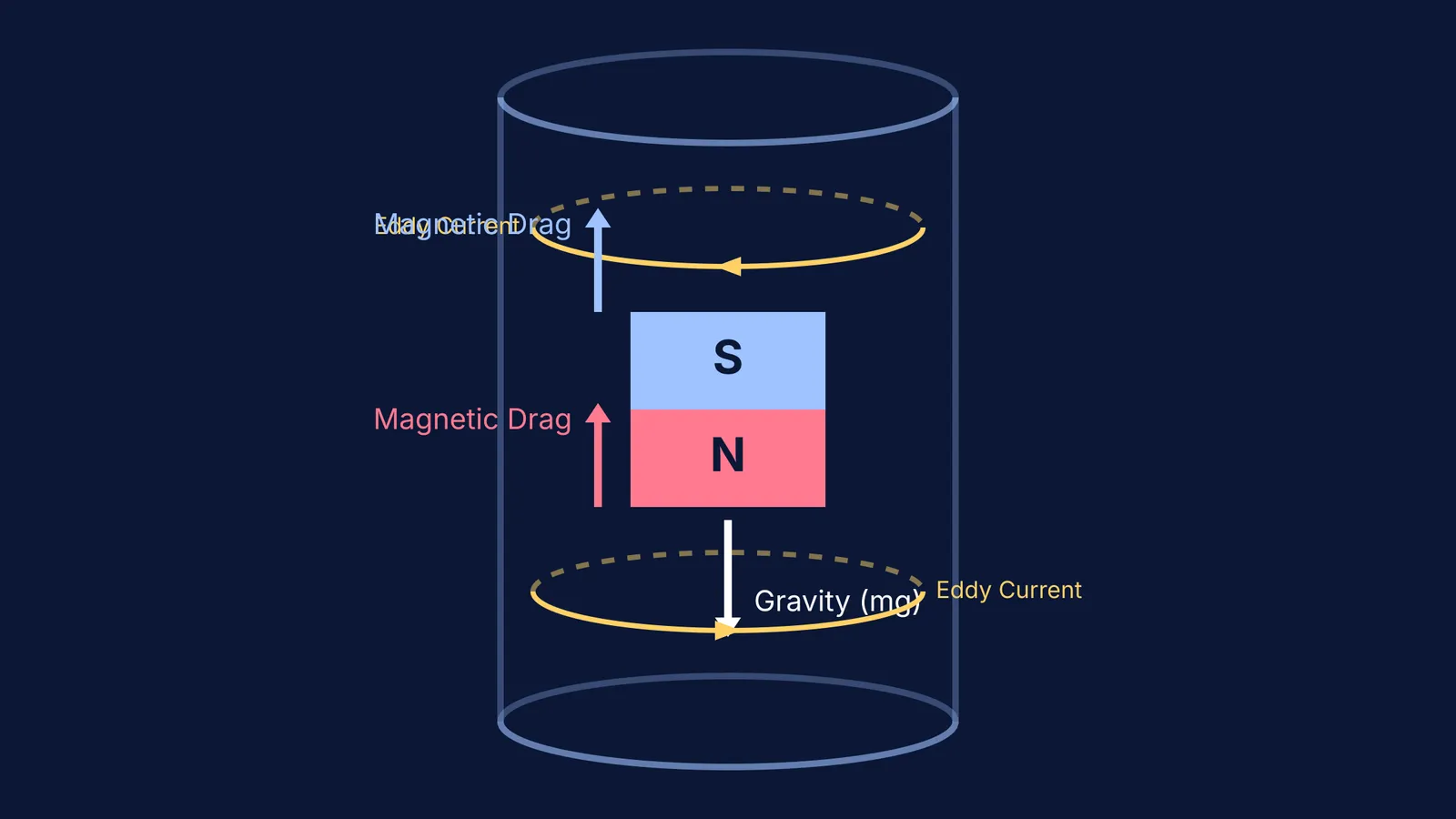
Once the eddy currents are flowing, they create their own secondary magnetic fields. Lenz's law dictates that an induced current will always flow in a direction that opposes the change that caused it, a principle you can review in Faraday's and Lenz's laws: finding the induced current direction. Consequently, the eddy currents created just below the falling magnet generate a magnetic north pole that pushes up on the magnet's north pole. At the same time, the currents created just above the magnet generate a magnetic north pole that pulls up on the magnet's south pole. Both of these induced magnetic forces act upward, directly opposing the downward pull of gravity.
When does it reach terminal velocity?
As the magnet accelerates under gravity, the rate at which the magnetic flux changes also increases. A faster change in flux means stronger eddy currents, which in turn produce a stronger upward braking force.
A 2006 paper in the *American Journal of Physics* demonstrated that this magnetic drag force increases linearly with the magnet's speed until it exactly balances the magnet's weight. At this precise point, the net force acting on the magnet becomes zero, and the magnet stops accelerating. It continues to fall, but at a constant terminal velocity.
This terminal velocity is often surprisingly slow. For a strong neodymium magnet in a thick copper pipe, it can be mere centimetres per second, compared to the rapid acceleration it would experience in free fall. Because the upward magnetic force is perfectly matched to the downward gravitational force (mg), the magnet's speed remains perfectly constant until it exits the bottom of the tube.
During this steady fall, the laws of thermodynamics are strictly maintained. The constant loss in gravitational potential energy does not disappear; instead, it is converted entirely into heat. As the eddy currents swirl through the copper, they meet electrical resistance, dissipating the energy as Joule heating.
What happens if you change the tube?
The strength of the braking force relies entirely on the pipe's ability to conduct large, unbroken loops of current. If you drop the same magnet through a plastic or glass tube, it falls with normal gravitational acceleration because these materials are insulators. Without flowing eddy currents, there is no opposing magnetic field.
Similarly, if you cut a long vertical slit down the entire length of the copper tube, the magnet will fall much faster. The slit acts as an infinite electrical resistance, breaking the circular path that the eddy currents need to flow continuously around the tube's circumference. While some smaller, localized loops can still form near the edges of the slit, the overall induced magnetic field—and the resulting upward braking force—is drastically reduced. You can explore similar principles involving changing fields in Faraday's law for a changing B: the circulating E inside a solenoid.
The thickness of the metal is just as crucial. A 2009 study in the *European Journal of Physics* showed that the braking force is directly influenced by the pipe wall thickness. A thicker wall provides a larger cross-sectional area for the eddy currents to travel through, which lowers the electrical resistance of the path. Lower resistance allows larger currents to flow for a given change in flux, significantly increasing the upward drag and resulting in an even slower terminal velocity.
When you are struggling to picture how these invisible fields interact or need to clarify the rules of induction for your exams, the Fermi Concept Library breaks down every concept in physics, chemistry, biology, mathematics and computing, helping you build a stronger intuition for the forces at play.


