On this page
Drop a strong magnet down a copper pipe and it drifts down as if the pipe were full of honey. Copper is not magnetic, so the magnet is not sticking to the walls. Something else is braking it, and once you see what, Lenz's law stops being a line in a textbook.
Why does a magnet fall slowly through a copper pipe?
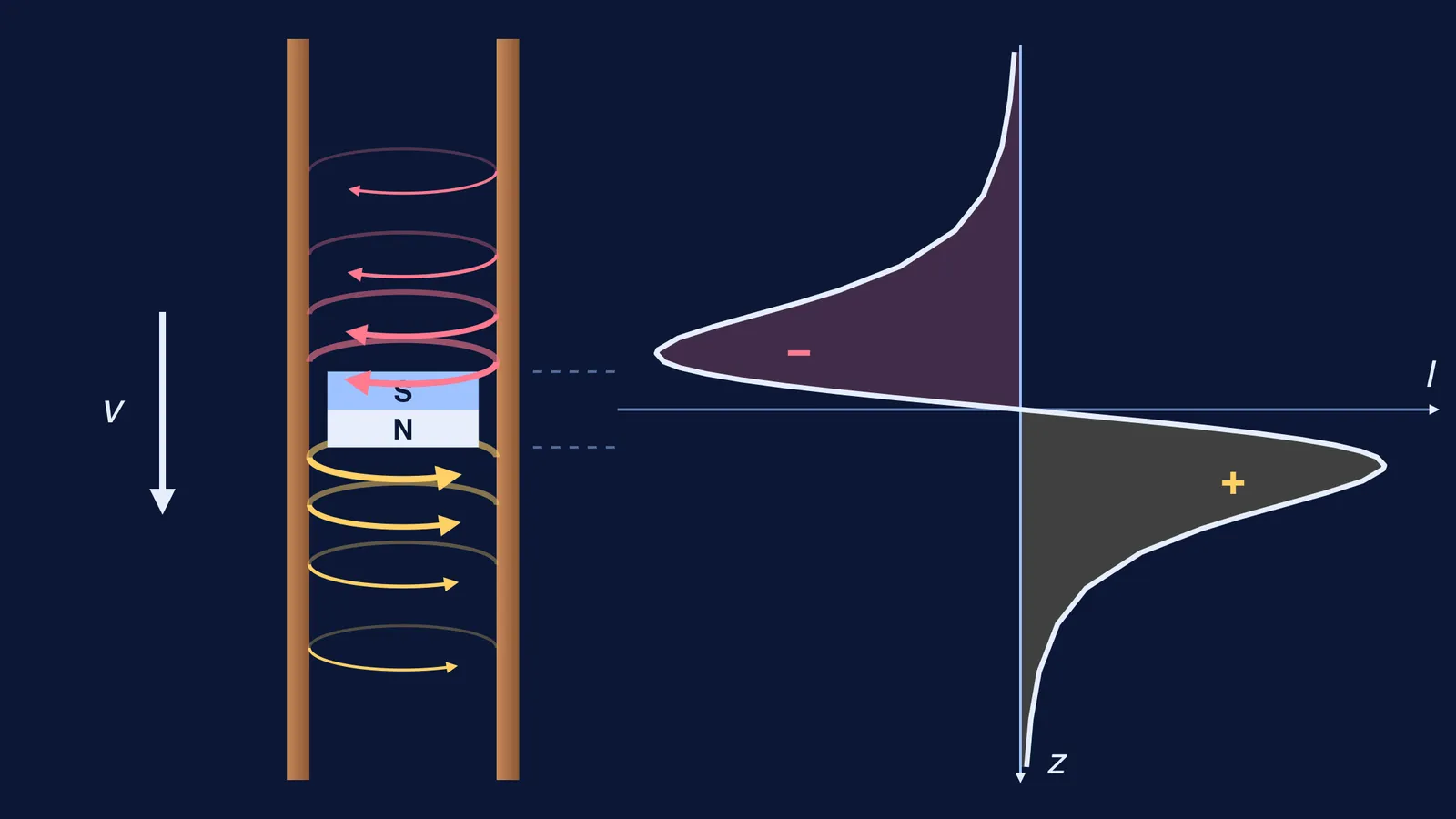
Think of the pipe as a stack of thin copper rings. As the magnet falls, the flux through each ring changes, inducing a current in it. Currents that swirl inside a solid conductor like this are called eddy currents.
The direction of those currents is set by Lenz's law, which the NCERT Class 12 Physics chapter on electromagnetic induction states as: the polarity of induced emf is such that it tends to produce a current which opposes the change in magnetic flux that produced it.
In the pipe, that means:
Rings below the magnet see the flux growing, so their currents make a field that repels the approaching pole.
Rings above the magnet see the flux shrinking, so their currents make a field that pulls the departing pole back.
Both forces point upward, and they grow with speed. Very soon the braking equals the magnet's weight and it falls at a steady terminal velocity. Levin, da Silveira and Rizzato (American Journal of Physics, 2006) explain where the energy goes: at constant speed the gravitational energy the magnet loses is turned into heat by the eddy currents in the pipe wall.
How slow is it? The numbers from a real experiment
In that 2006 paper, the researchers used a copper pipe 1.7 m long (inner radius 7.85 mm, wall 1.9 mm) and 6 g neodymium magnets.
One magnet took 22.9 s to pass through the pipe, a measured terminal speed of 7.4 cm/s against 7.3 cm/s from their model (arXiv full text).
A freely falling object covers 1.7 m in about 0.59 s (t = √(2h/g)), so the magnet took roughly 39 times longer.
The paper also found a surprise. Two magnets stuck together took 26.7 s, but three took only 23.7 s. The simple "point dipole" picture predicts that doubling the magnet should double the fall time; it does not, because the point-dipole picture fails once the magnet's length is comparable to the pipe's radius.
What does a simulation of the fall show?
You can simulate the fall with one idea from the Levin paper: the power lost to eddy currents grows with the square of the speed, so the braking force grows in proportion to the speed. Write it as F = kv. At terminal speed, kv = mg, so k = mg/v. Assuming that holds during the speed-up, the motion obeys dv/dt = g(1 − v/vₜ).
A worked example with the paper's single-magnet numbers (m = 6 g, vₜ = 7.4 cm/s):
Time constant: τ = vₜ/g = 0.074/9.8 ≈ 7.6 milliseconds.
Speed reaches 99% of terminal after τ × ln 100 ≈ 4.6τ ≈ 35 milliseconds.
Distance fallen by then: vₜ(t − τ(1 − e^(−t/τ))) ≈ 2 mm. After that the speed is constant, which is why timing the whole pipe and dividing works.
Heating power in the pipe: P = mgv = 0.006 × 9.8 × 0.074 ≈ 4.4 milliwatts, far too little to feel.
Some ideas are easier to see than to read, and the Fermi Simulation Lab has interactive simulations for them.
How can you try the copper pipe experiment at home?
You need a copper plumbing pipe (a metre or more is ideal), a neodymium magnet that slides through it freely, a wooden piece of similar size, and a phone stopwatch.
Hold the magnet against the pipe. It should not stick.
Drop the wooden piece through the vertical pipe and time it.
Time the magnet three times and average to get T.
Divide the pipe length L by T for your terminal speed.
Predict before you test: what would a pipe with a slit cut along its length do? Reason it out with Lenz's law first.
One safety rule: the US Consumer Product Safety Commission's magnet safety page warns that when two or more high-powered magnets are swallowed they attract each other inside the body, and many cases have needed surgery. Keep them away from children of all ages, and get medical help at once if one may have been swallowed.
How do you explain it in an exam answer?
A two-mark answer can follow this script: "The falling magnet changes the flux through the pipe, inducing eddy currents. By Lenz's law, these currents oppose the motion, so the magnet quickly reaches a low terminal velocity. Its lost potential energy is dissipated as heat in the pipe."
To practise the direction part, see checking Lenz's law current direction step by step. For the related graph question, read how induced emf changes with time as a magnet falls through a coil.
Get a pipe, a magnet and a stopwatch this weekend, and watch Lenz's law at work.