On this page
Plenty of students study with the phone face down next to the textbook, just in case. Research suggests the buzz itself costs attention. But studies report averages, so here is a one-week test of what your phone costs you, measured in what counts in JEE Main, NEET-UG or board exams: problems right in a fixed time.
Do phone notifications affect focus even if you don't check them?
In the lab, yes. Cary Stothart, Ainsley Mitchum and Courtney Yehnert found that cell phone notifications alone significantly disrupted performance on an attention-demanding task, even though participants did not touch a phone during the task. The authors say the effect was about as large as the distraction from actively using a phone for calls or texts, and suggest a buzz can prompt mind wandering.
A second study looked at real life over two weeks. Kostadin Kushlev, Jason Proulx and Elizabeth Dunn asked 221 people to spend one week with alerts on and the phone within reach, and another week with alerts off and the phone away. People reported more inattention and hyperactivity in the alerts-on week, and higher inattention predicted lower productivity. These were self-reports, not test scores.
Does a silent phone on the desk still hurt?
This is less settled. Adrian Ward and colleagues ran experiments with nearly 800 smartphone users and found that people whose phones were in another room did better on cognitive tasks than people with the phone face down on the desk (University of Texas summary; paper). We explain that study in does a phone on your desk hurt focus?
Later work is more cautious. A 2023 meta-analysis by Tobias Böttger, Michael Poschik and Klaus Zierer pooled 22 studies with 43 effects and found a significant but small overall negative effect of smartphone use and presence (g = −0.14), with some kinds of thinking affected more than others.
How do you test your phone's effect on your own studying?
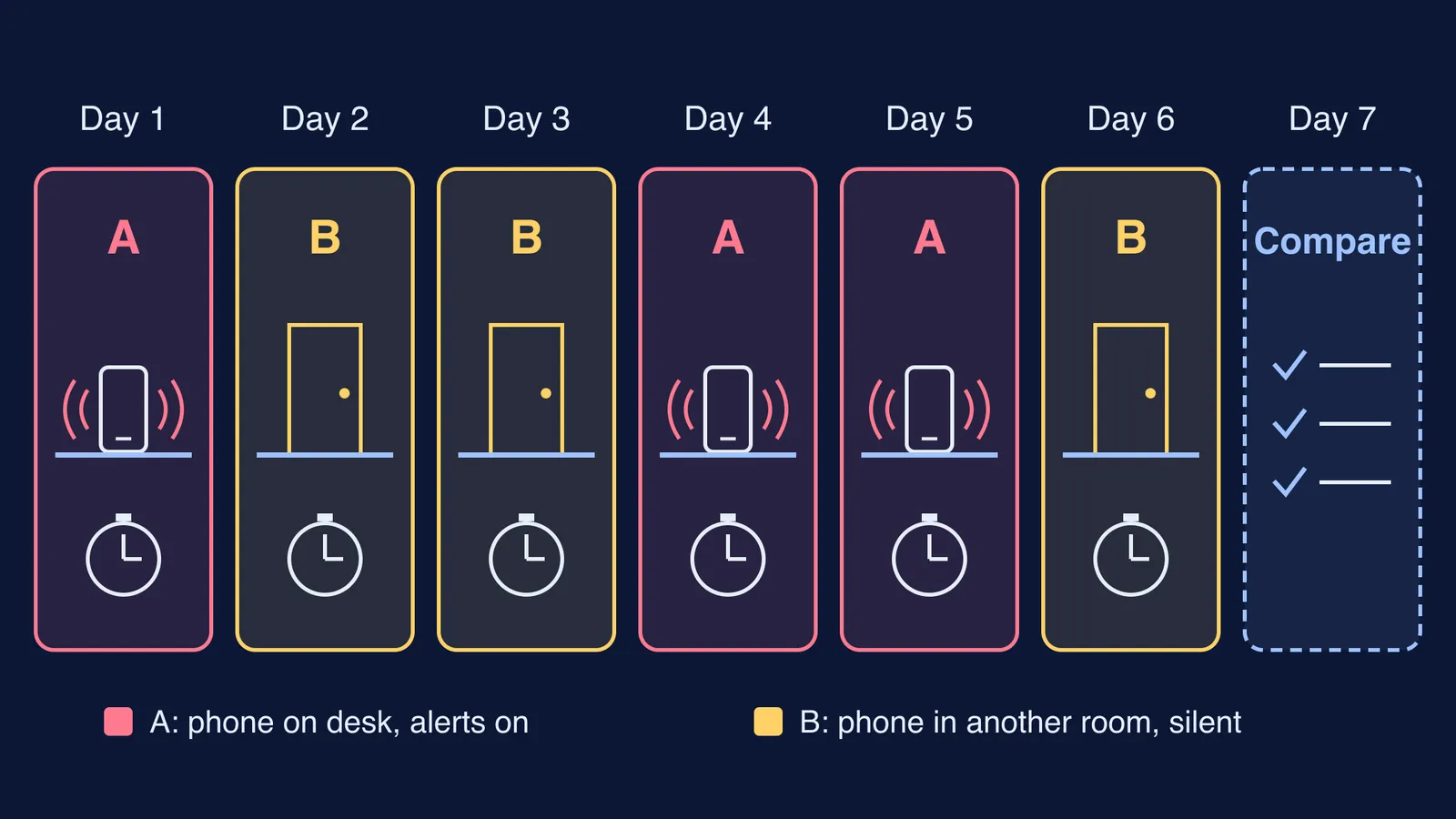
Use two conditions, much like the two weeks in the Kushlev study, but measure problems solved correctly instead of feelings.
Condition A (desk): phone face down on your desk, sound or vibration on, the way you normally keep it.
Condition B (other room): phone on silent in another room.
The week:
Prepare six problem sets of similar difficulty in one subject, for example 15 questions each from past papers.
Fix a time limit, say 30 minutes, and solve at the same time each day.
Follow this order: Day 1 A, Day 2 B, Day 3 B, Day 4 A, Day 5 A, Day 6 B. The ABBAAB order stops "I got better as the week went on" from favouring one condition.
After each set, log four things: questions attempted, questions correct, accuracy (correct divided by attempted), and a tally of every time you thought about or reached for the phone.
Day 7: no new set. Add up each condition and compare.
What might your log look like?
These numbers are made up, only to show the arithmetic. Say on the three desk days you attempted 13, 12 and 14 questions and got 9, 8 and 10 right. That is 27 correct out of 39 attempted, or 69% accuracy. On the three other-room days you attempted 14, 15 and 14 and got 11, 11 and 12 right: 34 out of 43, or 79%.
A difference of one or two questions over a week can be chance. A gap that shows up in both attempts and accuracy, alongside a higher phone tally on desk days, is worth acting on. No difference is a useful result too.
What should you do with the result?
Other room wins clearly: make it your default for timed practice. If your parents need to reach you, a phone Focus mode with exceptions can help; see how to set up Focus mode on a teen's phone.
A tie: keep alerts off while solving anyway, since the evidence on notifications is the stronger finding.
Either way: review the wrong answers from all six sets; see timed practice followed by review.
If the wrong answers come from using the wrong method, the Fermi Problem Library has worked problems with a step-by-step solver that explains the reasoning rather than printing an answer. If you are not sure what to practise next, Fermi's AI tutor can work out what you already know and build a plan for the session.
Parents, run the test with your child, not on them: "Let's find out if the phone matters for you. One week, and we go with your numbers."
If trouble concentrating comes with weeks of low mood or poor sleep, talk to a doctor or school counsellor, or call Tele MANAS on 14416, the government's free mental health helpline.
Pick your six problem sets tonight, and start with Day 1 tomorrow.