

On this page
When preparing for competitive exams like JEE Main or NEET-UG, consulting an AI tutor the moment a problem feels difficult creates an illusion of mastery. An unfamiliar mechanics question appears, you pause briefly, and before writing a single force equation, you paste the prompt into an AI tool. The AI generates a clean derivation, you nod along, and you assume you understand the topic. Yet on test day, with the timer ticking and no screen in front of you, the same problem leaves you stuck.
Why does using AI while solving problems hurt exam scores?
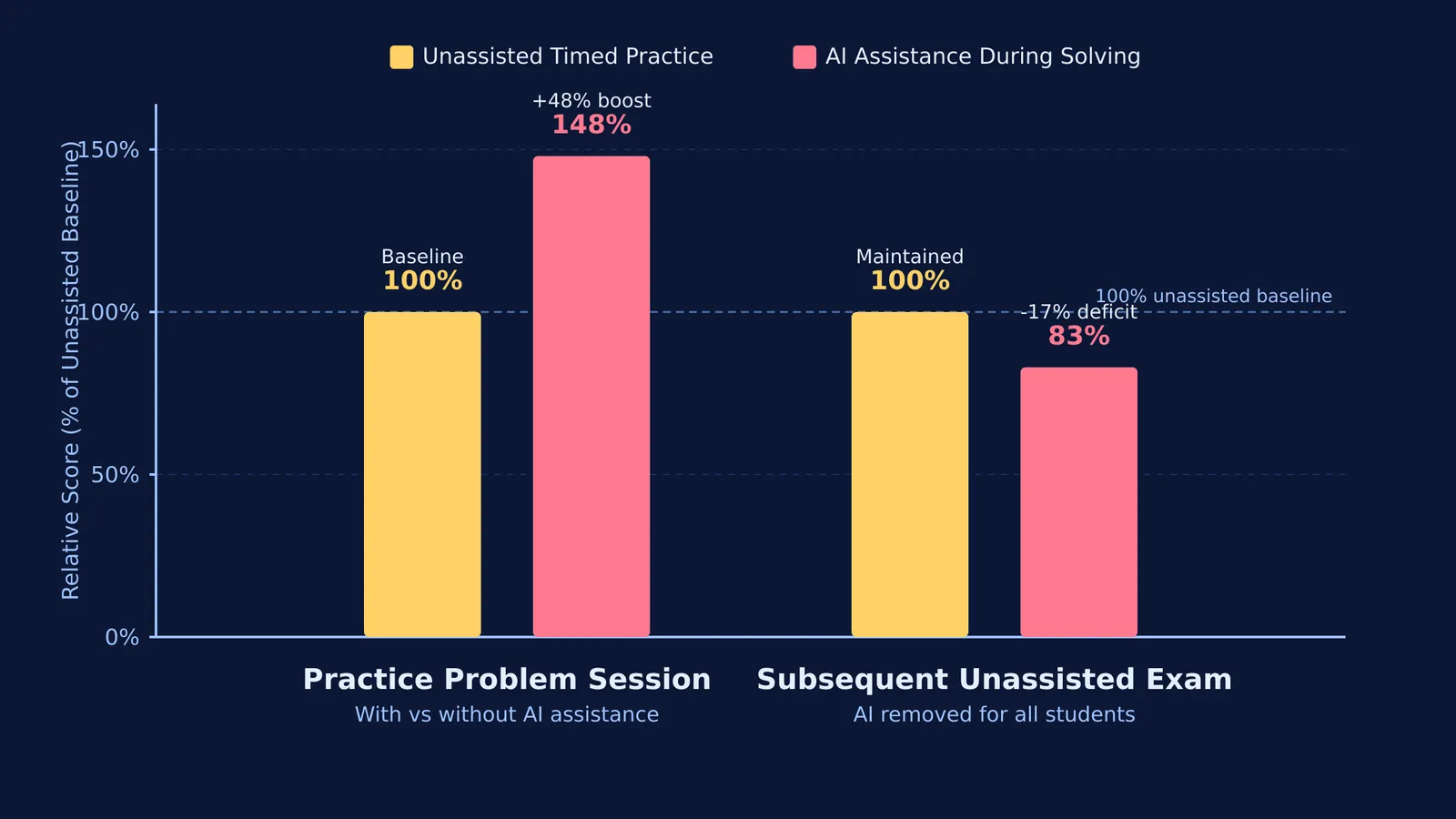
This breakdown occurs because receiving hints during problem solving short-circuits the mental struggle that builds memory. In a randomized controlled trial published in the Proceedings of the National Academy of Sciences, Hamsa Bastani and colleagues tracked nearly 1,000 high school students solving mathematics problems. Students with access to standard generative AI during practice scored 48% higher on homework sets than unassisted peers. However, when the AI was removed on subsequent unassisted exams, those students scored 17% worse than students who had practiced with no AI at all.
The researchers found that students used AI as a crutch, offloading cognitive effort before their own brains could attempt recall. Cognitive scientists describe cognitive offloading—reviewed in Trends in Cognitive Sciences by Evan F. Risko and Sam J. Gilbert—as using physical actions or external devices to reduce internal processing demands. When you view an AI solution while solving, you experience fluent comprehension, mistaking ease of reading for independent retrieval competence.
Why should you delay AI feedback until after the timer rings?
Competitive exams enforce strict speed constraints. Official specifications from the National Testing Agency give students 180 minutes for 75 questions in JEE Main, allowing an average of 2.4 minutes per problem. An uninterrupted timer trains retrieval speed and teaches you to abandon unproductive dead ends.
Delaying AI feedback until the entire test set is finished also improves long-term memory. In the Journal of Experimental Psychology: Applied, Andrew C. Butler, Jeffrey D. Karpicke, and Henry L. Roediger III demonstrated that delayed feedback delivered after an entire test produces superior retention compared to immediate question-by-question feedback. An uninterrupted test forces repeated retrieval attempts, and the delay introduces spacing that makes subsequent corrective feedback stick.
How should you triage mistakes before opening an AI tutor?
When the timer expires, score your test and sort every wrong, omitted, or slow question into distinct categories:
Method trap: You understood the concept but picked an invalid framework, such as applying conservation of mechanical energy when non-conservative friction did work.
Concept void: You could not write the governing equations because the fundamental principle was unfamiliar.
Execution slip: Your physics setup was sound, but an arithmetic slip, sign error, or reading mistake altered the result.
Time drag: You found the right answer, but spent excessive time on a straightforward problem due to an inefficient algebraic route.
Triage preserves active analysis before you ask an AI for input. This pairs with using AI to understand mistakes rather than fetch answers and interleaved practice routines that mix related topics.
What does an effective post-test AI review look like?
With your errors sorted, you can target specific reasoning gaps rather than asking for general solutions.
For execution slips and method traps, practice showing your rough scratchwork before asking for an explanation. Type your exact setup: "I calculated torque about the center of mass as τ = Iα, but my linear acceleration is double the answer key. Which constraint did my coordinate frame violate?"
This diagnostic approach aligns with how Fermi's AI tutor teaches. Instead of merely outputting an answer, the tutor maintains a line of reasoning across the session, notices where your working breaks down, and decides whether to prompt you with a question, highlight a flawed assumption, or draw a clarifying figure. When triage uncovers an unfamiliar topic, working through step-by-step reasoning in the Fermi Problem Library shows how first principles apply before you re-test yourself.
How can you structure a timed practice and review session?
You can implement this two-phase routine in a focused study block:
Initial timed block: Solve a targeted problem set with an uninterrupted timer. Keep all notes, reference sheets, and AI tools closed.
Immediate scoring: Check your answers against an answer key. Tag missed and slow problems with their triage category.
Targeted AI analysis: Open your AI tutor. Query the exact inflection point of each error, exploring why an alternative technique was faster.
Unassisted re-test: Close the AI tutor. Solve the hardest missed problems on a clean sheet of paper without consulting external explanations.
Separating timed solving from AI review preserves independent retrieval while ensuring every mistake is diagnosed and corrected.


