

On this page
Lenz's law questions look like quick marks, but each one hides four separate decisions, and a slip in any of them flips the answer. Ask a chatbot "clockwise or anticlockwise?" and you get one word you can copy. Work out the direction yourself first and then ask the AI to check each step, and you find out which decision you got wrong.
How do you find the induced current direction with Lenz's law?
Lenz's law says the induced emf drives current around a loop so as to always oppose the change in magnetic flux that causes it (OpenStax University Physics, Volume 2, section 13.2). The key word is change. The induced current does not oppose the magnet's field. It opposes that field getting stronger or weaker.
The same OpenStax section sets out the method in steps, starting with a sketch. Here it is as four questions you can write in the margin:
Which way does the external field point through the loop?
Is the flux through the loop increasing or decreasing?
Which way must the induced field point? Against the external field if the flux is increasing, along it if the flux is decreasing.
Which way must the current flow to make that induced field? Point your right thumb along the induced field; your fingers curl the way the current flows.
Which way does current flow when a north pole approaches a ring?
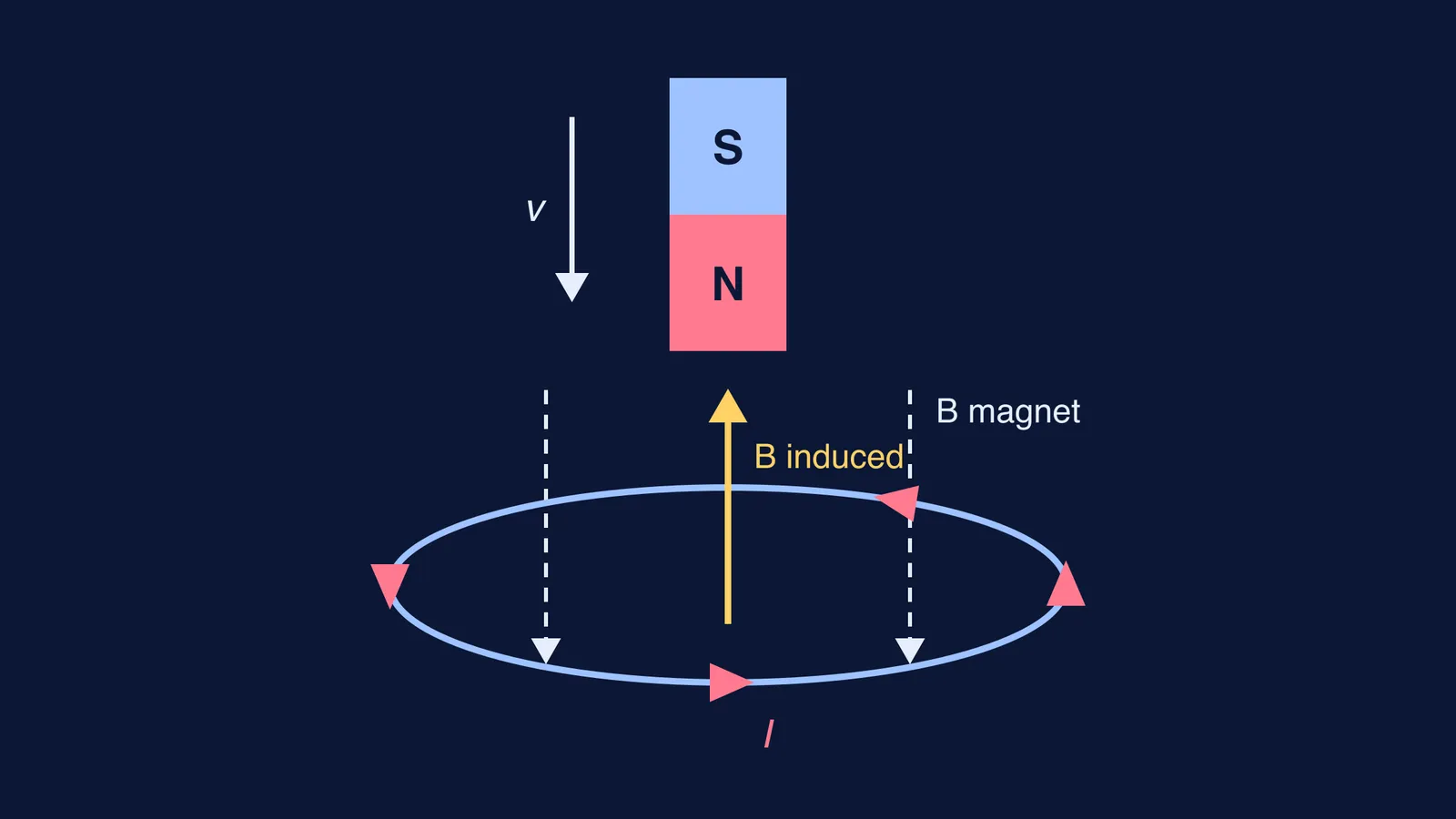
A copper ring lies flat on your desk. You hold a bar magnet above it, north pole down, and push it towards the ring. You are looking down from above.
External field: field lines leave a north pole, so under the magnet the field through the ring points down.
Change: the magnet is getting closer, so the downward flux is increasing.
Induced field: it must oppose the increase, so it points up through the ring.
Current: thumb up, fingers curl anticlockwise as seen from above.
Answer: anticlockwise, viewed from above. Check it a second way. The ring's upper face now acts as a north pole and repels the approaching north pole, which is what OpenStax describes for a magnet approaching a loop. That repulsion is why you have to push, and why Lenz's law follows from conservation of energy.
Now pull the magnet away. Only step 2 changes: the downward flux is decreasing, so the induced field points down and the current runs clockwise from above. If your answer flipped for any other reason, the mistake is in a step that should not have changed. Our post on three common mistakes in finding induced current direction covers the usual ones.
How do you ask AI to check each step, not just the answer?
Why do it yourself first? In a field experiment with nearly a thousand high-school maths students, Hamsa Bastani and colleagues found that GPT-4 access during practice raised practice grades by 48% with a standard ChatGPT-style interface. When the access was taken away, those students scored 17% lower than students who never had it (PNAS, 2025). A tutor version with learning safeguards largely removed that drop. The authors say students without guardrails used the tool as a "crutch".
So write your four steps down, then paste them in with a prompt like this:
"Here is a Lenz's law problem and my working in four steps. Do not give me the final answer. For each step, tell me whether it is right. If a step is wrong, ask me a question that helps me find the error myself."
Then push further:
"Which of my steps would change if the magnet were moving away?"
"Explain step 4 in words: where does my thumb point, and why?"
"Give me a new problem with a south pole and a ring, and don't solve it."
Test every claim in the reply against the four questions. A chatbot can get a step right and the final word wrong, or the other way round. Here is what a good step-by-step AI explanation looks like in physics, so you know what to expect.
What if you still can't picture the flux changing?
Many direction errors start with not seeing the field at all. The Fermi Simulation Lab has interactive simulations for ideas that are easier to see than to read. If you want to work through a problem set with something that asks as well as tells, Fermi's AI tutor decides whether to explain, ask or show, and checks your understanding as it goes.


