On this page
Current Electricity rewards practice: the ideas are few, circuits repeat in new disguises, and most mistakes are slips you can train away. Here is the official scope, four worked problems and a two-week plan.
What does the JEE Main syllabus include in Current Electricity?
In the JEE (Main) 2027 syllabus published by NTA (linked from jeemain.nta.nic.in), Current Electricity is Unit 12 of Physics. It lists:
drift velocity, mobility, Ohm's law and I-V graphs of ohmic and non-ohmic conductors
power, resistivity, series and parallel resistors, temperature dependence of resistance
emf, internal resistance, cells in series and parallel
Kirchhoff's laws, the Wheatstone bridge and the metre bridge
The potentiometer is not on that list. Its Experimental Skills unit includes two related practicals: a wire's resistivity with a metre bridge, and its resistance using Ohm's law.
Your textbook is NCERT Class 12 Physics Part I, Chapter 3, Current Electricity. It covers the NTA list, but names the metre bridge in one sentence only, so learn that from the practical. Read the chapter fully once.
How do you solve Current Electricity problems step by step?
Most circuit questions yield to five steps:
Redraw the circuit with junctions as dots.
Give every unknown current an arrow; a negative answer means it flows the other way.
Combine obvious series and parallel groups, but not branches holding a cell.
Write junction and loop equations (or node voltages) and solve.
Check that junction currents balance and power supplied equals power used.
Series, parallel and internal resistance. A 9 V cell with 1 Ω internal resistance drives a 2 Ω resistor in series with a 6 Ω and 3 Ω pair in parallel. The pair gives (6 × 3)/(6 + 3) = 2 Ω, so the total is 1 + 2 + 2 = 5 Ω and the current is 9 V / 5 Ω = 1.8 A. The terminal voltage is 9 − 1.8 × 1 = 7.2 V. The pair has 1.8 A × 2 Ω = 3.6 V across it, so 0.6 A goes through 6 Ω and 1.2 A through 3 Ω.
Power. Here the 3 Ω resistor uses (1.2 A)² × 3 Ω = 4.32 W; V²/R gives (3.6 V)²/3 Ω = 4.32 W too. The cell supplies 9 V × 1.8 A = 16.2 W, exactly what the four resistances, internal one included, use. See our guide to choosing between P = VI, I²R and V²/R.
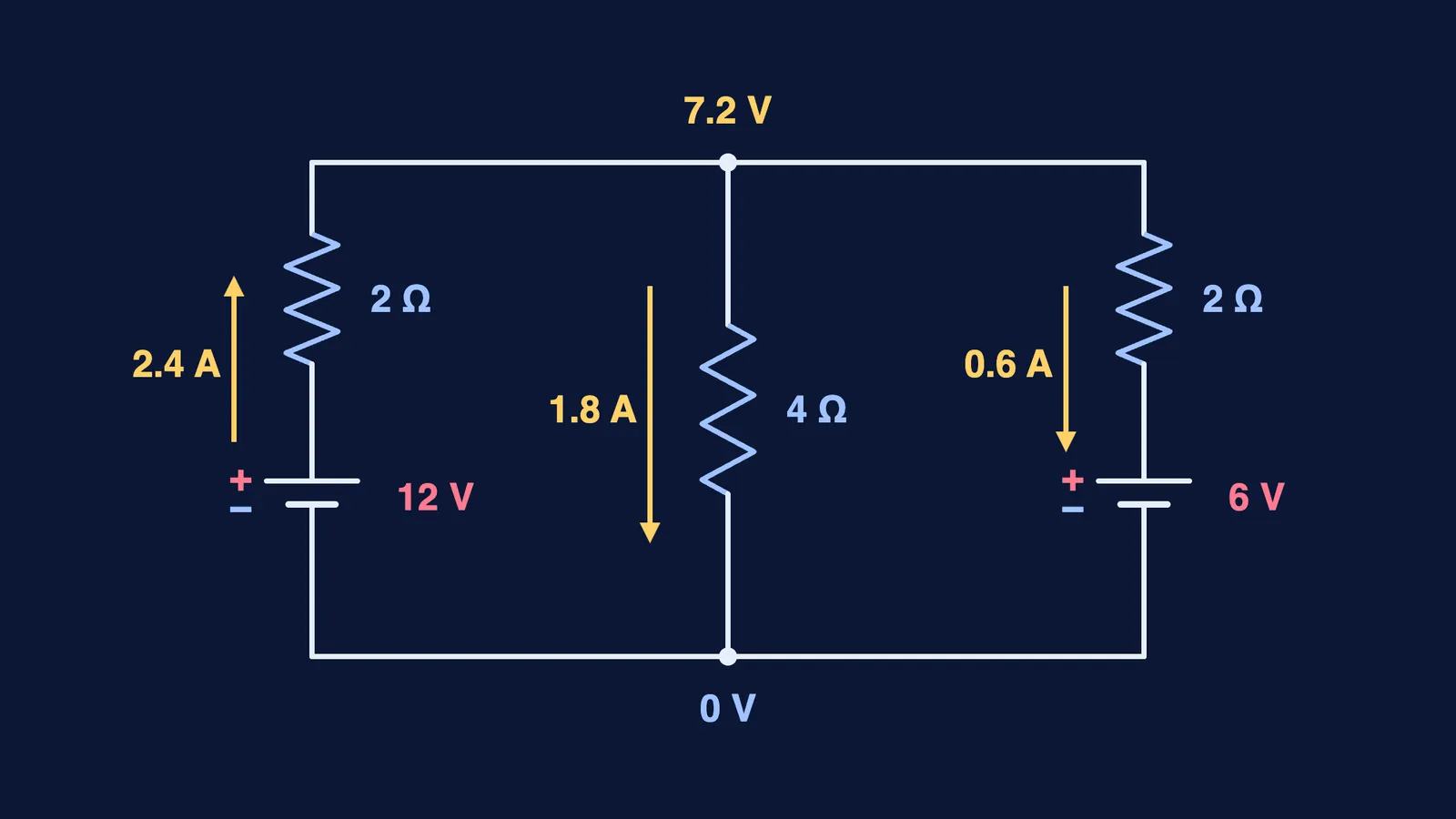
Kirchhoff with two cells. The diagram above has a 12 V cell with 2 Ω on the left, 4 Ω in the middle, and a 6 V cell with 2 Ω on the right, positive terminals up. With the bottom wire at 0 V and the top junction at V, the junction rule gives (12 − V)/2 + (6 − V)/2 = V/4, so 5V = 36 and V = 7.2 V. The left branch carries (12 − 7.2)/2 = 2.4 A up, the middle (7.2 V)/(4 Ω) = 1.8 A down, and the right branch (6 − 7.2)/2 = −0.6 A. So 0.6 A flows down into the 6 V cell, charging it. Check: 2.4 A = 1.8 A + 0.6 A.
Metre bridge. An unknown wire X sits in the left gap and a 6 Ω standard in the right gap. The null point on the 100 cm wire is 40.0 cm from the left end, so X/6 Ω = 40.0/60.0 and X = 4.0 Ω. For a 0.50 m wire of 0.40 mm diameter, A = π(0.20 × 10⁻³ m)² ≈ 1.26 × 10⁻⁷ m², so ρ = RA/L ≈ 1.0 × 10⁻⁶ Ω m.
What mistakes cost marks in this chapter?
Sign flips in loops. Crossing a cell from − to + is +E; crossing a resistor along your current arrow is −IR. Never switch convention mid-question.
Emf versus terminal voltage. They match only when no current flows or internal resistance is zero.
Forcing series-parallel on an unbalanced bridge. It needs Kirchhoff or node voltages.
Temperature questions. Use R = R₀(1 + αΔT); a change in kelvin equals the same change in °C.
Units. Convert mm and cm to metres before the resistivity step; an area left in mm² is off by a factor of a million.
If your answers keep going wrong the same way, the Fermi Problem Library has worked problems with a step-by-step solver that explains the reasoning rather than printing an answer, so you can find where your method went off.
What does a two-week practice plan look like?
Days 1-3: read NCERT Chapter 3 and redo its solved examples without looking.
Days 4-6: series-parallel and cell problems, each ending with a current or power check.
Days 7-9: Kirchhoff circuits with two or three cells; clean signs before speed.
Days 10-11: Wheatstone and metre bridge, plus the two syllabus practicals.
Days 12-14: timed mixed sets from past papers, logging each error by type.
Our guide on using previous year questions for JEE and NEET shows how to turn that error log into practice.