On this page
You have three formulas for one quantity, and the wrong choice turns a two-line problem into a page of algebra. NCERT's Class 10 Science chapter Electricity derives P = VI as the power a source supplies to a circuit (Eq. 11.19), then uses Ohm's law, V = IR, to get Joule's law of heating, H = I²Rt (Eq. 11.21). Substitute the other way, with I = V/R, and you get P = V²/R. Same physics, rearranged; the skill is picking the version that keeps your working short.
When is each power formula the easiest to use?
OpenStax College Physics puts the limit plainly: P = IV is always valid, while P = I²R and P = V²/R can be used only for resistors.
P = VI: when you know the voltage across a component and the current through it, or when the device is not a plain resistor (a motor, a phone charger).
P = I²R: when the current is fixed or shared, such as resistors in series or a wire carrying a known current.
P = V²/R: when the voltage is fixed, such as appliances on household mains or resistors in parallel across one battery.
The rule behind the list: find the quantity that is the same for the things you are comparing, and pick the formula that pairs it with R. NCERT's ammeter and voltmeter activities show that in series the current is the same through every resistor, and in parallel the potential difference across each resistor is the same.
Which bulb glows brighter in parallel?
Question: a 60 W bulb and a 100 W bulb, both rated for 220 V, are connected in parallel to 220 V mains. Which glows brighter? Take brightness to follow power, as these questions do.
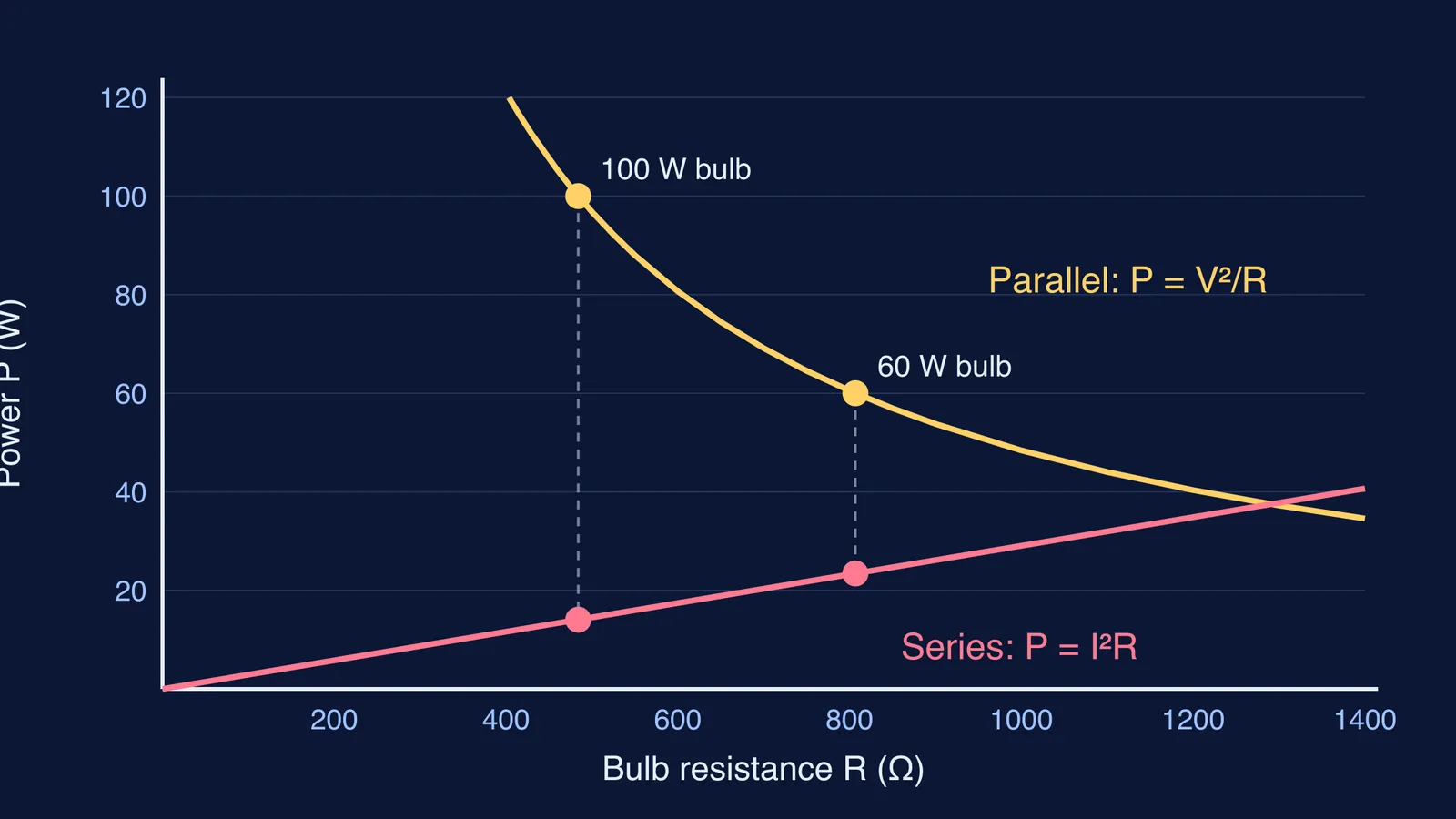
A rating tells you the power at the rated voltage, so R = V²/P. For the 60 W bulb, R = 48,400 ÷ 60 ≈ 807 Ω. For the 100 W bulb, R = 48,400 ÷ 100 = 484 Ω.
In parallel, each bulb gets the full 220 V. Voltage is shared, so use P = V²/R.
At its rated voltage, each bulb gives its rated power: 100 W and 60 W.
The 100 W bulb is brighter, and it is the one with the lower resistance.
Why does the 60 W bulb glow brighter in series?
Now put the same two bulbs in series across 220 V.
Total resistance: 807 + 484 ≈ 1,291 Ω.
Current: I = 220 ÷ 1,291 ≈ 0.170 A, and it is the same through both bulbs.
Current is the shared quantity, so use P = I²R. With I² ≈ 0.02906 A², the 60 W bulb gets 0.02906 × 807 ≈ 23.4 W and the 100 W bulb gets 0.02906 × 484 ≈ 14.1 W.
The 60 W bulb is now brighter, and the pair uses only 37.5 W in total, less than either rating. More on this in why the higher-watt bulb glows dimmer in series.
Why do series and parallel give opposite answers?
The resistances did not change. Only the shared quantity did. With voltage fixed, P = V²/R puts R in the denominator, so the smaller resistance takes more power. With current fixed, P = I²R puts R in the numerator, so the larger resistance takes more power. The ratio is the same both times, 807 ÷ 484 = 5/3, just flipped: 100 W against 60 W in parallel, 23.4 W against 14.1 W in series.
The common trap is using V²/R in series with V = 220 V. That 220 V is across the pair, not either bulb. Each bulb's own voltage is IR: about 137.5 V and 82.5 V. Put 137.5 V into V²/R and you get 23.4 W again. All three formulas agree when each gets the right component's numbers.
One caution: OpenStax notes that a filament's resistance rises as it heats, so real bulbs drift from this arithmetic. Textbook problems like this one treat R as fixed. See how much a bulb's resistance changes between hot and cold.
What should you check before choosing a formula?
Mark what is fixed: a shared current (series, or a given current) or a shared voltage (parallel, or mains).
Ask whether the component is a plain resistor. If it is not, use only P = VI.
Use P = I²R for a fixed current and P = V²/R for a fixed voltage.
Use the component's own V and I, not the supply's, unless it sits directly across the supply.
The same V²/R reasoning explains why a heater coil cut in half draws double the power on the same mains. If you keep picking the wrong formula, the Fermi Problem Library has worked problems with a step-by-step solver that explains the reasoning rather than printing an answer.