

On this page
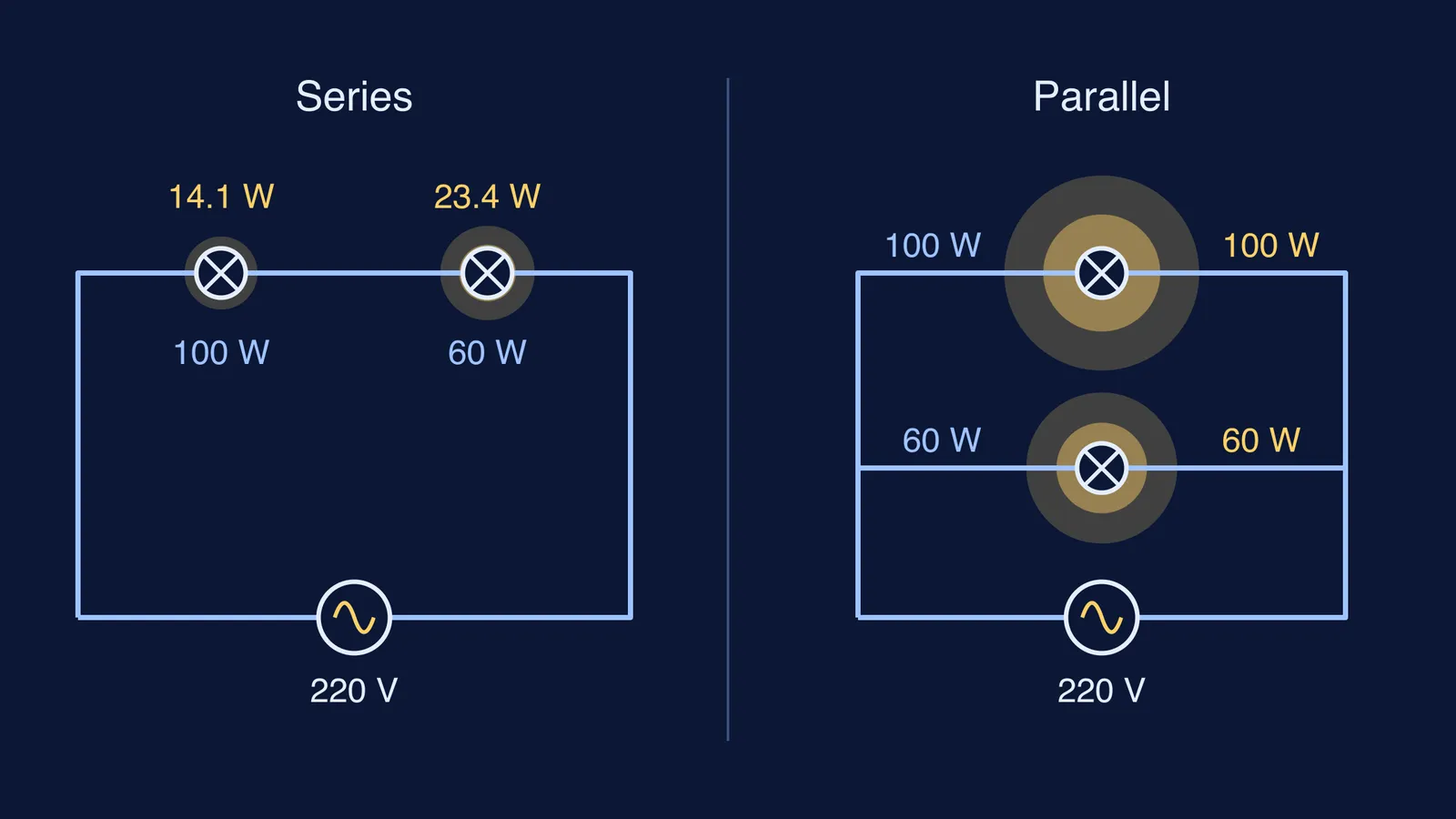
Connect a 100 W bulb and a 60 W bulb one after the other across the mains and the 60 W bulb glows brighter. It looks wrong, but two lines of algebra explain it.
Why does a higher-watt bulb glow dimmer in series?
A bulb's wattage is the power it draws only at its rated voltage.
The NCERT Class 10 chapter on electricity gives electric power as P = VI = I²R = V²/R (NCERT Science Class 10, Chapter 11, Eq. 11.22). Rearranged, R = V²/P.
So at the same rated voltage, the bulb with the lower wattage has the higher resistance. A 220 V, 100 W bulb has R = 220²/100 = 484 Ω. A 220 V, 60 W bulb has R = 220²/60, about 807 Ω.
In a series circuit the current is the same in every part of the circuit (NCERT, Section 11.6.1). With the same current, the power P = I²R grows with R. The 60 W bulb has more resistance, so it takes more power and glows brighter.
Why is it the other way round in parallel?
In parallel, every bulb has the same potential difference across it, the full supply voltage (NCERT, Section 11.6.2). Now the useful form is P = V²/R, and smaller R means more power.
At 220 V each bulb draws its full rating, so the 100 W bulb is brighter.
This is also why homes are wired in parallel. NCERT points out that a series circuit is impracticable for a bulb and a heater, because they need very different currents, and that in parallel each gadget can draw the current it needs (NCERT, Section 11.6). If the idea that current is shared rather than used up still feels shaky, our post on whether current is used up in a series circuit shows how to test it.
Worked example: 100 W and 60 W bulbs on 220 V
The numbers below use the power formulas from NCERT Chapter 11 and assume each filament's resistance stays fixed, as textbook problems usually do.
Resistances: R₁ = 220²/100 = 484 Ω; R₂ = 220²/60 ≈ 806.7 Ω.
Series total: R = 484 + 806.7 ≈ 1290.7 Ω.
Current: I = 220/1290.7 ≈ 0.170 A, the same through both bulbs.
Power in the 100 W bulb: I²R₁ ≈ 0.02906 × 484 ≈ 14.1 W.
Power in the 60 W bulb: I²R₂ ≈ 0.02906 × 806.7 ≈ 23.4 W.
Check: total power V²/R = 220²/1290.7 ≈ 37.5 W, and 14.1 + 23.4 = 37.5 W.
In series the powers are in the ratio of the resistances, 23.4 : 14.1 = 5 : 3. That is the rated wattages flipped, 100 : 60. In parallel the same pair draws 160 W in total, a line current of 160/220 ≈ 0.73 A, which is exercise 15 at the end of the NCERT chapter.
A shortcut for two bulbs with the same rated voltage V, on a supply of V: in series, bulb 1 takes P₁P₂²/(P₁ + P₂)². For the 100 W bulb that is 100 × 3600/25,600 ≈ 14.1 W, which matches step 4. If the rated voltages differ, skip the shortcut and work out each resistance.
Does a real filament behave like this?
Mostly, with one caveat. Ohm's law holds for a conductor "provided its temperature remains the same", and NCERT notes that resistance varies with temperature (NCERT, Sections 11.4 and 11.5). A filament running dim in series is cooler than at full power, so its resistance is not exactly the value worked out from its rating. A lab reading will not match 14.1 W and 23.4 W exactly. In exams, use the rated resistance unless the question says otherwise. To see why the filament is tungsten in the first place, read why tungsten is used in bulbs and nichrome in heaters.
How do you decide which bulb is brighter in 30 seconds?
Use this four-question check on any bulb question:
What is each bulb's resistance? Use R = V²/P from its rating. Same rated voltage means lower watts, higher resistance.
What is shared? Series shares current; parallel shares voltage.
Which formula fits? Same current: use I²R, so the larger R is brighter. Same voltage: use V²/R, so the smaller R is brighter.
Does the total make sense? In series on its rated voltage, each bulb takes less than its rating, and the total is less than either rating.
One related trap: power scales with V². That is why a 220 V, 100 W bulb run on 110 V takes 25 W, not 50 W (exercise 3 in the NCERT chapter; see also HyperPhysics on electric power).
If a mixed series-parallel network keeps tripping you up, the Fermi Problem Library has worked problems with a step-by-step solver that explains the reasoning rather than printing an answer. If the gap is the idea of resistance itself, start with the lesson in the Fermi Concept Library.
For practice with real readings, try the series and parallel resistors practical.


