

On this page
Experiment 5 on the CBSE Class 10 Science practical list for 2025-26 is "Determination of the equivalent resistance of two resistors when connected in series and parallel" (CBSE Science curriculum 2025-26). The same document gives 5 of the 20 internal assessment marks to practical work done through the year and says all listed practical work must be completed. Expect viva questions on it too.
What formulas are you trying to verify?
NCERT defines resistance through Ohm's law: R = V/I, where V is the potential difference across a conductor and I the current through it, provided its temperature stays the same (NCERT Class 10 Science, Chapter 11).
For resistors in series, the same chapter gives Rs = R1 + R2 + R3 (Eq. 11.14), so the combination is greater than any single resistor.
For resistors in parallel, it gives 1/Rp = 1/R1 + 1/R2 + 1/R3 (Eq. 11.18), so the combination is smaller than the smallest resistor.
How do you set up the circuit?
You need a battery, a plug key, an ammeter, a voltmeter, two resistors, a rheostat if available, and connecting wires. NCERT's Activities 11.4 to 11.6 show both arrangements.
Series: battery, key, ammeter and the two resistors in one loop, with the voltmeter across both resistors together.
Parallel: the two resistors side by side between points X and Y, the ammeter in the main line to read the total current, and the voltmeter across X and Y.
Connect + terminals towards the + side of the battery. Our guide on how to connect an ammeter and a voltmeter explains why each meter goes where it does.
Before switching on, note each meter's least count and any zero error.
How do you record the readings and find R?
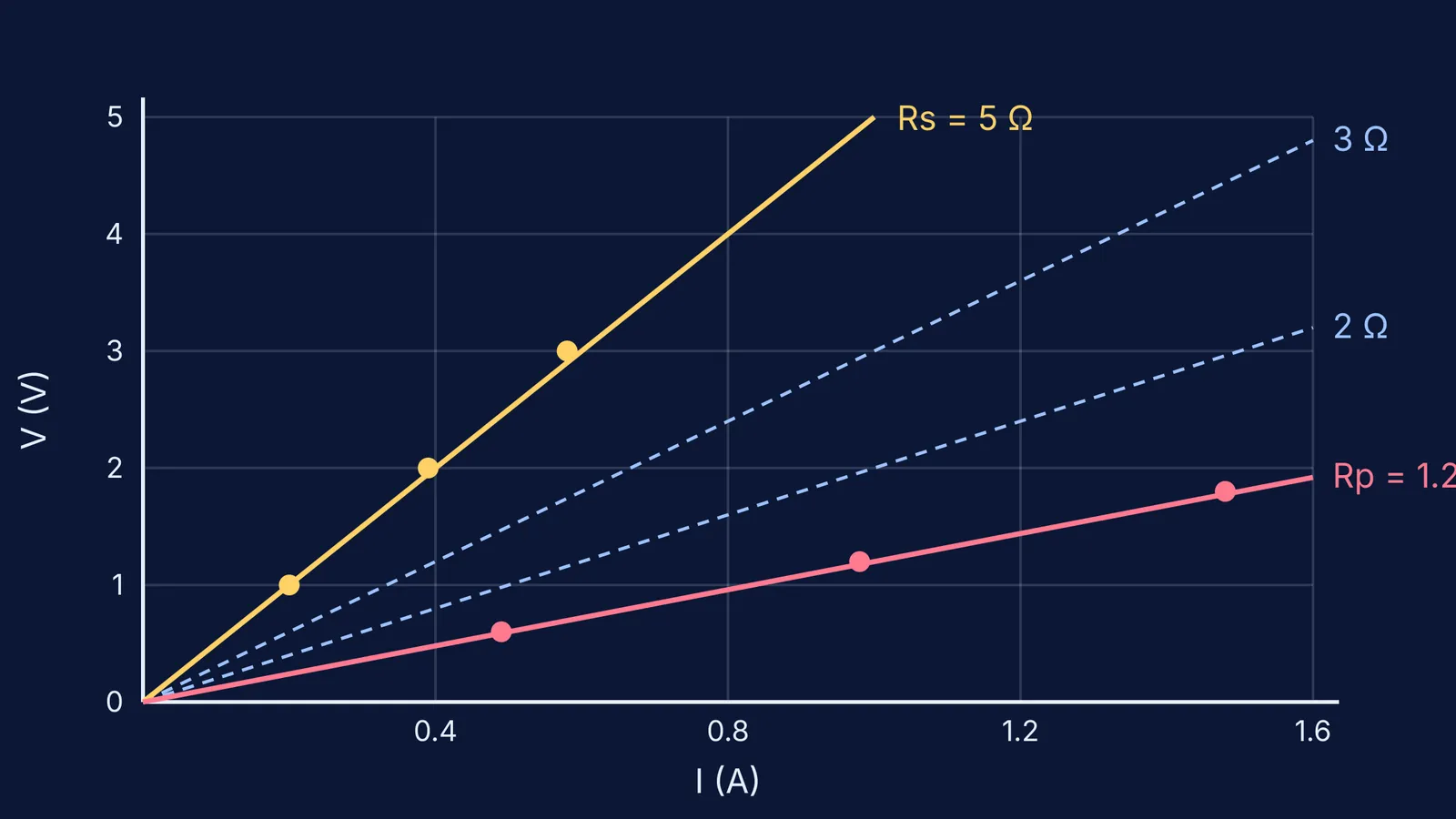
Take at least three sets of readings for each arrangement, changing the current with the rheostat or the number of cells. Calculate V/I for each set, then take the mean. Here are illustrative sample readings for R1 = 2 ohm and R2 = 3 ohm.
Series (formula: 2 + 3 = 5.0 ohm):
V = 1.0 V, I = 0.20 A, so V/I = 5.00 ohm
V = 2.0 V, I = 0.39 A, so V/I = 5.13 ohm
V = 3.0 V, I = 0.58 A, so V/I = 5.17 ohm
Mean Rs = 5.10 ohm. Percentage difference = (5.10 − 5.0) / 5.0 × 100 = 2.0%.
Parallel (formula: 1/Rp = 1/2 + 1/3 = 5/6, so Rp = 1.2 ohm):
V = 0.6 V, I = 0.49 A, so V/I = 1.22 ohm
V = 1.2 V, I = 0.98 A, so V/I = 1.22 ohm
V = 1.8 V, I = 1.48 A, so V/I = 1.22 ohm
Mean Rp = 1.22 ohm. Percentage difference = (1.22 − 1.2) / 1.2 × 100 = about 1.7%.
A V–I graph for each arrangement should be a straight line through the origin whose slope is the equivalent resistance. Our post on plotting graphs in physics practicals covers scales and best-fit lines.
Why doesn't my measured value match the formula exactly?
A small difference is expected. Name the cause rather than writing "human error".
Heating. For metals, resistivity rises with temperature, while alloys such as nichrome, manganin and constantan change very little (NCERT Class 12 Physics, Section 3.8). NCERT's Class 10 chapter tells you to take the key out of the plug after measuring the current.
Tolerance. A "2 ohm" resistor is rarely exactly 2 ohm, so your formula value carries its own uncertainty.
Contacts and wires. Loose terminals, rusty plug keys and long leads add resistance. In the series circuit, any wire inside the voltmeter's span adds to your measured Rs.
Meter limits. Zero error, a coarse least count and parallax all shift readings.
The voltmeter's own current. A real voltmeter draws a little current, so the main-line ammeter in both arrangements reads slightly more than the resistors' current.
Precautions follow: tighten terminals, clean wire ends, correct for zero error, read straight above the needle, and keep currents small.
What do examiners ask in the viva?
Why is Rs greater than either resistor? The same current flows through both and the voltages add.
Why is Rp smaller than the smallest resistor? Each branch adds a new path, so the total current rises for the same voltage.
Why is household wiring in parallel? NCERT notes that one failed component breaks a series circuit, while a parallel circuit lets each gadget draw the current it needs.
For more numericals, try our explainer on the ratio of series and parallel resistance for n resistors. The Fermi Problem Library has worked circuit problems with a step-by-step solver that explains the reasoning rather than printing an answer. If the idea behind the formulas is shaky, the Fermi Concept Library has a lesson for each concept in physics.
Set up the circuit, take three readings each way, and write down one specific error source for every gap you find.


