

On this page
When electric current flows through a circuit, the arrangement of conductors dictates total opposition to charge flow. Connecting resistors in series forces charge along a single path, while connecting them in parallel divides charge across multiple branches. When all resistors in a network are identical, this topological contrast produces an exact quadratic scaling law.
What is the ratio of resistance in series and parallel for n identical resistors?
Consider n identical resistors, each of resistance R. Their equivalent resistance depends entirely on whether they are wired end-to-end or across common junctions.
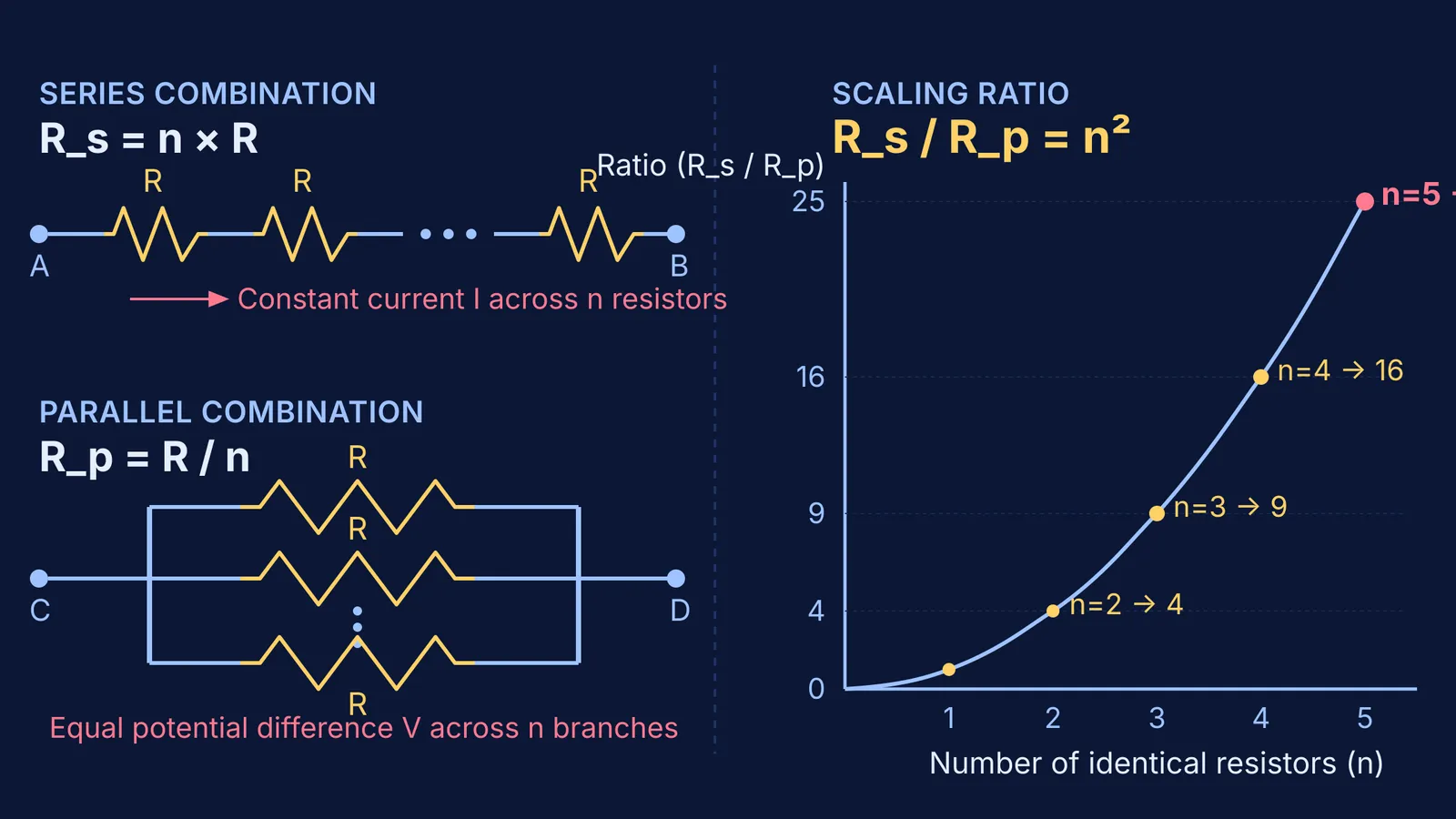
In a series combination, resistors connect consecutively in one branch. With no intermediate branching, the same current I flows through every resistor. By Ohm's law, the potential difference across each component is V_k = I × R. The total potential difference is the sum of these individual drops:
V_total = V_1 + V_2 + ... + V_n = n × I × R
The equivalent series resistance R_s is:
R_s = V_total / I = nR
Connecting resistors in series increases total resistance in direct linear proportion to n, as outlined in NCERT Class 10 Electricity and NCERT Class 12 Current Electricity.
In a parallel combination, all n resistors connect across the same two terminal nodes. The potential difference across each branch is identical (V). The total current divides equally across the n paths, each carrying I_branch = V / R. Summing branch currents gives:
I_total = n × (V / R)
The reciprocal of the equivalent parallel resistance R_p equals the sum of the reciprocals:
1 / R_p = n / R, so R_p = R / n
Dividing the series resistance by the parallel resistance gives the scaling ratio:
R_s / R_p = (nR) / (R / n) = n²
The individual resistance R cancels out completely. Whether each component is 2 Ω or 50 kΩ, the series-to-parallel ratio depends solely on n. If a question asks for the ratio of parallel to series resistance, the result is 1 / n².
How do you find the number of resistors and individual resistance from measured values?
In physics practical examinations, questions often provide measured equivalent resistances from a multimeter and ask for the unknown count n and component value R.
Because R_s = nR and R_p = R / n, you can isolate both unknowns directly:
Determine n from the quotient: Dividing R_s by R_p yields n², so n = √(R_s / R_p).
Determine R from the product: Multiplying R_s by R_p yields (nR) × (R / n) = R². Taking the square root reveals that R is the geometric mean of the measurements: R = √(R_s × R_p).
Consider a worked problem: An unknown number n of identical resistors gives a combined resistance of 72 Ω in series and 2 Ω in parallel.
To find the number of resistors, compute the ratio:
R_s / R_p = 72 / 2 = 36
Because n² = 36, taking the square root gives n = 6 resistors.
To find the component resistance, calculate their geometric mean:
R = √(72 × 2) = √144 = 12 Ω
Checking with the individual formulas confirms the answer: 6 × 12 Ω = 72 Ω in series, and 12 Ω / 6 = 2 Ω in parallel.
This principle also solves wire-cutting questions. If a uniform wire of resistance R is cut into n equal pieces, each piece has resistance r = R / n because resistance scales with length, as discussed in measuring the resistivity of a wire. Connecting those n pieces in parallel gives R_parallel = r / n = R / n². For example, cutting a wire into five equal pieces and wiring them in parallel—Exercise 1 of Chapter 11 in NCERT Class 10 Electricity—reduces equivalent resistance to R / 25, creating an initial-to-final ratio of 25.
Why do students struggle with series and parallel circuit problems?
Although the formulas are compact, resistor networks remain a persistent stumbling block. Physics education research shows that errors usually stem from flawed qualitative reasoning rather than arithmetic mistakes.
In an investigation published in the American Journal of Physics, Paula Vetter Engelhardt and Robert J. Beichner assessed circuit reasoning using a 29-item diagnostic instrument across high school and university cohorts (Engelhardt & Beichner, 2004). They found that students frequently treat batteries as constant-current sources. Foundational work by Lillian C. McDermott and Peter S. Shaffer demonstrated that learners often hold misconceptions about electric current as it moves through series elements (McDermott & Shaffer, 1992).
When students confuse current division with potential drops, multi-resistor questions turn into guesswork. The Fermi Problem Library provides worked problems with a step-by-step solver that explains the reasoning rather than printing an answer, helping students verify their derivations before tackling complex circuits.
Reviewing circuit fundamentals alongside Class 10 electricity principles and exploring symmetry in combination of resistors problems strengthens conceptual foundations. For revision across the wider physics syllabus, the Fermi Concept Library offers every concept in physics, chemistry, biology, mathematics and computing, each with its own lesson and its place in the map.
How can you avoid mistakes on resistor ratio questions?
To solve ratio problems accurately under exam conditions, use this four-step diagnostic checklist:
Verify ratio direction: Confirm whether the question asks for series-to-parallel (n²) or parallel-to-series (1 / n²). Inverting the fraction is the most common source of lost marks on multiple-choice papers.
Confirm identical ratings: The n² shortcut holds only when every resistor has the exact same value R. If ratings differ, individual values do not cancel.
Check consistency with the geometric mean: Verify that your calculated values satisfy both n = √(R_s / R_p) and R = √(R_s × R_p). If either relation fails, recalculate.
Perform the boundary sanity check: For any integer n greater than 1, equivalent series resistance must exceed R, while equivalent parallel resistance must be less than R.


