On this page
In the CBSE Class XII Physics curriculum for 2026-27, Unit VI Optics (Chapter 9, Ray Optics and Optical Instruments, plus Chapter 10, Wave Optics) carries 18 of the 70 theory marks. If you are also preparing for JEE, our ray optics guide for JEE Main covers the speed side.
Which ray optics derivations does NCERT 2026-27 include?
The NCERT Class 12 Physics Chapter 9 (2026-27 reprint) derives these:
Mirror equation, 1/v + 1/u = 1/f, from similar triangles in the concave-mirror ray diagram.
Refraction at a spherical surface, n₂/v − n₁/u = (n₂ − n₁)/R, using small angles and Snell's law.
Lens maker's formula, by applying that surface result twice, then the thin lens formula 1/v − 1/u = 1/f.
Thin lenses in contact, 1/f = 1/f₁ + 1/f₂, so P = P₁ + P₂ and m = m₁m₂.
Prism, r₁ + r₂ = A and δ = i + e − A, giving n = sin[(A + Dm)/2] / sin(A/2) at minimum deviation.
Instruments: compound microscope m = (L/fo)(D/fe) and refracting telescope m = fo/fe, both with the final image at infinity.
It also describes, without a derivation, the Cassegrain reflecting telescope.
The reprint has no section on dispersion, rainbows or scattering, and CBSE says content NCERT excludes will not be assessed. For the diagrams themselves, use our guide to drawing ray diagrams in the board paper.
How should you set out 2-, 3- and 5-mark answers?
In the CBSE 2026-27 sample paper, the 5-mark compound microscope question, Q32(A), is split 2 + 2 + 1: image position, magnifying power, then a short explanation. A layout that fits:
2 marks: formula, values with signs, answer with unit.
3 marks: labelled diagram, the geometric step, then the sign convention applied in one visible line, such as "BP = −u, B′P = −v, FP = −f".
5 marks: number the parts to match the question, box each answer, keep the explanation to two or three sentences.
Where does the sign convention go wrong?
NCERT uses the Cartesian convention: measure from the pole or optical centre; distances along the incident light are positive, against it negative.
Mirrors use 1/v + 1/u; lenses use 1/v − 1/u.
For a double-concave lens, R₁ is negative and R₂ positive, so f comes out negative on its own. Do not add another minus sign.
A real object always has negative u. Writing u = +1.25 cm below gives an image 0.56 cm away, which no microscope makes.
Worked example: one microscope numerical, done twice
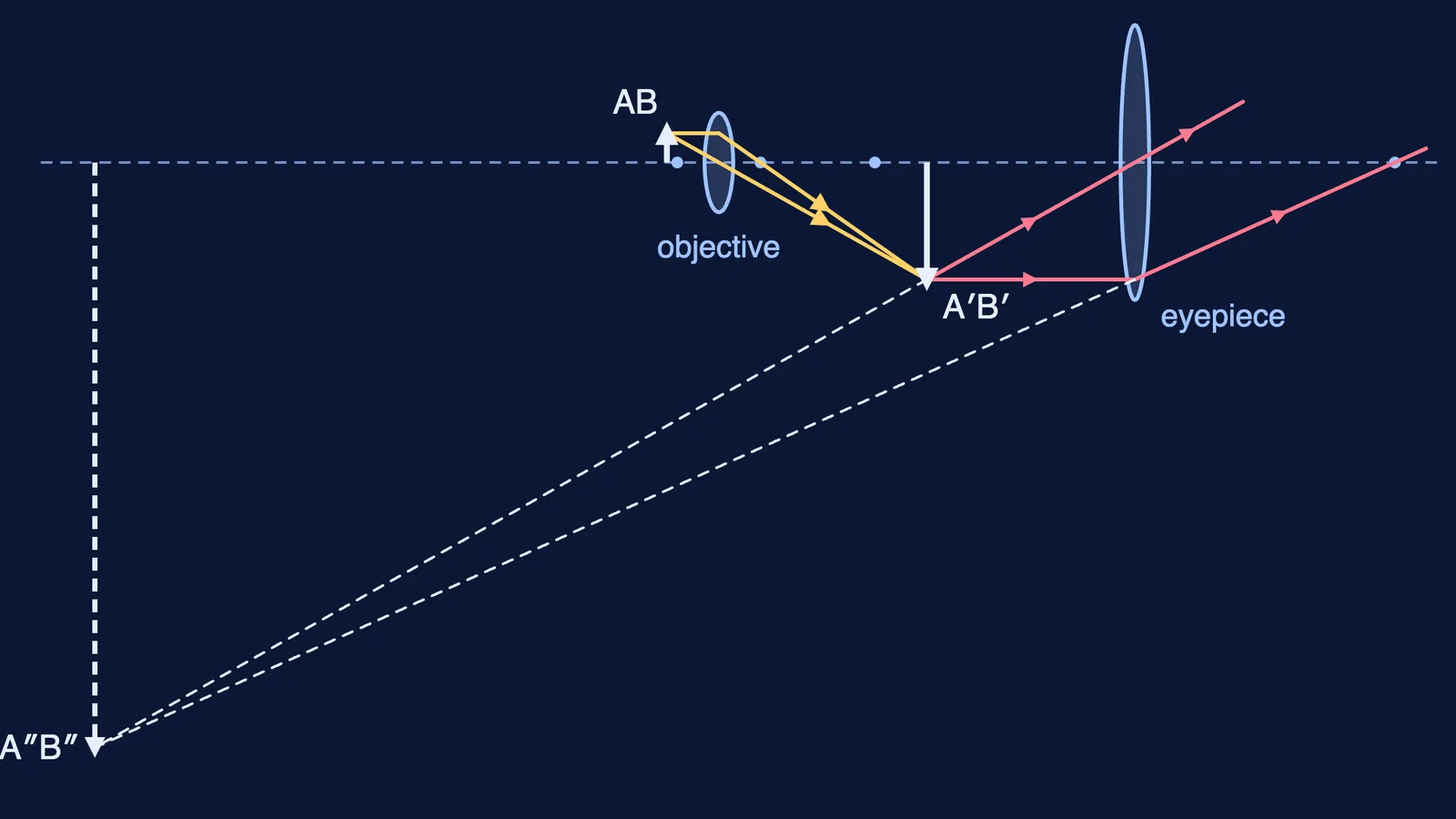
A compound microscope has an objective of focal length 1.0 cm and an eyepiece of 6.25 cm. The object is 1.25 cm in front of the objective. Take D = 25 cm.
Objective (both cases). u = −1.25 cm, f = +1.0 cm. 1/v = 1/f + 1/u = 1 − 0.8 = 0.2, so v = +5.0 cm. mo = v/u = −4.
Case 1: final image at the near point. ve = −25 cm. 1/ue = 1/ve − 1/fe = −0.04 − 0.16 = −0.20, so ue = −5.0 cm and the lenses are 10 cm apart. me = 1 + D/fe = 5. Total m = −20.
Case 2: final image at infinity. The first image sits at the eyepiece focus, ue = −6.25 cm, so the lenses are 11.25 cm apart. me = D/fe = 4. Total m = −16.
The minus sign means an inverted image. The marking scheme quotes magnifying power as a plain size (50 for Q32(A)), so also say "inverted" in words. The diagram at the top is Case 1 drawn to scale. For more problems in the same steps, the Fermi Problem Library has worked problems with a step-by-step solver that explains the reasoning rather than printing an answer.
What do assertion-reason and case-study questions test?
The sample paper's Section A has four 1-mark assertion-reason questions. Its ray optics one, Q14, says a convex lens's focal length increases in water. The marking scheme explains it with the lens maker's formula: glass has a smaller refractive index relative to water than to air. NCERT's Example 9.7 puts numbers on it: a 20 cm glass lens in air becomes about 78.2 cm in water.
The usual trap is a true reason that does not explain the assertion. Section D has two 4-mark case studies; our post on finding the key number in case-based optics questions works one through.
A seven-day ray optics revision plan
Day 1: sign convention and the mirror equation, from memory.
Day 2: spherical surface and lens maker's formula, plus three NCERT exercises.
Day 3: lenses in contact and power.
Day 4: prism and minimum deviation, with the i–δ graph.
Day 5: microscopes, both settings.
Day 6: telescopes, then the sample paper's optics questions under time.
Day 7: redo every derivation without the book; mark any skipped step.
If image formation is hard to picture, the Fermi Simulation Lab has interactive simulations for ideas that are easier to see than to read.