

On this page
The official CBSE Physics sample question paper for 2026-27 says Section D contains two case study-based questions of four marks each, in a 70-mark, 3-hour paper where calculators are not allowed. Each case is one passage followed by four 1-mark parts. In the sample paper, five of the eight parts are MCQs and three ask for a short written answer. Its two cases are on semiconductors and the photoelectric effect, not optics, so treat the optics case below as practice in the same format, not a prediction.
What does a case-based optics question look like?
An optics case is likely to describe a real device: an optical fibre, the eye, a telescope or a prism. The passage hides one or two numbers that all four parts are built on, and a useful way to read the parts is as a climb:
Concept: why does the device work at all?
Key number: work out the one quantity everything rests on.
Apply: use that number on a new situation from the passage.
Extend: take the result one step further.
Because the parts are linked, one misread number in part two can cost you parts three and four too.
How do you find the key number in an optics passage?
Each device has a pair of numbers that matter:
Optical fibre: the refractive index of the core and of the cladding. Their ratio gives the critical angle, sin C = n(cladding) / n(core).
Telescope: the two focal lengths. With the final image at infinity, magnifying power m = fo / fe. The telescope question in the CBSE 2026-27 sample paper (a Section E long answer) uses 100 cm and 5 cm, which gives 20.
Eye and microscope: the least distance of distinct vision (25 cm in that telescope question) plus the object distance.
Prism: the prism angle and refractive index, which decide whether light escapes or is totally reflected; see how a total reflecting prism turns light by 90° and 180°.
Then ask of every refractive index: relative to what? Many optics traps live there.
Worked example: one optical fibre passage, four linked MCQs
We wrote this passage in the CBSE style, following the NCERT Class 12 chapter on ray optics, which says a fibre's core has a higher refractive index than its cladding, and that silica fibres can transmit more than 95% of the light over a fibre length of 1 km.
Passage. An optical fibre has a glass core inside a cladding of lower refractive index. In one fibre, the core has refractive index 1.50 and the cladding 1.30.
(i) Light stays inside the core because of: (a) absorption by the cladding (b) total internal reflection at the core-cladding boundary (c) a mirror coating on the core (d) diffraction. Answer: (b), possible only because the core is optically denser.
(ii) The critical angle at the core-cladding boundary is closest to: (a) 30° (b) 42° (c) 60° (d) 90°. Answer: (c). sin C = 1.30 / 1.50 ≈ 0.87, and sin 60° ≈ 0.87. The trap is (b): 42° comes from sin C = 1 / 1.50, the glass-air value, but no air touches the core.
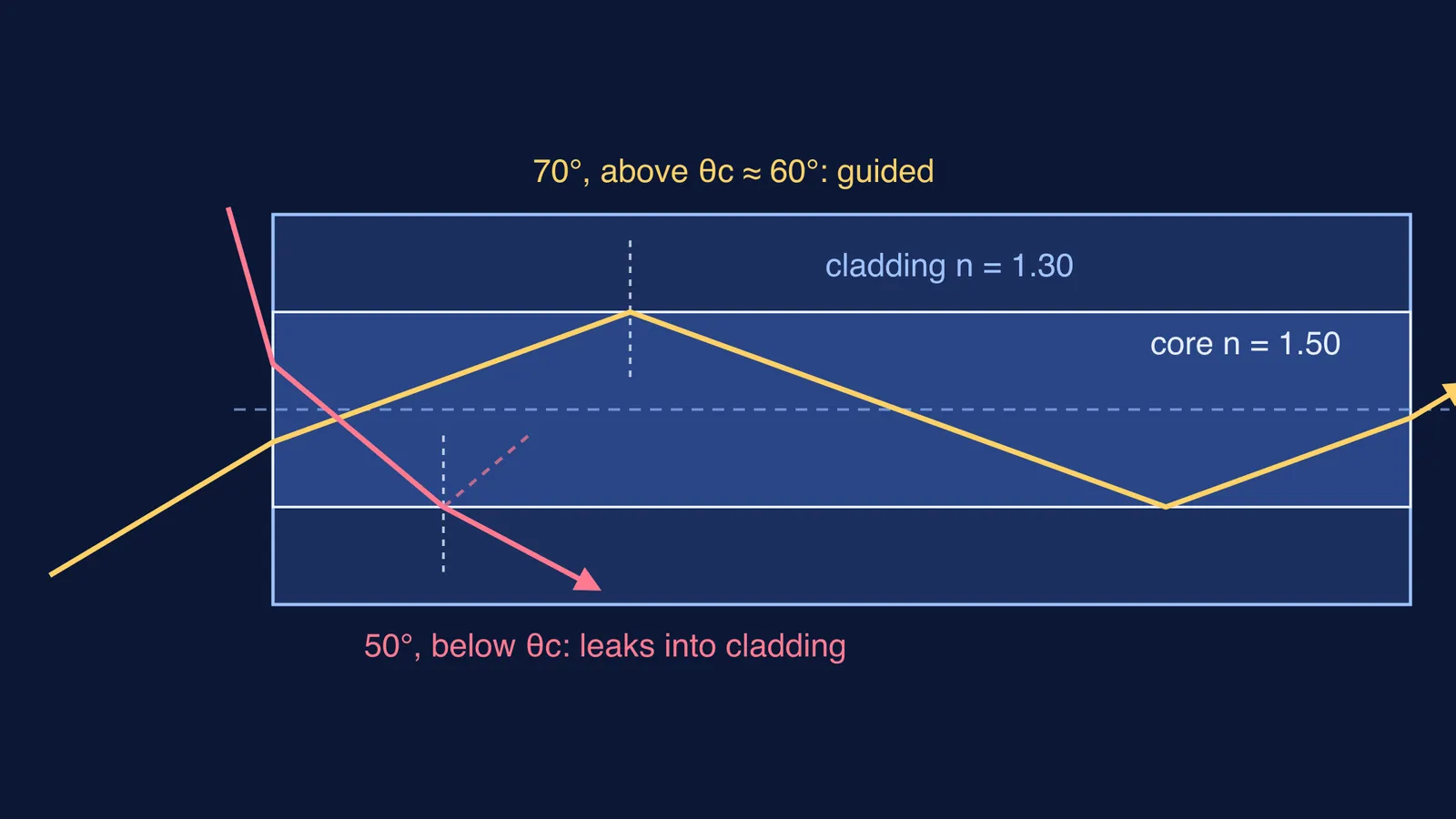
(iii) Two rays meet the boundary at 70° and 50° to the normal. Which is true? (a) both are guided (b) the 70° ray is guided and the 50° ray partly leaks into the cladding (c) the 50° ray is guided and the 70° ray leaks (d) both leak. Answer: (b). Total internal reflection needs an angle of incidence greater than C. The diagram at the top draws both rays.
(iv) The largest angle a guided ray can make with the fibre's axis is about: (a) 30° (b) 48° (c) 60° (d) 70°. Answer: (a). The normal to the boundary is perpendicular to the axis, so the limit is 90° − C = 30°. If you used 42° in part (ii), you would pick 48° here.
How should you practise case-based questions for Class 12 optics?
The sample paper gives you 180 minutes for 70 marks: about two and a half minutes per mark, so a 4-mark case deserves around 10 minutes. Use them like this:
Read the four parts first, so you know which number you are hunting.
Underline every number with a unit, and note what it is relative to: air, water or cladding.
Write the formula linking the key numbers before you look at the options.
Answer in order, carrying results forward, with a sense check: a critical angle is below 90°.
After marking, label each wrong part: misread number, wrong formula or concept gap.
That label decides what you do next. For a misread number, slow down step 2. For a wrong formula, the Fermi Problem Library has worked problems with a step-by-step solver that explains the reasoning rather than printing an answer. For a concept gap, the Fermi Concept Library gives each physics concept its own lesson. Wrong options are worth studying too; this three-question method for learning from wrong MCQ options shows how.
If telescopes are your weak spot, build a refracting telescope in a simulation.


