

On this page
When a beam of light hits a standard mirror, a small percentage of the energy is absorbed and lost. But by using a block of glass shaped like a right-angled isosceles triangle, we can bounce light without losing any brightness. A total reflecting prism is an optical device that deviates light by exactly 90° or 180° using the phenomenon of total internal reflection.
This simple piece of glass is a staple of optics, turning up in everything from submarine periscopes to the binoculars you use for birdwatching.
What is a total reflecting prism?
A total reflecting prism is made of glass and cut so that its angles are exactly 45°, 90°, and 45°. Its ability to bend light perfectly relies on the critical angle of the material it is made from.
When light travels from a dense medium (like glass) into a rarer medium (like air), it speeds up and bends away from the normal line. If you keep increasing the angle at which the light hits the boundary, you reach a tipping point where the refracted ray travels flat along the surface. This is the critical angle. For common glass in air, the critical angle is approximately 41.8°, often rounded to 42° Source: [Wikipedia].
Whenever light inside the glass hits the air boundary at an angle greater than this critical angle, it cannot escape. Instead, it reflects entirely back into the glass. Because of the prism's 45°-90°-45° geometry, light that enters straight through one face will strike the next angled face at exactly 45°. Since 45° > 42°, the light undergoes total internal reflection.
If you find it hard to picture how changing the material alters the critical angle, the Fermi Simulation Lab provides interactive simulations for ideas that are easier to see than read, letting you observe exactly when refraction breaks down and reflection begins.
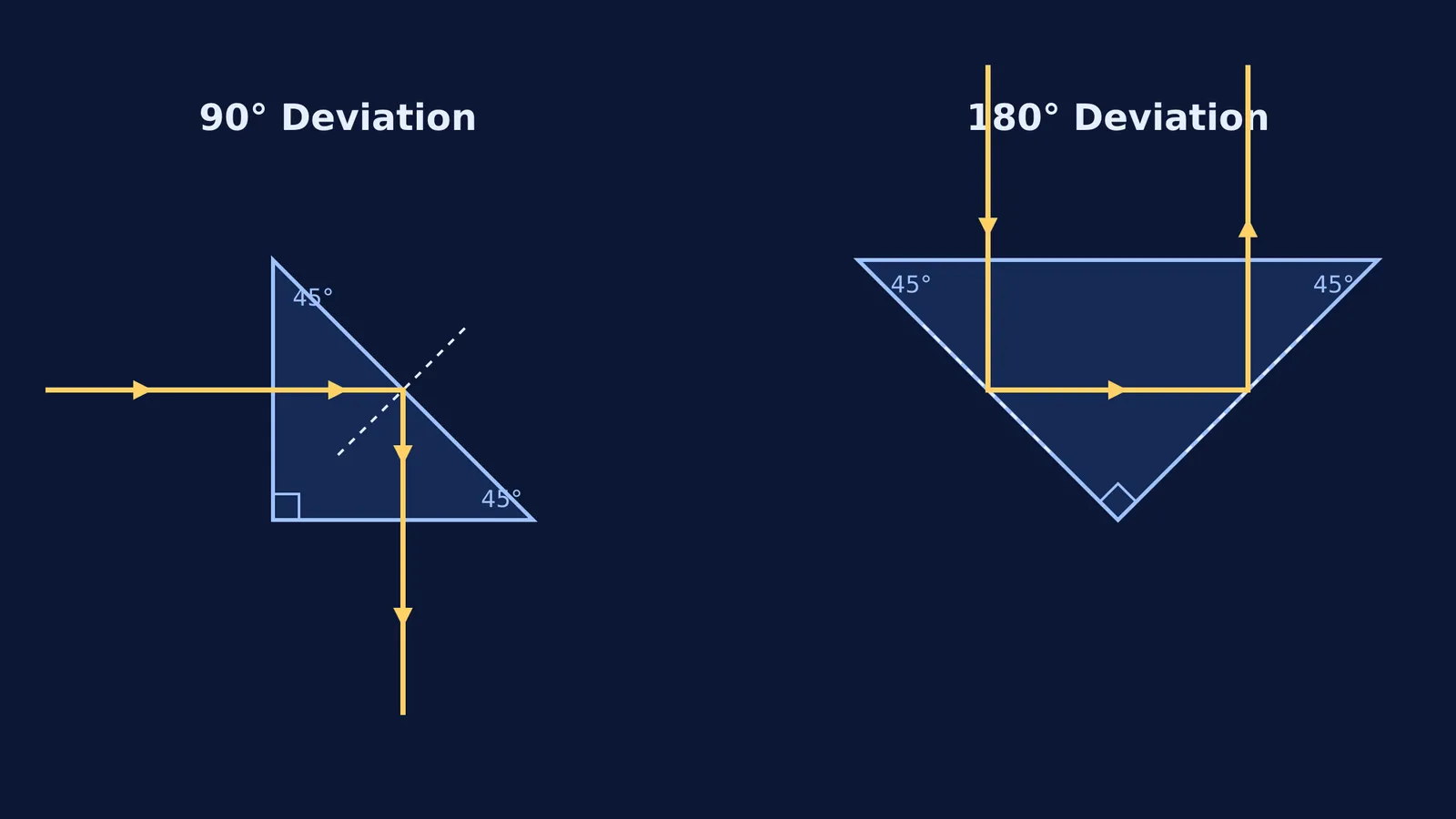
How does a right-angled prism deviate light by 90 degrees?
To turn a ray of light by a right angle, the prism is positioned so that light enters through one of its two shorter faces (the legs of the right-angled triangle).
Entry: The light strikes the short face at a 90° angle (normal incidence). Because it hits straight on, it passes into the glass without bending.
Reflection: The ray travels straight through the glass until it hits the hypotenuse (the longest face). Because of the triangle's shape, the light hits this surface at an angle of incidence of 45°.
Exit: Since 45° is greater than the critical angle of 42°, total internal reflection occurs. The light bounces off the inside of the hypotenuse at 45°, turning a full 90°. It then strikes the second short face head-on and exits the prism without further deviation.
This 90° deviation setup is famously used in periscopes. However, just like a standard mirror, a single reflection laterally inverts the image (left becomes right). This is why periscopes typically use two prisms in sequence: the first one shifts the light down and inverts it, and the second one turns it back toward the viewer's eye, reversing the inversion so the final image looks perfectly normal.
How is light turned through 180 degrees by a prism?
If we want to send light back in the exact direction it came from, we use the same prism but orient it differently. This configuration is known as a Porro prism Source: [Wikipedia].
Entry: The light enters through the large flat face (the hypotenuse) at normal incidence, travelling straight into the glass without bending.
First Reflection: The ray hits one of the shorter, slanted faces at 45°. It undergoes total internal reflection and reflects at a 90° angle, sending it straight across the inside of the prism toward the other short face.
Second Reflection: The ray strikes the second short face at 45°, undergoes total internal reflection again, and turns another 90°.
Exit: Having turned a total of 180°, the light exits the hypotenuse straight out, parallel to its original path but shifted slightly over.
This double-reflection technique is primarily used in binoculars. The objective lens at the front of a pair of binoculars creates an image that is upside down and backwards. To completely erect the image, binoculars use a double Porro prism system—two prisms set at 90° to each other. One prism corrects the vertical inversion, and the other corrects the horizontal inversion. This clever design rights the image and folds the long optical path into a short, compact body.
Why use a total reflecting prism instead of a mirror?
Mirrors are cheaper to manufacture, but prisms are optically superior for precision instruments.
A conventional mirror relies on a metallic coating on the back of a glass pane. This coating inevitably absorbs a small percentage of the light. Furthermore, when light hits an ordinary glass mirror, a tiny fraction reflects off the front surface of the glass, while the rest reflects off the silvered back. This creates a faint "ghost image" slightly offset from the main image, which ruins clarity in optical instruments.
In contrast, total internal reflection is 100% efficient Source: [Wikipedia]. No light is lost to absorption at the reflecting surface, and because the reflection happens entirely at a single optical boundary, there are no ghost images. The prism also will never tarnish.
If you are reviewing optics for an exam and find yourself repeatedly drawing the normal line on the wrong side, Fermi's AI tutor can help. It notices where you are stuck, draws the figure with you on a shared board, and checks your understanding as it goes.
A checklist for drawing the ray diagrams
When sketching these paths for an assignment, follow this reliable sequence to avoid careless errors:
Draw the prism clearly: Make sure the 90° corner is obvious. Label the 45° corners so your geometry is explicitly stated.
Start the incident ray: Draw a straight line entering the correct face perpendicularly (one of the short faces for 90° deviation, or the hypotenuse for 180° deviation).
Draw the normal: At the exact point where the ray hits the slanted boundary, draw a dashed line perpendicular to that surface.
Check your angles: Verify that the angle between the normal and your incident ray is exactly 45°.
Draw the reflection: Bounce the ray off at the exact same 45° angle on the other side of the normal.
Understanding how light moves through simple shapes makes broader optical setups much easier to follow. To review the core rules of reflection and critical angles, head over to the Fermi Concept Library. For more on tracing light paths through standard optical blocks, check out Tracing a ray through a glass slab: the Class 10 practical or explore the relationship between angles in Deviation vs incidence: the prism i-d graph practical explained. You can also read about how different wavelengths separate in Dispersion of white light by a glass prism, explained for Class 10.


