On this page
In Ray Optics, a wrong sign costs you the mark just as surely as a wrong formula. Below: the syllabus mapped to NCERT, four worked problem types, the traps and a two-week plan.
What does the JEE Main syllabus include in ray optics?
The official Syllabus for JEE (Main) - 2027, linked from the NTA's JEE Main website, puts this topic in Physics Unit 16, Optics. The ray part lists:
reflection of light, spherical mirrors and the mirror formula
refraction at plane and spherical surfaces, the thin lens formula and the lens maker formula
total internal reflection and its applications
magnification, power of a lens, and thin lenses in contact
refraction through a prism
the microscope and the astronomical telescope (reflecting and refracting) and their magnifying powers
Wave optics sits in the same unit; treat it as a separate block. Unit 20, Experimental Skills, adds parallax focal lengths of a convex mirror, concave mirror and convex lens, the deviation versus incidence plot for a prism, and a glass slab's refractive index by travelling microscope.
Your textbook is Chapter 9, Ray Optics and Optical Instruments, in NCERT Class 12 Physics Part II. Its sections follow the syllabus: 9.2 mirrors, 9.3 refraction, 9.4 total internal reflection, 9.5 lenses, 9.6 the prism, 9.7 instruments.
How do you use the sign convention without mistakes?
NCERT uses the Cartesian sign convention: distances are measured from the pole or optical centre, positive along the incident light, and heights above the axis are positive. Put signs on the numbers before using any formula.
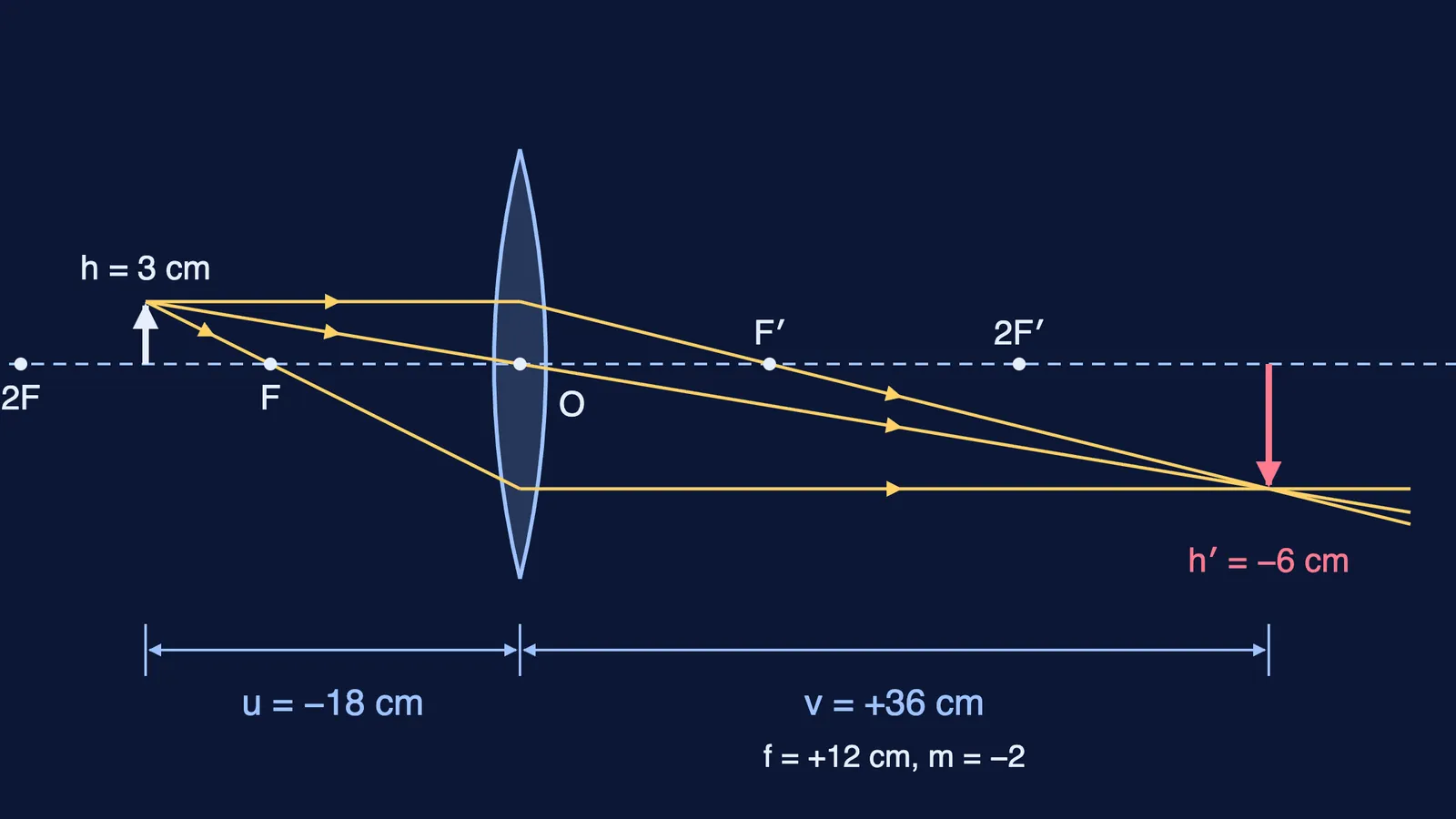
Lens example. A 3 cm object stands 18 cm in front of a convex lens of focal length 12 cm. So u = −18 cm and f = +12 cm. The lens formula is 1/v − 1/u = 1/f, so 1/v = 1/12 − 1/18 = 1/36 and v = +36 cm. Magnification m = v/u = 36/(−18) = −2, so the image is real, inverted and 6 cm tall. The diagram above draws this to scale.
Mirror example. An object sits 30 cm in front of a convex mirror of focal length 20 cm. Here u = −30 cm and f = +20 cm, because a convex mirror's focus lies behind it. The mirror formula is 1/v + 1/u = 1/f, so 1/v = 1/20 + 1/30 = 1/12 and v = +12 cm. For a mirror m = −v/u = −12/(−30) = +0.4: virtual, erect and smaller.
To see how the image moves with the object, try our concave mirror simulation walk-through.
How do you solve prism and total internal reflection questions?
Prism example. A prism of angle A = 60° gives a minimum deviation of 38°. The refractive index is n = sin((A + δm)/2) / sin(A/2) = sin 49° / sin 30° = 0.755 / 0.5, so n ≈ 1.51.
TIR example. Light travels inside a glass of n = 1.6 towards air. The critical angle is given by sin C = 1/n = 0.625, so C ≈ 38.7°. A ray meeting the surface at 40° to the normal is totally reflected. A ray at 35° escapes, bending to about 66.6°, from sin r = 1.6 × sin 35°.
For prisms that let no ray out, read when no ray emerges from a prism.
What are the common traps in ray optics?
Taking f as positive for every mirror. A concave mirror has negative f; a convex mirror has positive f.
Using the lens magnification v/u for a mirror, where it is −v/u.
Adding focal lengths for lenses in contact. Add powers instead: f₁ = +20 cm and f₂ = −30 cm give P = 5 − 3.33 ≈ 1.67 D, so f = +60 cm.
Applying TIR when light goes from a rarer to a denser medium. It needs denser to rarer and an angle above C.
Mixing up the microscope and telescope magnifying-power formulas.
How should you plan your ray optics practice?
About an hour a day for two weeks gives a first full pass.
Days 1-2: read NCERT 9.1-9.2. Draw concave mirror ray diagrams for five object positions, then check each with the formula.
Days 3-4: sections 9.3-9.4. Solve five refraction and TIR problems with your own numbers.
Days 5-7: section 9.5. Derive the lens maker formula once yourself, then solve ten lens problems, writing signs first.
Days 8-9: section 9.6. Prism problems and a hand-drawn deviation curve.
Days 10-11: section 9.7. Microscope and telescope, both adjustment cases.
Days 12-14: mixed timed sets. Tag each error as sign, formula or concept; redo sign errors next day.
When an answer comes out with the wrong sign and you cannot see why, the Fermi Problem Library has worked problems with a step-by-step solver that explains the reasoning rather than printing an answer, so you can find the step where your method went wrong.
In the exam, ray optics numericals are good candidates for your second pass; our JEE Main attempt strategy with three passes explains how to sort questions.