On this page
You can learn Table 9.1 of the NCERT Class 10 science textbook in an evening and forget it by the exam. A better route is to slide the object yourself in a ray simulation and say what you expect before every move.
Where does the image form for each object position in a concave mirror?
The NCERT Class 10 chapter Light: Reflection and Refraction summarises six cases in its Table 9.1. Moving the object from far away towards the mirror:
At infinity: image at F, highly diminished (point-sized), real and inverted.
Beyond C: image between F and C, diminished, real and inverted.
At C: image at C, same size, real and inverted.
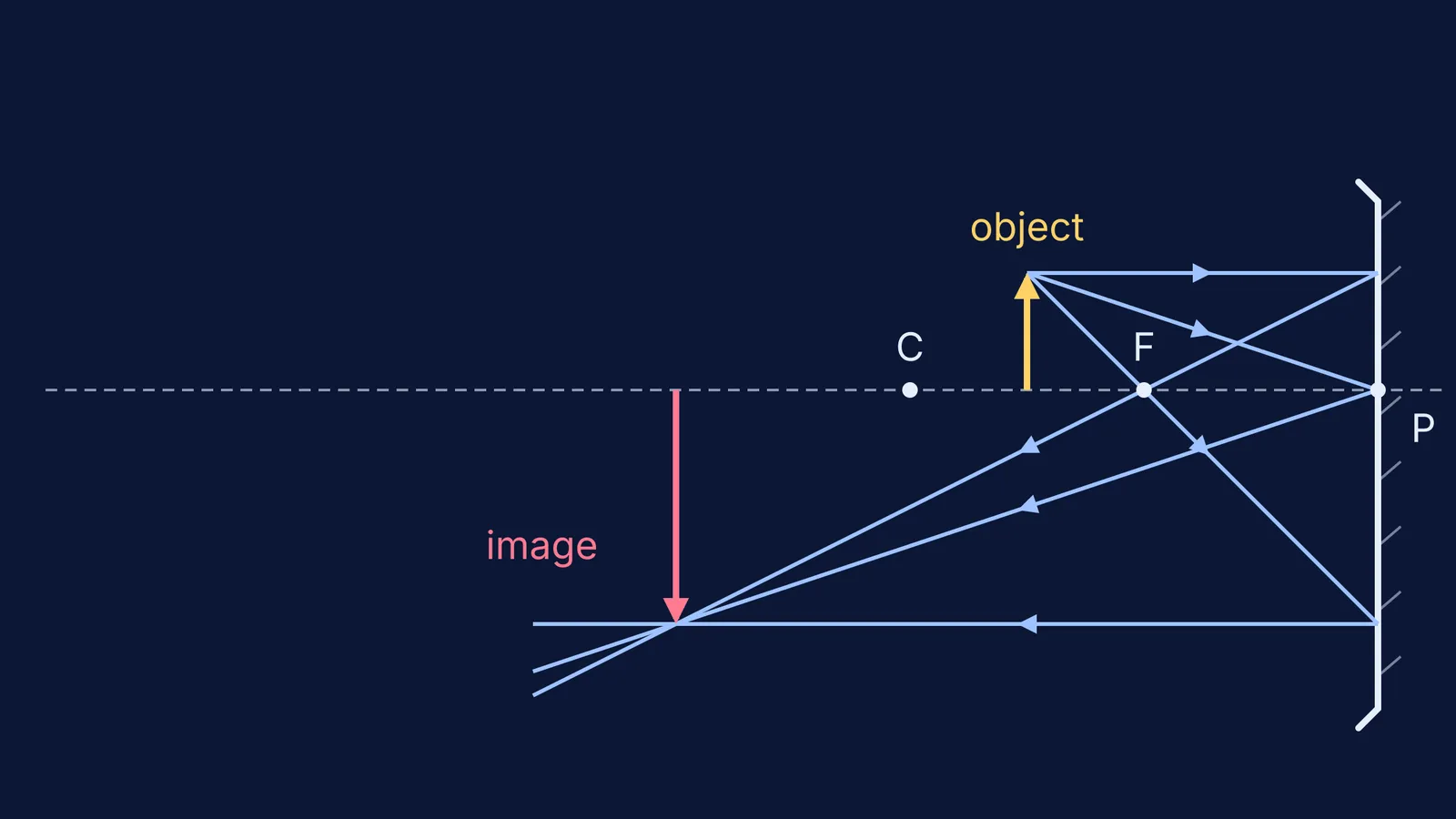
Between C and F: image beyond C, enlarged, real and inverted.
At F: image at infinity, so no image forms on a screen.
Between P and F: image behind the mirror, enlarged, virtual and erect.
Here P is the pole, F the principal focus and C the centre of curvature. For a mirror of small aperture, the same chapter gives R = 2f, so F sits halfway between P and C.
Watch the pattern, not the rows. As the object comes in from far away to F, the real image travels the other way, out from F towards infinity, and keeps growing. Cross F and the image jumps behind the mirror and turns upright.
How do you test this in a ray simulation?
Any ray simulation with a concave mirror will do. The free PhET Geometric Optics simulation from the University of Colorado Boulder has a concave mirror option alongside its lenses.
Choose the concave mirror, note where F and C sit, and start with the object far to the left.
Before each move, write a three-part prediction: where, what size, real or virtual.
Move the object to the next position and compare.
When you are wrong, trace the two rays that decide the image: the ray parallel to the axis, which reflects through F, and the ray through F, which reflects parallel to the axis.
What numbers should the simulation show?
Take a concave mirror with focal length 10 cm. NCERT's New Cartesian sign convention measures distances from the pole, with the object on the left, so u and f are negative: f = −10 cm. The same NCERT chapter gives the mirror formula 1/v + 1/u = 1/f and magnification m = −v/u, where a negative m means a real image and a positive m a virtual one.
Object at u = −1000 cm (far away): v ≈ −10.1 cm, m ≈ −0.01. A tiny real image almost exactly at F.
u = −40 cm (beyond C): v ≈ −13.3 cm, m ≈ −0.33. Real, inverted, a third of the size, between F and C.
u = −20 cm (at C): v = −20 cm, m = −1. Real, inverted, same size, at C.
u = −15 cm (between C and F): v = −30 cm, m = −2. Real, inverted, twice the size, beyond C. This is the case drawn at the top of this post.
u = −10 cm (at F): 1/v = 0. The reflected rays leave parallel and no image forms.
u = −5 cm (inside F): v = +10 cm, m = +2. Virtual, upright, twice the size, 10 cm behind the mirror.
Check one row by hand: for u = −15 cm, 1/v = 1/f − 1/u = −1/10 + 1/15 = −1/30, so v = −30 cm.
Why predict before you move the object?
In a 2004 study in the American Journal of Physics, Crouch, Fagen, Callan and Mazur found that students who passively watched classroom demonstrations understood the underlying concepts no better than students who did not see them at all. Students who predicted the outcome before seeing the demonstration showed significantly greater understanding.
A simulation is a demonstration you run yourself, and the prediction is where you find out what you actually believe.
What if ray diagrams still do not click?
Redo the six predictions a day later with a different focal length, say 15 cm, and cover the table first. If the same row trips you up twice, the gap is usually in the two ray rules, not the table.
If you would like help working through it, Fermi's AI tutor draws the figure and checks your understanding as it goes, so you can see which ray you misjudged. For other ideas that are easier to see than to read, from orbits to special relativity, the Fermi Simulation Lab has interactive simulations to explore.
Start tonight: cover Table 9.1, open a concave mirror in a simulation, and make six predictions before you move the object once.