On this page
You shine light into one face of a glass prism and nothing comes out of the other face, however you tilt it. This turns up often in ray-optics problem sets, and the answer takes two lines of geometry.
What is the condition for no emergence of light from a prism?
You need two results from NCERT Class 12 Physics, Chapter 9, Ray Optics and Optical Instruments. First, for a ray passing through a prism of angle A, the angles of refraction at the two faces satisfy r1 + r2 = A (equation 9.34 in that chapter). Second, the critical angle C of glass with respect to air satisfies sin C = 1/n, where n is the refractive index (equation 9.12 and the line after it).
If the angle of incidence inside the glass is greater than the critical angle, there is no refracted ray and the light is totally reflected, as HyperPhysics explains for total internal reflection (refresher: total internal reflection and the critical angle).
Now the derivation:
A ray leaves the second face only if r2 is C or less.
The biggest possible r1 is C. It happens at grazing incidence (i = 90°), because sin r1 = sin 90° / n = 1/n.
Since r2 = A − r1, the smallest possible r2 is A − C.
If A − C > C, that is A > 2C, even the smallest r2 is bigger than C. Every ray is totally internally reflected at the second face.
Since sin C = 1/n, you can write the same condition in terms of n: no ray emerges when n > 1/sin(A/2). For a 60° prism that means n > 2. For a 90° prism it means n > √2, about 1.414.
What angle of incidence gives grazing emergence?
When A is 2C or less, some rays get through. The limiting ray leaves along the second face, so e = 90°. That makes r2 = C and r1 = A − C. Snell's law at the first face then gives:
sin i = n sin(A − C)
Expand the sine and use n sin C = 1 and n cos C = √(n² − 1). You get a form that needs no table of C:
sin i = sin A √(n² − 1) − cos A
A smaller angle of incidence traps the ray; a larger one lets it out. If A is smaller than C, A − C is negative and every ray from 0° to 90° gets out. The opposite special case, where the ray leaves along the normal, is covered in our post on the incidence angle for normal emergence.
Worked example: which glass prisms let light through?
NCERT Table 9.1 lists crown glass with n = 1.52 and a critical angle of 41.14°, and dense flint glass with n = 1.62 and a critical angle of 37.31°. So 2C is 82.28° for crown glass and 74.62° for dense flint.
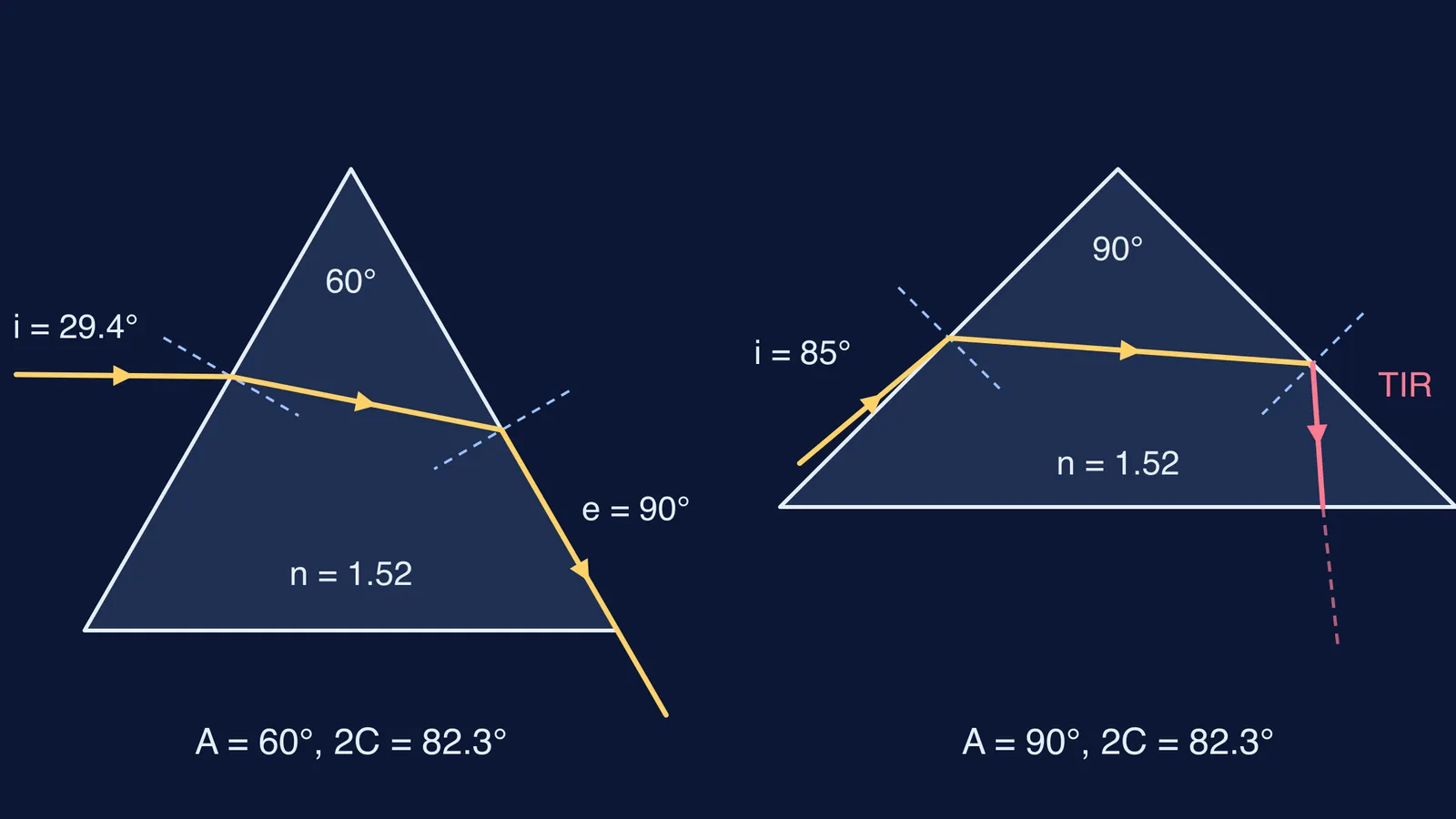
60° crown-glass prism: A < 2C, so light can get through. sin i = 1.52 × sin 18.86° ≈ 0.491, so i ≈ 29.4°. Rays between 29.4° and 90° emerge.
75° crown-glass prism: still A < 2C, but sin i = 1.52 × sin 33.86° ≈ 0.847, so i ≈ 57.9°. The window has shrunk to 57.9° to 90°.
75° dense-flint prism: A = 75° is just above 74.62°, so no ray leaves the second face.
90° crown-glass prism: 90° > 82.28°, so no ray leaves the second face.
Where do students slip on this question?
Putting i = 90° into r2 instead of r1. Grazing incidence sets the largest r1, and that gives the smallest r2.
Writing sin C = n. For glass in air it is 1/n.
Thinking a ray near the normal gets through most easily. It is the other way round: a small i gives a small r1, so r2 is large and more likely to be trapped.
Reading no emergence as meaning the prism is dark. The light still leaves, often through the base after reflecting, as in the right-hand prism of the diagram at the top of this post.
Before a test, use this three-step script: find C from sin C = 1/n, compare A with 2C, and if A is not bigger, find the grazing angle from sin i = n sin(A − C). The same r1 + r2 = A bookkeeping also drives the minimum deviation angle of a prism.
For practice, the Fermi Problem Library has worked problems with a step-by-step solver that explains the reasoning rather than printing an answer, so you can check each step of your r1 and r2 working. The Fermi Simulation Lab has interactive simulations for ideas that are easier to see than to read.