

On this page
When you shine a laser through a glass prism, the light refracts twice: once when it enters, and once when it leaves. The total bending is called the angle of deviation. As you change the angle at which the light hits the glass, this deviation changes—but it cannot go below a certain limit.
This lowest point is the angle of minimum deviation. It is the key to measuring a material's refractive index and understanding how raindrops form rainbows.
What is the angle of minimum deviation in a prism?
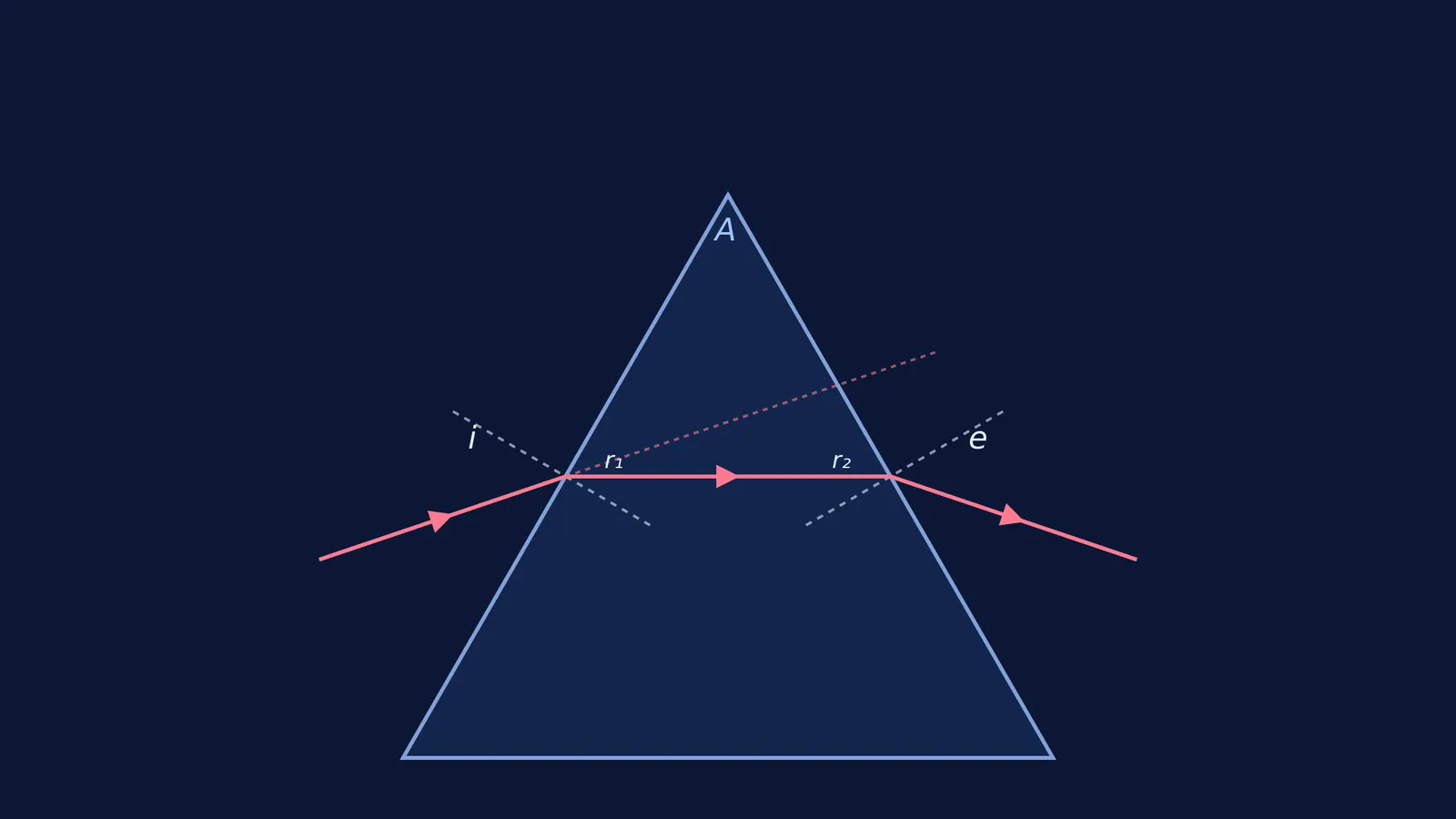
The angle of minimum deviation is the smallest possible angle between the incident ray entering a prism and the emergent ray leaving it. At this specific angle, the light ray passes through the prism perfectly symmetrically (Wikipedia).
When a prism is set to minimum deviation, three things are true:
The angle of incidence (i) is exactly equal to the angle of emergence (e).
The two angles of refraction inside the glass (r₁ and r₂) are equal.
The light ray travelling inside the prism is parallel to the base of the prism (if the prism is isosceles or equilateral).
This symmetry is not just a mathematical curiosity. It is the most stable path for the light, meaning the emergent beam is sharpest and brightest. This is why spectrometers use prisms set at minimum deviation to separate light into clear, distinct colours. (To understand how these colours spread, see our article on dispersion of white light by a glass prism.)
How to use a prism angle of minimum deviation simulation?
You do not need a dark room and a laser to see this happen. A virtual lab, such as the PhET Bending Light simulation, lets you experiment with the geometry directly.
To find the minimum deviation in the simulation:
Drag a triangular prism into the main workspace.
Turn on the laser and point it at the left face of the prism.
Use the protractor tool to measure the angle between the incoming laser beam and the outgoing beam.
Slowly rotate the prism (or the laser). You will see the emergent ray swing in one direction, slow down, stop, and then swing back.
The exact turning point—where the ray stops before reversing its direction—is the angle of minimum deviation.
If you are studying optics and need to build intuition for how light bends, the Fermi Simulation Lab provides interactive simulations for the ideas that are easier to see than to read. You can adjust the material of the prism and immediately watch how the deviation changes.
What is the refractive index of a prism at minimum deviation?
Physicists use the angle of minimum deviation (Dₘ) to calculate the refractive index (n) of the prism material with extremely high precision. They do this using the prism formula:
n = sin((A + Dₘ)/2) / sin(A/2)
Here, A is the apex angle of the prism (usually 60° for an equilateral prism, per Wikipedia). Because both A and Dₘ can be measured directly with a spectrometer, this equation is the standard laboratory method for finding the refractive index of unknown glasses or liquids. If you get stuck on the algebra while solving these equations, the Fermi Problem Library has worked problems with a step-by-step solver that explains the reasoning rather than printing an answer.
A checklist for your prism lab experiment
When you perform this experiment in a physical laboratory, you will measure the deviation for several different incident angles and plot a graph. Here is how to run the practical smoothly:
Pin placement: Place your two source pins well apart. This reduces the angular error when you line them up by eye.
The angle range: Take readings for a wide range of incident angles in regular steps.
Plotting the curve: Your graph of deviation angle vs incident angle should form a smooth U-shape. Do not force a V-shape; the bottom of the curve is rounded.
Finding the minimum: Draw a smooth curve of best fit through your points. The lowest point on this curve gives you your experimental Dₘ.
For a complete breakdown of how to draw and read this graph, read our guide on Deviation vs incidence: the prism i-d graph practical explained. Once you have your minimum deviation from the graph, you can plug it straight into the prism formula to find your glass's refractive index.


