

On this page
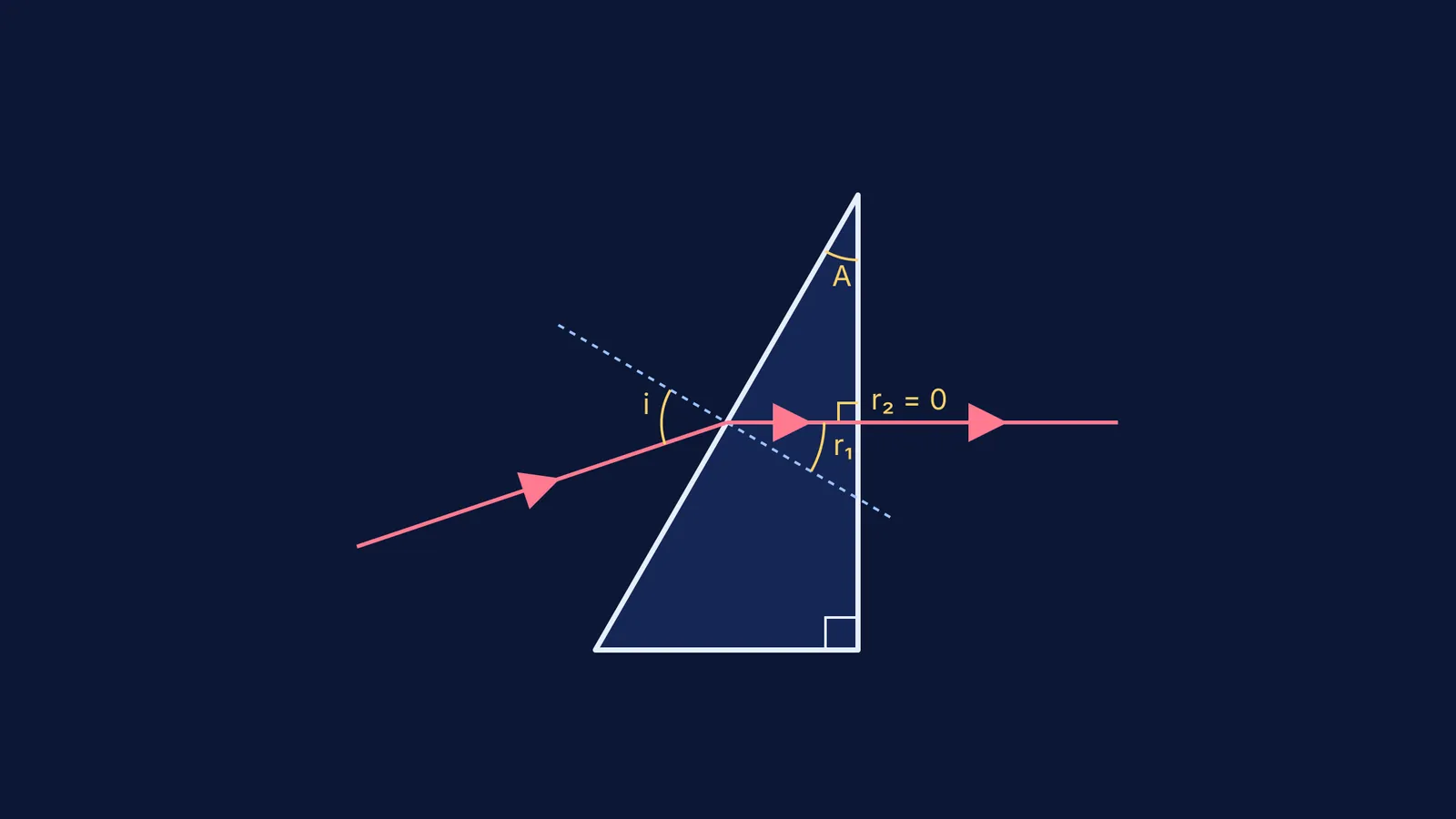
When a light ray passes through a standard glass prism, it bends twice: once when entering the first face, and again when leaving the second. The total angle of the prism (A) is the sum of the two internal angles of refraction (r₁ and r₂).
What does normal emergence mean?
"Normal emergence" means the ray exits the second face precisely along its normal line—at a 90° angle to the surface itself. If light crosses a boundary along the normal, it does not bend. For this to happen, the internal ray must also have hit that second face head-on, meaning the angle of incidence at the second face is zero (r₂ = 0°).
What is the formula for the angle of incidence?
Since the prism formula states that A = r₁ + r₂, setting r₂ to zero simplifies the geometry considerably. It leaves us with:
r₁ = A
The ray must be refracted at the first face to exactly match the angle of the prism. To find the required angle of incidence (i) on the outside, we apply Snell's law at the first boundary. For a prism of refractive index μ sitting in air, the law states that sin i = μ sin r₁. Substituting our condition gives the final formula:
sin i = μ sin A
This equation tells you exactly how to aim a laser to achieve normal emergence. If you know the prism's refractive index and its refracting angle, taking the inverse sine of μ sin A gives you the correct launch angle.
For example, if you have a thin prism with an angle of 4° and a refractive index of 1.5, the angle of incidence is small enough that the sine function is roughly equal to the angle itself in radians. The relation simplifies to i ≈ μ A, meaning the required angle of incidence is simply 1.5 × 4° = 6°.
Once you find the correct angle of incidence, calculating the total deviation of the light ray becomes straightforward. The general formula for the angle of deviation (δ) is δ = i + e - A. Because the emergent ray leaves normally, its angle of emergence is zero (e = 0°). This simplifies the deviation formula to just δ = i - A.
Can a ray emerge normally from any prism?
Can you achieve normal emergence with any prism? The maths reveals a hard limit.
The sine of the incident angle (sin i) can never be greater than 1. This means the right side of our equation is also bound by 1:
μ sin A ≤ 1
sin A ≤ 1/μ
The quantity 1/μ is exactly the sine of the critical angle (C) for the material. Therefore, the condition becomes:
A ≤ C
For normal emergence to be physically possible, the prism angle cannot exceed the critical angle of the glass. If you try it with a prism where A > C, the formula breaks down because the required angle of incidence would be mathematically impossible. In reality, a ray refracting at the first face would hit the second face at an angle greater than the critical angle, causing total internal reflection rather than emerging.
For standard crown glass, with a refractive index of 1.52, the critical angle is 41.1°. You can only achieve normal emergence if the prism angle is 41.1° or less. This means you cannot get normal emergence from an equilateral crown glass prism (A = 60°), because total internal reflection will always trap the light inside.
If you are reviewing the rules for ray tracing or struggling with optical geometry, the Fermi Concept Library covers every concept in physics, giving you a clear foundation before you tackle exam problems.


