On this page
JEE Main Paper 1 gives you 180 minutes for 75 questions, according to the JEE (Main) 2027 Information Bulletin published by the National Testing Agency. That works out to 2.4 minutes a question if you spend time evenly, and you should not. Many lost marks come from the order you attempt questions in and from answers you should have left blank, not from gaps in the syllabus. Here is a three-pass plan built on the official marking scheme.
What is the JEE Main 2027 pattern and marking scheme?
These rules are from the NTA information bulletin for JEE (Main) 2027, also linked from the official JEE Main website:
Mathematics, Physics and Chemistry each have 20 multiple-choice questions in Section A and 5 numerical-value questions in Section B, worth 100 marks per subject and 300 in total.
A correct answer earns +4, an incorrect answer costs −1, and an unanswered question scores 0, in both sections.
Section B answers are integers typed on an on-screen keypad, and the bulletin says the answer should be rounded off to the nearest integer.
If two candidates have the same total NTA score, ties are broken by Mathematics, then Physics, then Chemistry NTA scores, then by who has the lower proportion of incorrect to correct answers.
How does the three-pass JEE Main strategy work?
The splits below are a starting point to test in mocks, not an official rule. The bulletin does let you move between sections and questions at any time, which is what makes passes possible.
Pass 1, about 70 minutes: sure questions. Read each question once. If you see the method within about a minute and can finish in about two, solve it and click Save & Next. If not, use Mark for Review & Next without answering, and move on. Start with your fastest subject.
Pass 2, about 80 minutes: long but known. Open the Question Palette and return to marked questions where you know the method and only need time.
Pass 3, last 30 minutes: decide and check. Decide what to attempt from what is left, then check every Section B entry for units and rounding.
Two screen rules from the bulletin matter in pass 3. Clicking a question number in the palette does not save the answer to the question you were on; Save & Next (or Mark for Review & Next) does. And a question marked for review without an answer is not evaluated, while one answered and marked for review is.
For how often to rehearse this, our guide to how many JEE Main mocks to take a week has plans for different time frames.
When should you leave a question in JEE Main?
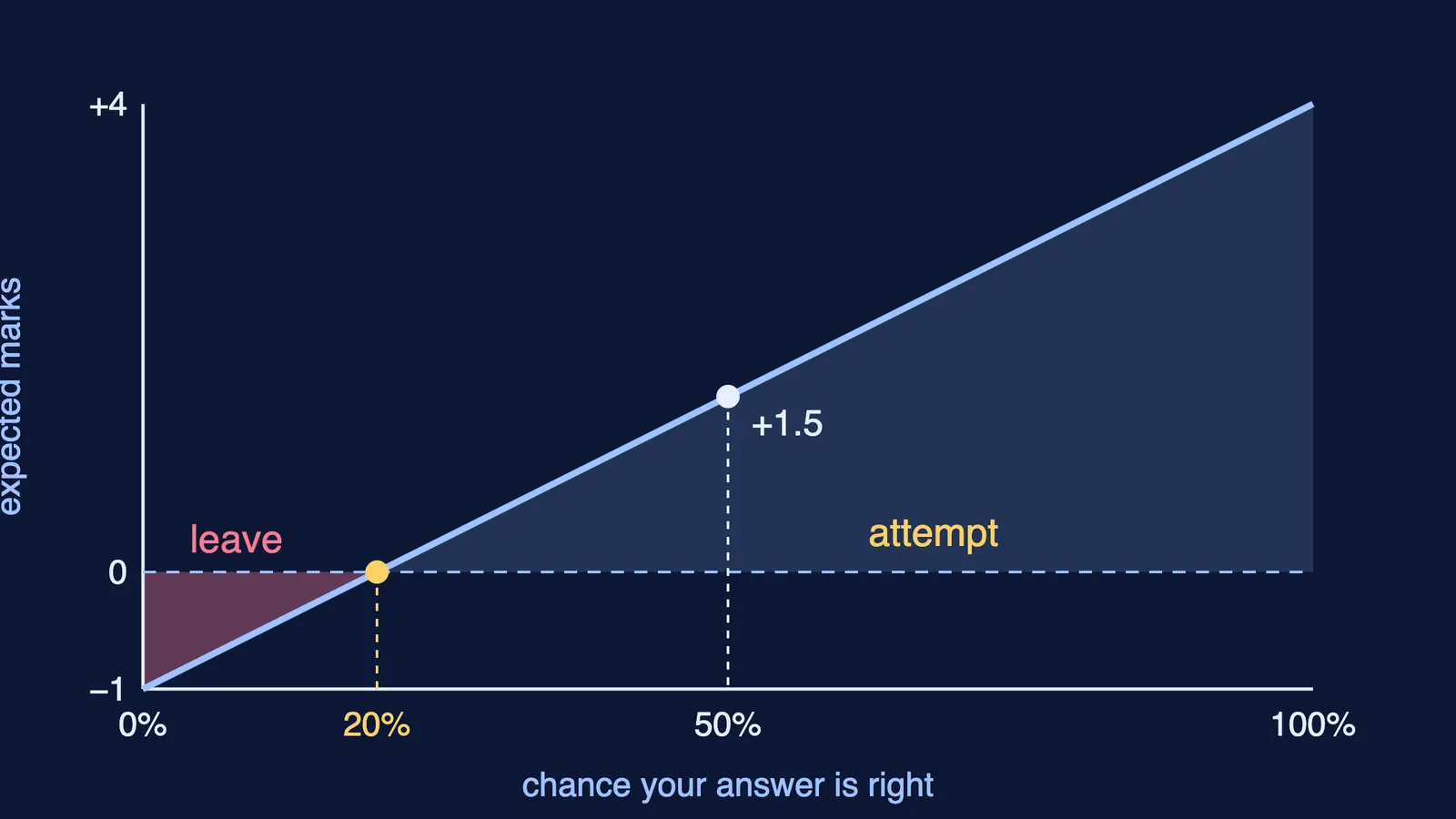
Use the marking scheme in the bulletin: +4 for right, −1 for wrong. If your honest chance of being right is p, your expected marks from attempting are 4p − (1 − p), which is 5p − 1.
That number is above zero only when p is above 20%. Below it, leaving the question blank is worth more on average.
MCQ narrowed to two options: 5 × 0.5 − 1 = +1.5 marks on average. Attempt it.
Numerical you have not worked out: the chance of hitting the exact integer is close to zero. Leave it.
Numerical you set up but doubt one step: run a quick check (units, a limiting case, order of magnitude). If the answer survives, enter it.
Expected value is an average across many questions. On any single question you gain 4 or lose 1, and the tie-break rule above favours candidates with fewer incorrect answers per correct one. For a drill that calibrates your sense of "50-50", read when to guess with negative marking.
A worked example of pass 3: say 30 minutes remain and you have 10 questions left.
4 MCQs where you have ruled out two options each. Attempting all four adds 4 × 1.5 = 6 marks on average.
3 numericals you set up but did not finish. Each finished one is worth +4, so spend most of the remaining time here.
1 numerical you finished but whose sign you doubt. Check it against a limiting case; enter it if it holds.
2 questions you cannot start at all. Leave them until the rest are done.
How do you practise the three passes before the exam?
Run every full mock with the same passes. Note which pass each wrong answer came from. If most pass-3 attempts are wrong, your "two options left" judgment is too confident; tighten it.
If wrong answers in pass 2 come from the wrong method rather than slow arithmetic, the Fermi Problem Library has worked problems with a step-by-step solver that explains the reasoning rather than printing an answer. If pass 1 keeps skipping a whole topic, the gap is usually a concept, and the Fermi Concept Library gives each concept its own lesson.
Close to the exam, fold the passes into a day-by-day plan for the last 30 days before JEE Main, so exam day feels like your tenth run, not your first.