On this page
NTA's public notice for JEE Main 2027 puts Session 1 exams on 20 to 24 and 28 January 2027 and Session 2 in April 2027, with Paper 1 (B.E./B.Tech) lasting 3 hours (NTA public notice, 24 October 2026). If you are aiming for January, the first exam day is about ten weeks away from mid-November. Stacking mocks back to back can feel like progress. It is not always.
Why does analysis time decide how many mocks you take?
A mock does two jobs: it measures you, and it teaches you. Psychologists call the second job the testing effect. In a 2006 study, students who took tests on prose passages remembered substantially more after 2 days and after 1 week than students who restudied the same passages (Roediger and Karpicke, Psychological Science). A 2017 meta-analysis found practice tests more beneficial for learning than restudying and every other comparison condition it examined (Adesope, Trevisan and Sundararajan, Review of Educational Research).
The catch is feedback. In a study of multiple-choice tests, feedback raised the share of correct answers on a later test and reduced the wrong options students carried forward, compared with no feedback (Butler and Roediger, Memory and Cognition, 2008). JEE Main Section A is multiple choice, and there is negative marking in both sections (NTA public notice). A mock you never review can leave a wrong answer or method in place.
So size your mocks to your analysis, not the other way round.
How many mock tests per week for JEE Main?
There is no official number. Use this rule of thumb instead: one full mock costs one mock cycle, and a cycle has three parts.
The paper: 3 hours and 75 questions for Paper 1, timed like the real one (NTA public notice).
The analysis: sort every wrong, skipped and slow question by cause. Budget about as long as the paper itself. Our guide on how to analyse a JEE mock test walks through the sorting.
The fix: practice aimed at what the analysis found, done before the next paper.
The number of mocks you can take in a week is the number of full cycles you can finish. If the last analysis is half done, the next mock waits.
A worked example: say you have about 35 hours of self-study in a week, outside school or coaching. A cycle is roughly 3 hours of paper, 3 of analysis and 3 of fix practice, so about 9 hours. One mock a week takes about a quarter of your time and leaves plenty for new chapters. Three mocks a week take about 27 hours, which only works once the syllabus is finished.
What should your week look like before JEE Main?
These plans are starting points, not rules. Sit each mock in an NTA shift window, 9 am to 12 noon or 3 pm to 6 pm, so you practise being sharp at the right time (NTA public notice). Take some papers on NTA's official mock tests so the computer-based interface feels familiar.
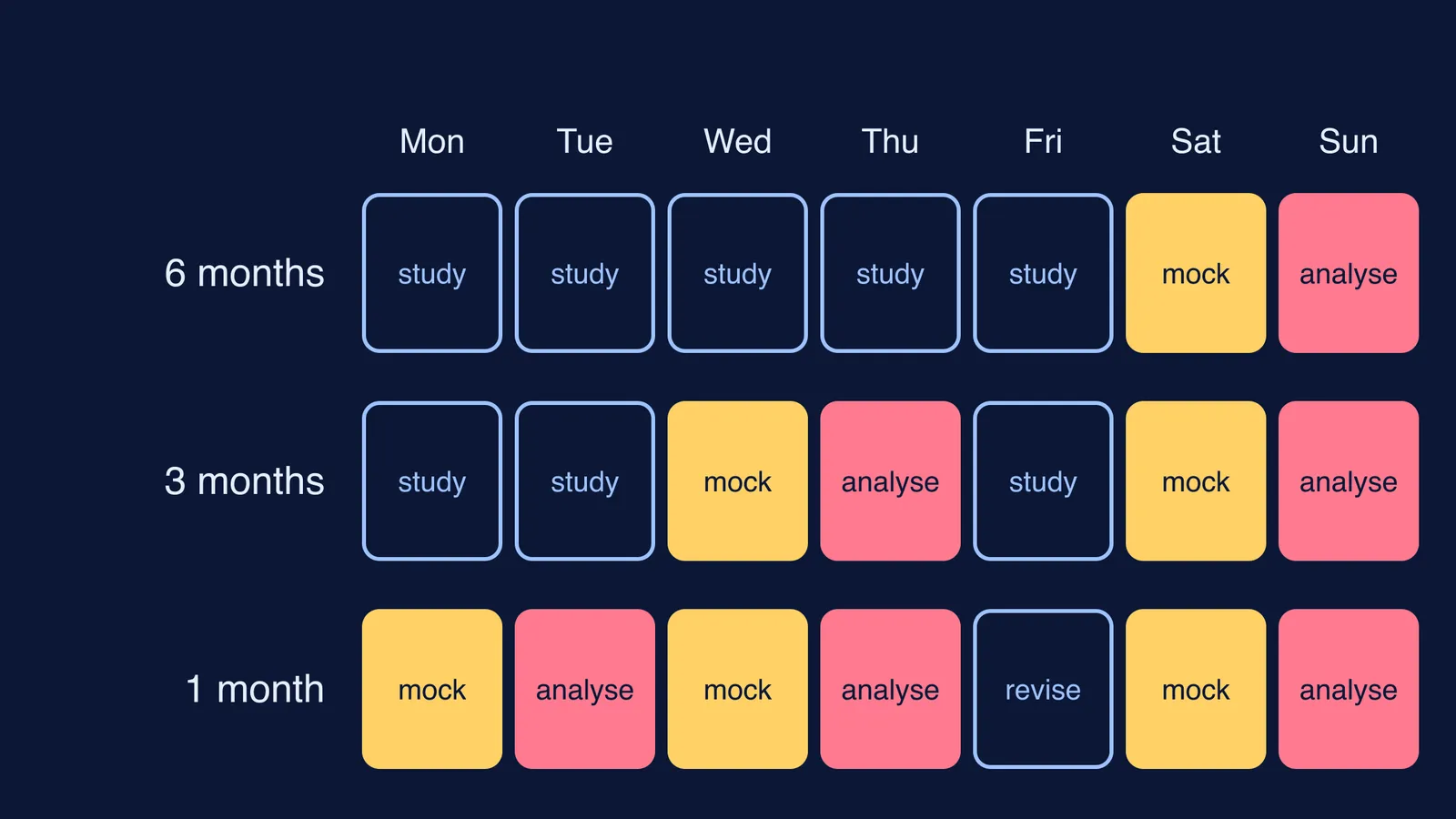
Six months before: one mock a week, at most.
Monday to Friday: syllabus, chapter tests and topic-wise problems.
Saturday: full mock, 9 am to 12 noon.
Sunday: analysis in the morning, fix practice in the afternoon.
If finishing chapters is still the bigger job, one mock every two weeks is fine.
Three months before: two mocks a week.
Monday, Tuesday and Friday: syllabus gaps and revision.
Wednesday: full mock. Thursday: analysis and fix.
Saturday: full mock. Sunday: analysis and fix.
One month before: three mocks a week, never two in a row.
Monday, Wednesday and Saturday: full mocks in your likely shift.
Tuesday, Thursday and Sunday: analysis and fix.
Friday: light revision of formulas and your error log.
Even in the last month, every mock day is followed by an analysis day. Two papers back to back give you two scores and less time to learn from either.
When should you take fewer mocks?
Your score has stayed flat across several mocks. That often means the same mistakes are repeating; read why JEE aspirants plateau before adding papers.
Your error log shows the same entries week after week.
You skip analysis because you are tired.
You cut sleep to fit papers in.
When analysis keeps turning up a wrong method, work similar problems slowly in the Fermi Problem Library, where a step-by-step solver explains the reasoning rather than printing an answer. When the cause is a concept you never quite understood, the Fermi Concept Library gives each concept its own lesson.
What can parents ask after a mock?
Skip "What did you score?" and try "What did you find, and what will you fix this week?" The score tends to move once the fixes do.
Mock season is hard. If worry or low mood starts affecting sleep, eating or daily life, talk to someone you trust, or call Tele MANAS, the free 24x7 national mental-health helpline, on 14416 (IIT Kanpur counselling service page).
This week, finish analysing your last mock before you book the next one.