On this page
Negative marking turns every unsure question into a small bet. Know the maths and you can decide in the exam hall with a number you measured, not gut feel.
How does negative marking change the maths of guessing?
NEET-UG uses four-option questions with four marks for a correct answer, minus one for a wrong one and zero for a skipped one, according to the NTA Information Bulletin for NEET (UG)-2026. JEE Main uses the same +4 and −1 for both its multiple-choice and numerical-value questions, as set out in the NTA Information Bulletin for JEE (Main) 2027. Check the bulletin for your own year, because patterns change.
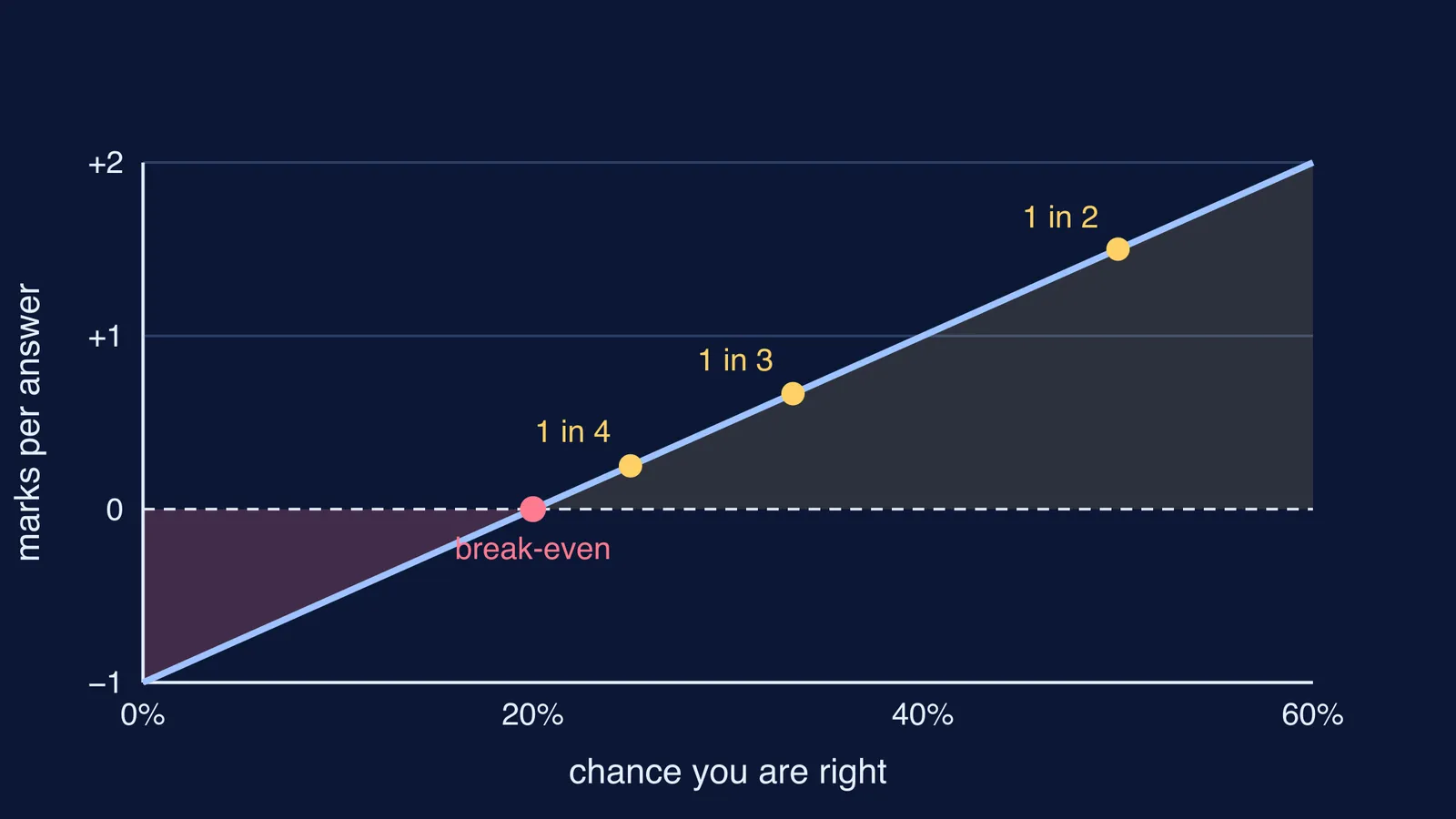
If p is your chance of being right, the expected marks from answering are 4p − 1(1 − p), which simplifies to 5p − 1. That is zero when p is 1 in 5. So under +4/−1 marking, a guess pays off on average only when your chance of being right is above 20%.
On a four-option question, that gives:
Blind guess, all four options alive: 25% chance, about +0.25 marks per question on average.
One option ruled out: 33% chance, about +0.67 marks.
Two options ruled out: 50% chance, +1.5 marks.
Why can a "safe" guess still cost you?
The 25% figure assumes you pick at random among the four options of a NEET-UG question. You rarely do. Wrong options are often written to look right, so if you lean towards the one that feels familiar without a reason, your real hit rate on blind guesses can fall below 20%. The mock drill below measures it.
Numerical-value questions are different. With no options to choose from, the chance of typing the right integer by luck is close to zero, so a guess there is close to a straight −1. The JEE (Main) 2027 bulletin also breaks ties partly in favour of the candidate with a lower proportion of incorrect answers to correct answers, so careless wrong answers can matter even between equal scores.
Skipping too much has a cost too. In a study using practice SAT II history questions, Katherine Baldiga found that when wrong answers were penalised, women answered significantly fewer questions than men despite no difference in knowledge, and that test takers who skipped did worse relative to what they knew (Management Science, 2014).
What is the elimination rule of thumb?
For a four-option paper marked +4/−1, like NEET-UG, use this as your starting rule until your own data says otherwise:
If you can rule out two options for a clear reason, answer.
If you can rule out one option for a clear reason, answer, unless your mocks show your one-out guesses land below 20%.
If you cannot rule out any option, skip, and come back only if time is left.
Never guess a numerical-value answer you have not worked out.
"A clear reason" means something you could say aloud: wrong units, wrong sign, a limiting case that fails, a fact you know is false. For worked examples, see our guide to eliminating options in NEET biology MCQs.
How do you set your own guessing limit in a mock test?
Run this over your next three full mocks.
While solving, tag every answered question: S for sure, E2 for two options ruled out, E1 for one ruled out, B for blind. See marking confidence while you practise.
After each mock, count right and wrong answers for each tag.
Pool the three mocks so each tag has enough questions.
Work out accuracy per tag. Keep the tags above 20%, the break-even under JEE Main and NEET-UG marking; drop the tags below it.
A made-up example shows the arithmetic. Over three mocks, a student had 24 E2 answers with 13 right: 13 × 4 − 11 = +41 marks, 54% accuracy, keep. They had 18 E1 answers with 5 right: 20 − 13 = +7 marks, 28% accuracy, keep but watch it. They had 10 B answers with 1 right: 4 − 9 = −5 marks, 10% accuracy, stop guessing blind.
If one tag sits close to 20%, test a change for a mock or two rather than switching rules on exam day. Our post on trying different attempt strategies in mocks shows how to compare them fairly.
What do your guesses say about what to study?
Look at where your E1 and B tags cluster. If they keep landing in the same chapter, the problem is the concept, not the guessing. The Fermi Concept Library gives every concept in physics, chemistry, biology and mathematics its own lesson. If you knew the idea but chose the wrong method, the Fermi Problem Library has a step-by-step solver that explains the reasoning rather than printing an answer.
Parents can help by asking about the tags, not the total. "Which kind of guess paid off this week?" is a calmer question than "Why did your score drop?"