

On this page
A score tells you how many questions you got right. It does not tell you which of those you actually knew. If you were torn between two options in a rotational-motion question and picked the right one, the answer key gives you a tick and you move on. In the exam, the same coin toss can land the other way.
Confidence marks close that gap. They add only a moment per question and turn one column of ticks and crosses into groups that each need a different next step.
Why mark confidence on practice questions at all?
The first reason is lucky right answers. In a 2008 study by Andrew Butler, Jeffrey Karpicke and Henry Roediger, people took a general-knowledge multiple-choice test and rated their confidence after each answer. Feedback doubled the retention of correct low-confidence responses, compared with no feedback (abstract). Put simply, a right answer you were unsure of, and never reviewed, is easy to lose.
The second is confident mistakes. The hypercorrection effect is the finding that errors committed with high confidence are corrected more readily than low-confidence errors once the right answer is shown (Butterfield and Metcalfe, 2001). Janet Metcalfe's 2017 review of learning from errors adds that corrective feedback, including analysis of the reasoning that led to the mistake, is crucial.
How do you mark confidence while solving?
Mark before you check. Write S, U or G beside the question number the moment you commit to an answer. Once you have seen the key, honest ratings are impossible.
Use three levels only. Sure means you would bet on it. Unsure means you narrowed it down but could be wrong. Guess means you picked with little or no working.
Do not deliberate. If you cannot decide between two letters, write the less confident one.
Keep doing it in full mocks. The tags show whether your guesses tend to pay off, which matters for when to guess under negative marking.
Which wrong answers should you fix first?
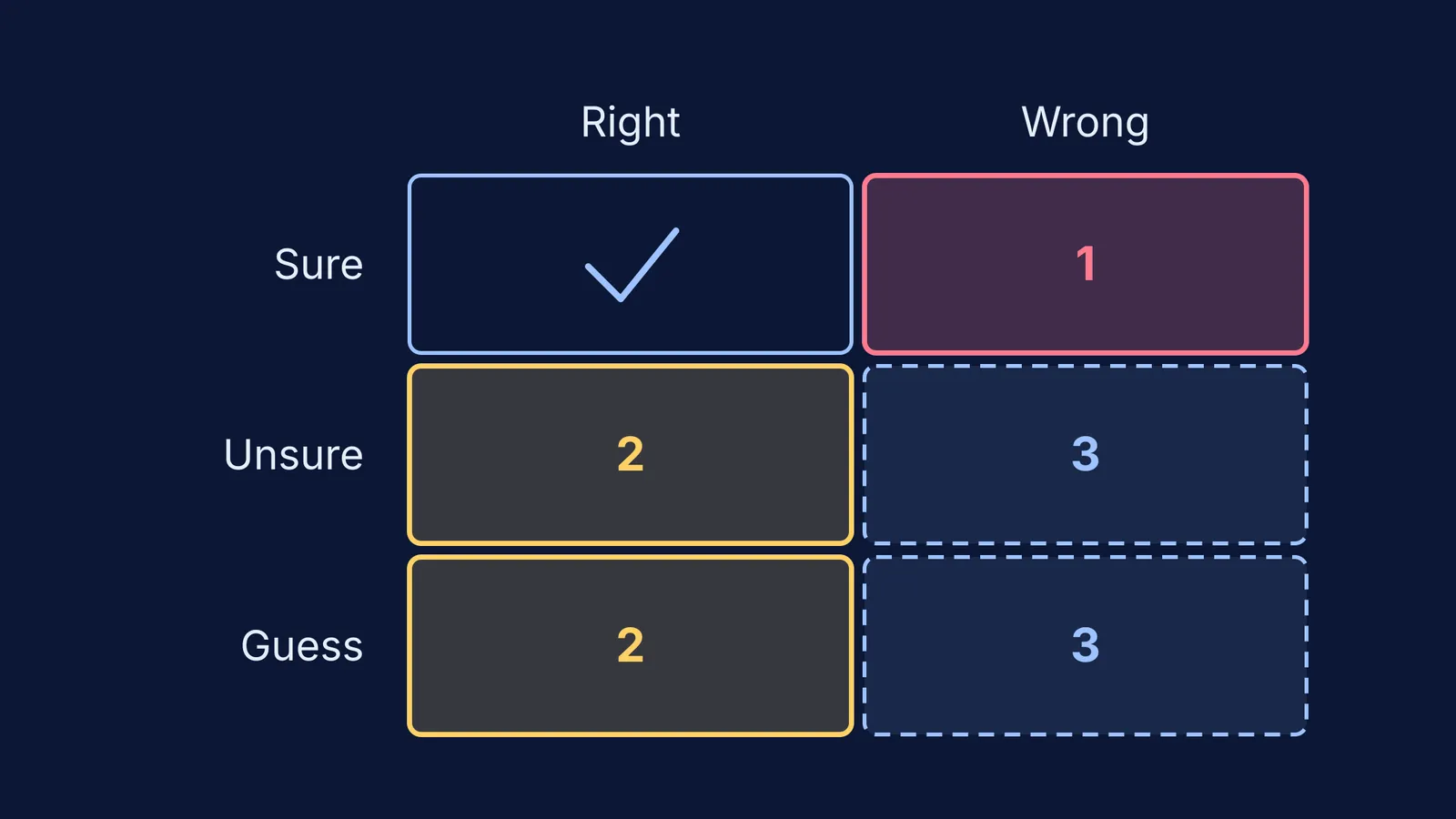
After checking, sort every question into one of four piles:
Sure and wrong: a confident error. Fix first.
Unsure or guess, and right: a lucky right answer. Fix second.
Unsure or guess, and wrong: a known gap. Fix third, usually by going back to the concept.
Sure and right: done. Skip it.
Confident errors go first because they are both a quick win and a risk. A 2011 study by Butler, Fazio and Marsh found the hypercorrection effect still held after a one-week delay, but error correction decreased, and high-confidence errors were more likely than low-confidence ones to come back when the correct answer was forgotten (abstract). So fix them today and test them again a week later.
What does this look like on a real practice set?
Say you finish 30 physics MCQs and score 21. Your tags split the set like this:
Sure and right: 15
Unsure or guess, and right: 6
Sure and wrong: 4
Unsure or guess, and wrong: 5
Your score says 21. Your tags say you can rely on 15. The plan:
Today, the 4 confident errors. Find the exact step where your reasoning broke, for example taking g as positive upward, and write the one-line fix.
Today, the 6 lucky answers. Read each solution and write why the right option beats the one you were torn between.
This week, the 5 gaps. These are usually a concept you have not learned yet, not a slip.
In seven days, redo the 4 confident errors and the 6 lucky answers without looking at the solutions. That one-week gap matches the delay in the Butler, Fazio and Marsh study, where some confident errors came back.
If a confident error comes from the wrong method, the Fermi Problem Library has worked problems with a step-by-step solver that explains the reasoning rather than printing an answer, so you can compare it with yours line by line. For the gaps, the Fermi Concept Library covers every concept in physics, chemistry, biology, mathematics and computing, each with its own lesson.
Over a few weeks, watch your S column. If sure-and-wrong keeps growing, slow down on questions that feel easy. The same sorting works on a full paper; see our guide on how to analyse a mock test.
How can parents help without adding pressure?
Swap one question. Instead of asking what the score was, ask: "How many were sure and wrong, and what did you find?" That makes a confident mistake something to look for, not something to hide, which is the idea behind our post on why mistakes help you learn.
Try it on your next practice set: one letter per question, before you open the key.


