

On this page
Have you ever stared at a difficult physics question for five minutes, only to realise you missed three easy questions at the end of the test? How you navigate an exam paper can be just as important as how well you know the syllabus. When you change how you move through a test, you can often gain points that were previously hidden behind poor pacing.
Running an experiment with your mock exams is the best way to find a strategy that avoids the time trap.
Why do your mock scores get stuck?
Time management is often the culprit behind a stagnant score, and it feeds directly into test anxiety. According to research, between 25 and 40 percent of students experience test anxiety, and highly test-anxious students score about 12 percentile points below their low-anxiety peers (Wikipedia).
When you solve a paper sequentially from start to finish, you risk hitting a tough question early on. This can trigger panic and burn the time you need for questions you could have easily solved. As the clock ticks down, the anxiety spikes, making it even harder to recall simple formulas. If you constantly run out of time or find your mind going blank, you need a different plan for time management in the exam hall.
What is a round-based attempt strategy?
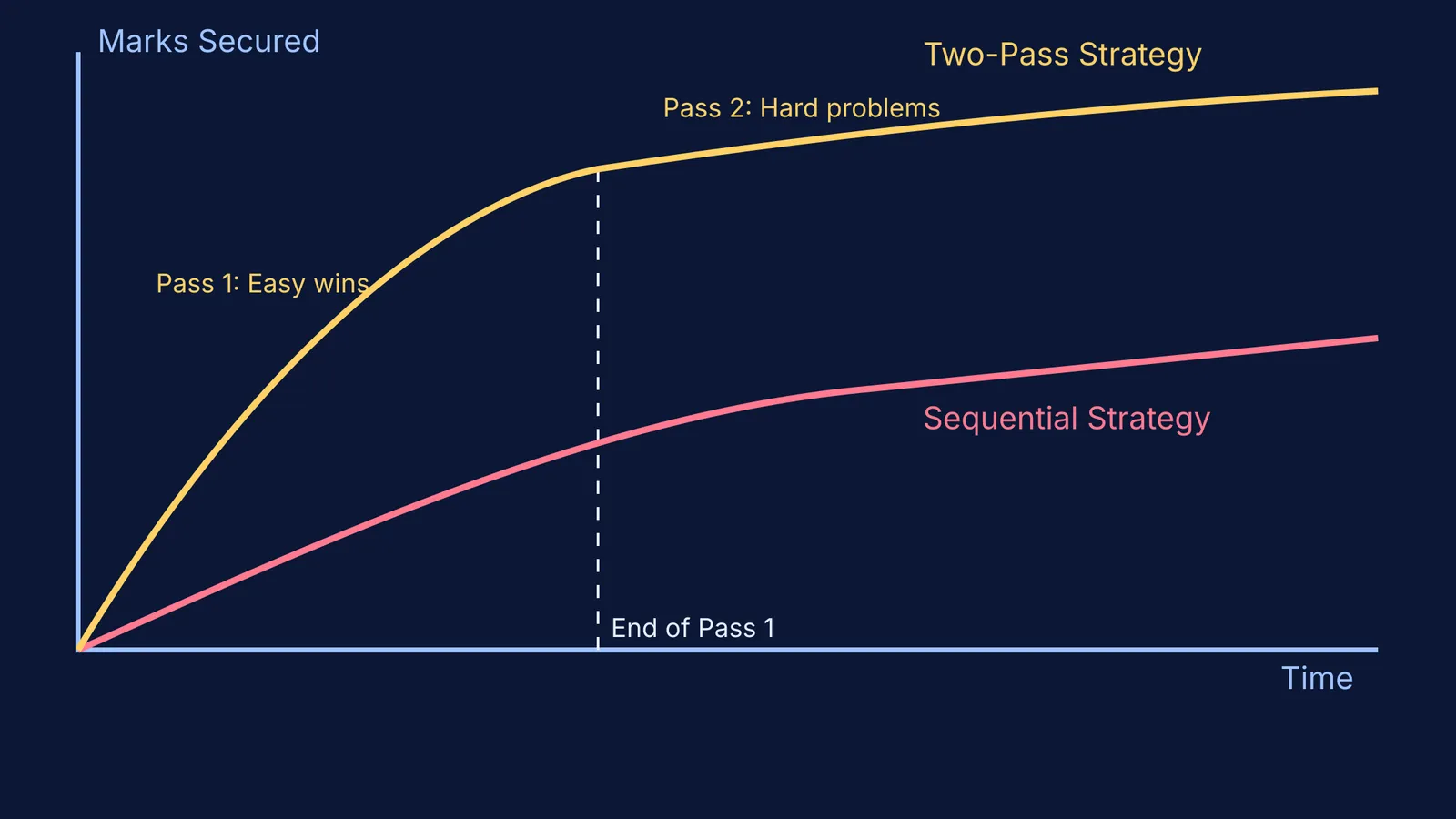
A round-based, or "two-pass", strategy requires you to complete the exam in distinct waves rather than one continuous push.
Pass 1 (Easy wins): You scan the paper and answer only the questions you are certain of and can solve in under a minute. Anything that makes you hesitate, involves a long calculation, or feels unfamiliar is skipped and flagged.
Pass 2 (Heavy lifting): You return to the flagged questions. Because you have already secured the easy marks, you can apply your full focus to these challenging items without the anxiety of a ticking clock.
By the time you finish your first pass, your brain is warmed up and your confidence is stable. If you encountered a knowledge gap during the first pass, you can note it down for later; the Fermi Concept Library covers every concept in physics, chemistry, biology, mathematics and computing to help you patch these holes after the test.
How to test strategies across mocks?
To know if a strategy actually works for you, you must test it methodically. You cannot change your study routine, sleep schedule, and attempt strategy all in the same week and expect to know what caused a score increase.
Baseline: Take a mock exam using your usual, sequential strategy. Note your score, how many questions you had to leave blank at the end, and your general stress level.
Experiment: Take your next mock using a strict two-pass strategy. Keep everything else constant. Enforce a 60-second rule: if you are not making progress in one minute, flag the question and move on.
Review: Compare the results. Did you see all the easy questions? Did your percentile improve? The guide on How to analyse a mock test provides a 60-minute routine for reviewing these metrics.
If you find that specific numericals consistently bogged you down in Pass 2, the Fermi Problem Library has worked problems with a step-by-step solver that explains the reasoning rather than just printing an answer. This helps you figure out exactly where your method went wrong.
Does changing your answer lower your score?
A common fear with the two-pass strategy is the "second-guessing" effect. Students worry that returning to a flagged question will make them change a correct first instinct to a wrong answer.
This fear is largely a psychological illusion. A 2005 study by Kruger, Wirtz, and Miller in the *Journal of Personality and Social Psychology* investigated the "first instinct fallacy" (DOI: 10.1037/0022-3514.88.5.725). They found that while students vividly remember the painful times they changed a right answer to a wrong one, strategic changes made on a second pass actually result in a net gain of points.
Your initial intuition is useful, but the contextual clues and relaxed state of a second pass make it a safe time to adjust your answers. You can prove this to yourself by Using your mock test data to track how many times an answer change actually lost you a mark versus gaining you one.


