On this page
A month can still move your score, but not by opening chapters you have never studied. The last 30 days are for testing yourself, fixing what the tests reveal, and revising so nothing fades. With more time, start with our week-by-week plan for three months before JEE Main.
What should you do in the last 30 days before JEE Main?
Start with the dates. NTA's public notice of 24 October 2026 lists the JEE Main 2027 Session 1 exam on 20, 21, 22, 23, 24 and 28 January 2027, with the exam city announced on 30 December 2026 and admit cards downloadable from 13 January 2027.
Paper 1 (B.E./B.Tech) is a 3-hour computer-based test, held in a 9 AM to 12 noon or a 3 PM to 6 PM shift, according to the same notice. Each subject has 20 multiple-choice questions in Section A and 5 numerical-answer questions in Section B, 75 questions in all, with negative marking in both sections.
Your own date comes later from NTA; until then, call 20 January Day 30 and count back to Day 1.
How should you split the 30 days?
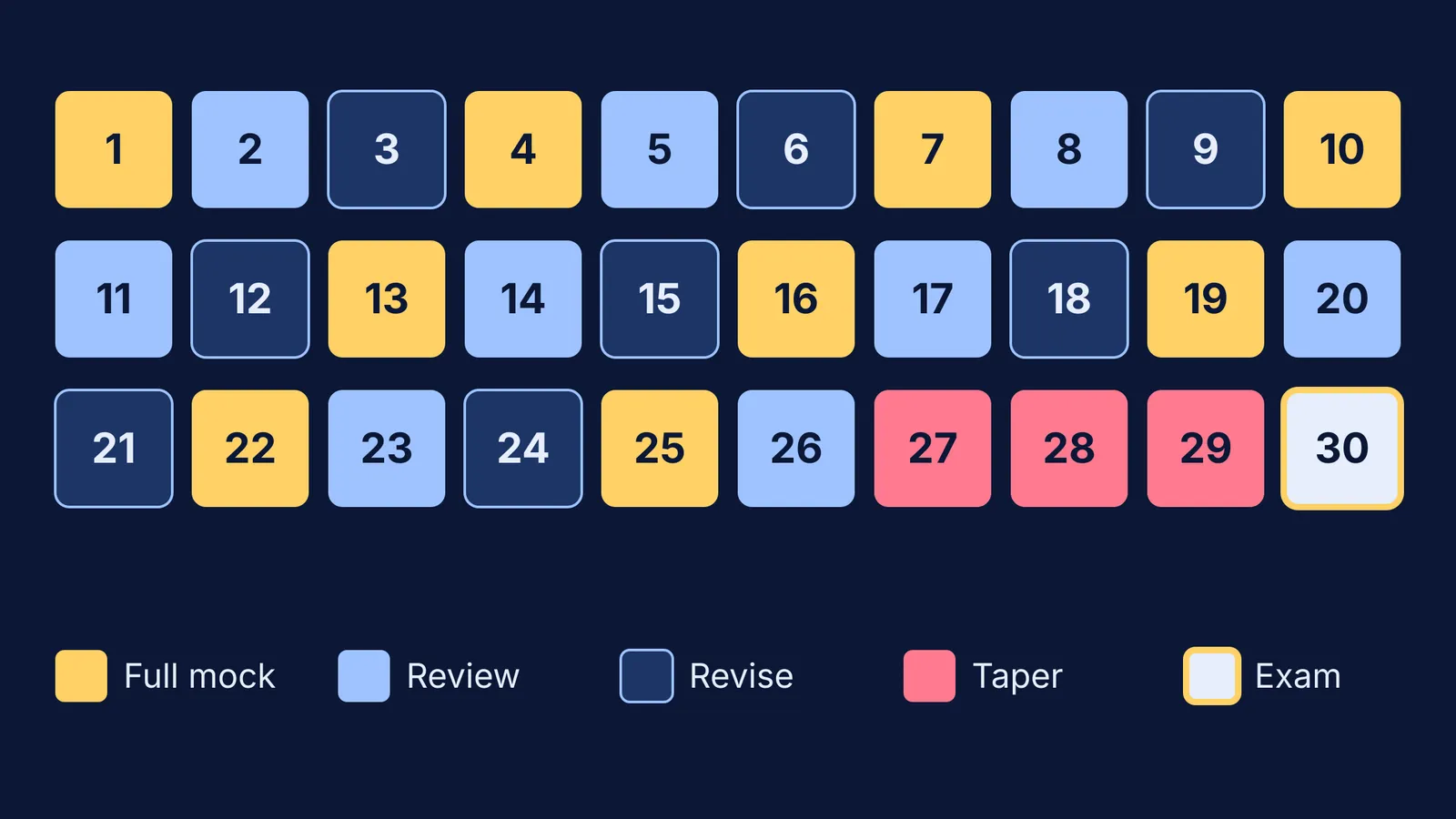
Use a three-day cycle: mock, review, revise. In a 2006 study by Henry Roediger and Jeffrey Karpicke, students who took recall tests remembered more of a passage after 2 days and after 1 week than students who restudied it, even though restudying made them feel more confident.
A review of 317 experiments by Nicholas Cepeda and colleagues found that spacing practice out beats massing it together, and that the best gap between sessions grows the longer you need to remember.
The plan:
Day 1: a full 3-hour baseline mock.
Day 2: review it and sort every chapter into three lists (next section).
Day 3: first revision day.
Days 4 to 24: repeat the cycle, with mocks on Days 4, 7, 10, 13, 16, 19 and 22.
Day 25: last full mock. Day 26: review it.
Days 27 to 29: taper.
Day 30: the exam.
That is nine full mocks. On review days, use our 60-minute mock test review routine.
How do you triage weak topics with a month left?
On Day 2, put every chapter into one of three lists:
Fix: you lose marks here, and one or two focused sessions would close the gap (a formula you mix up, a question type you avoid).
Maintain: you mostly score here. Revise it, but do not spend fix time on it.
Let go: you would have to learn it from scratch. Skip it this month and protect the marks you already have.
A worked example: a hypothetical student, Riya, loses marks in rotational motion (wrong sign on torque), definite integrals (half-remembered properties) and coordination compounds (never studied). The first two go on Fix, coordination compounds on Let go, and mole concept, where she scored, on Maintain.
Update the lists on every review day. A chapter leaves Fix when you get its questions right in consecutive mocks.
When the error is a wrong method rather than a slip, work similar questions in the Fermi Problem Library, where a step-by-step solver explains the reasoning rather than printing an answer. If the gap is the idea itself, the Fermi Concept Library has a lesson for each concept in physics, chemistry and mathematics.
What does a revision day look like?
Use three blocks with breaks between them:
Fix block: one Fix-list chapter. Read the concept, close the book, then solve a timed set on it.
Spaced block: redo the questions you got wrong three days and a week ago, from your error log, before looking at solutions.
Recall block: write one subject's formulas from memory, then check against your notes.
From Day 13, shift the balance towards Spaced and Recall, so everything you fixed early is revisited before the exam.
What should the final week before JEE Main look like?
Stop adding. No full mocks after Day 25, and no new chapters at all.
Sleep: the American Academy of Sleep Medicine recommends 8 to 10 hours per 24 hours for teenagers aged 13 to 18. Set your wake-up time so you are alert when your shift starts. Our piece on why sleep before an exam beats an all-nighter explains the research.
Days 27 to 29: short timed sets in the morning, error log and formulas in the afternoon.
Paperwork: download your admit card when it is out (13 January 2027 in NTA's notice), read its instructions, and check the centre address and reporting time.
Day 29: pack everything the admit card asks for, then stop studying by early evening.
For parents, the most useful line this week is short: "You have done the work. What time do you want to leave tomorrow?"
If stress stops you sleeping or eating, talk to someone you trust. Tele MANAS, the government's tele-mental health service, offers 24x7 counselling on the toll-free number 14416, according to the Press Information Bureau.
Tonight, count back 30 days from your exam date (20 January until NTA gives you yours) and book your baseline mock for Day 1.