

On this page
NTA's public notice of 24 October 2026 lists the JEE Main Session 1 exam dates as 20, 21, 22, 23, 24 and 28 January 2027, with Session 2 in April 2027. From early November, that leaves about 11 weeks. Online applications for Session 1 close on 22 November 2026, so do that first; our post on JEE Main 2027 Session 1 registration has the steps.
Is three months enough for JEE Main?
It is enough to improve a lot, not to start from zero. According to the same NTA notice, Paper 1 is a 3-hour computer-based test with 75 questions: 25 each in mathematics, physics and chemistry, of which 20 are multiple-choice and 5 need a numerical answer. Wrong answers in both sections carry negative marks.
Research supports moving toward tests. A 2013 review of ten study techniques by Dunlosky and colleagues rated only two as high utility: practice testing and distributed practice. In two 2006 experiments by Roediger and Karpicke, students who took recall tests remembered more on tests two days or a week later than students who restudied, even though restudying made them feel more confident.
Which half-done chapters should you finish first?
List your half-done chapters and ask three questions of each:
Does it come up regularly in past JEE Main papers? Our guide to using chapter weightage in JEE Main preparation shows how to check this from past papers.
Can you reach the point of attempting a standard past-year question within a day or so of focused work?
Do other chapters depend on it?
Three yes answers: finish it in November. One or two: learn the core idea and the question types that keep returning, then stop. None: park it until after Session 1.
A worked example: say your half-done chapters are definite integration, electrochemistry and rotational motion, and your own past-paper count shows all three turning up most years. Definite integration needs a day and feeds area under curves: finish it. Electrochemistry needs a day: finish the numericals. Rotational motion would take more than a week, so learn torque, moment of inertia of standard bodies and rolling, and stop there.
If you are stuck on why a method works, the Fermi Concept Library covers every concept in physics, chemistry, biology, mathematics and computing, each with its own lesson, so you can close that one gap and get back to questions.
When should you switch to full mock tests?
Start now, and shift gradually. In a 2015 classroom study of 126 seventh-graders, mixed (interleaved) maths practice beat practice grouped by topic on tests given 1 and 30 days later. A full mock mixes topics by design.
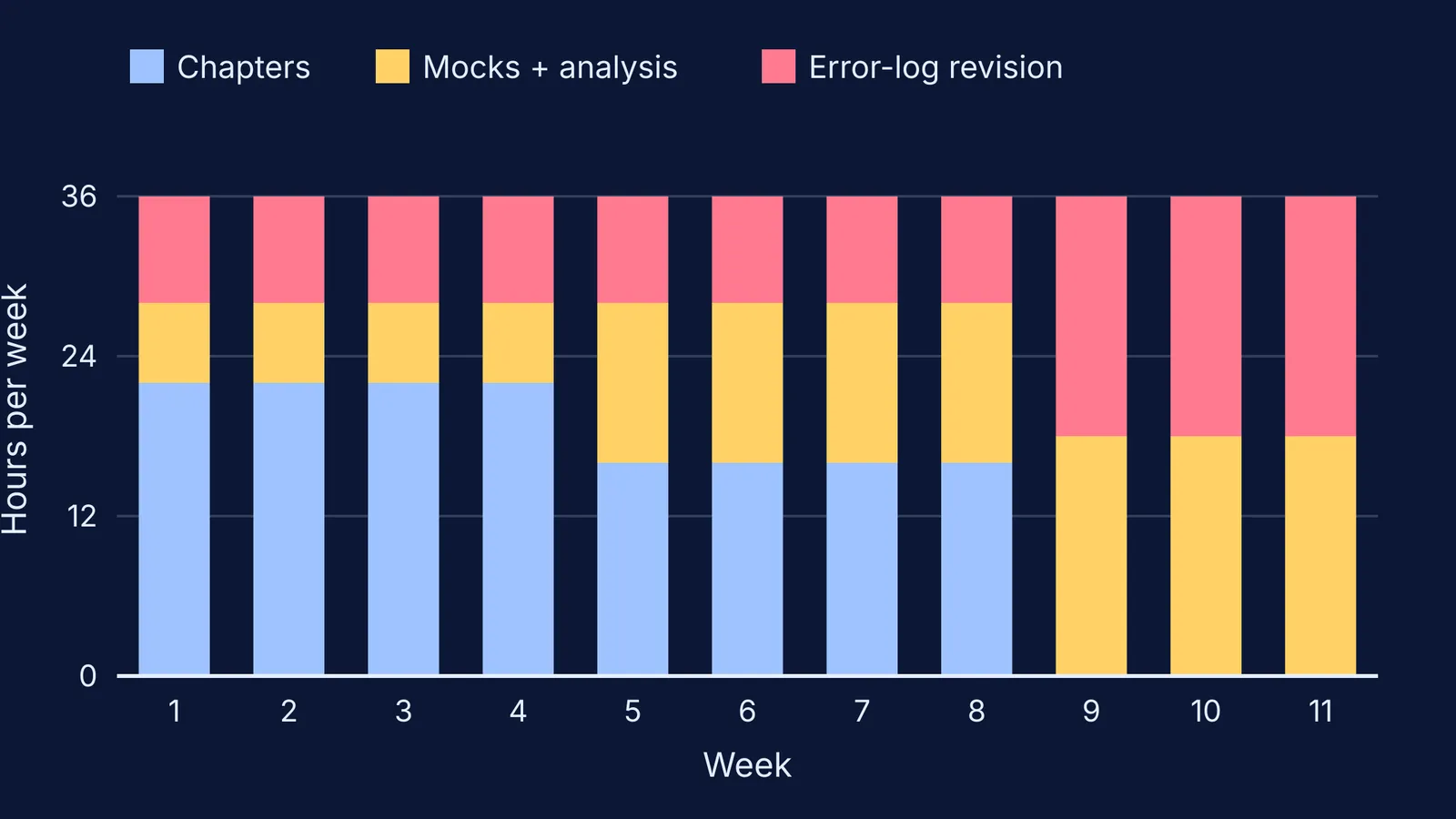
Weeks 1 to 4 (November): one full mock a week; most hours still go to chapters.
Weeks 5 to 8 (December): two mocks a week; chapter work shrinks.
Weeks 9 to 11 (January): three mocks a week, no new chapters, the rest on your error log.
Take some on the official interface; our guide to NTA's official mock tests for JEE Main explains how.
How do you analyse a JEE Main mock?
Give the analysis as long as the mock itself. For every question you got wrong, skipped or guessed, write one line in an error log and tag it:
Concept gap: you did not know the idea.
Wrong method: you knew the topic but chose the wrong approach.
Slip: arithmetic, sign or unit.
Misread: you answered a different question from the one asked.
Time: you ran out, or stayed stuck too long.
Risky guess: you lost marks to negative marking.
Redo each logged question a few days later without the solution, and count the tags every Sunday. If wrong method is your biggest pile, the Fermi Problem Library has worked problems with a step-by-step solver that explains the reasoning rather than printing an answer, so you can see where your approach went off. Time and risky-guess tags are fixed by changing how you sit the paper, not by more chapters.
What does a good week look like?
Sit each mock at your shift time: the NTA notice sets 9:00 am to 12:00 noon and 3:00 pm to 6:00 pm. For weeks 5 to 8, a 36-hour week might hold 12 hours for two mocks with analysis, 16 hours of chapter work and 8 hours of error-log revision.
Sunday: full mock, analysis after lunch.
Monday to Thursday: one half-done chapter, then 30 minutes redoing error-log questions.
Friday: a timed mixed set of past-year questions, formula sheets, an early night.
Saturday: second full mock and its analysis.
In weeks 1 to 4, Saturday's mock becomes chapter time. In weeks 9 to 11, chapter time becomes a third mock and more error-log work.
Parents can help most by protecting the mock slots: a quiet house and no questions about the score that evening. If pressure affects sleep, eating or mood for more than a few days, talk to a doctor or counsellor; Tele MANAS, the government's toll-free mental health helpline, is on 14416.
Pick your half-done chapters tonight, book Sunday's mock, and let the error log decide the rest.


