

On this page
Every exam season, coaching spreadsheets classify chapters in the National Testing Agency syllabus into high-yield and low-yield categories. These lists promise a shortcut: master a few prominent chapters to secure most of your marks. Yet students are routinely caught off guard when a supposedly minor topic appears across several questions.
The reason is simple: the National Testing Agency publishes only a syllabus and test structure in its official bulletin, never a prescribed chapter-wise marks distribution. Published weightage lists are retrospective averages calculated by tutors looking at past shifts.
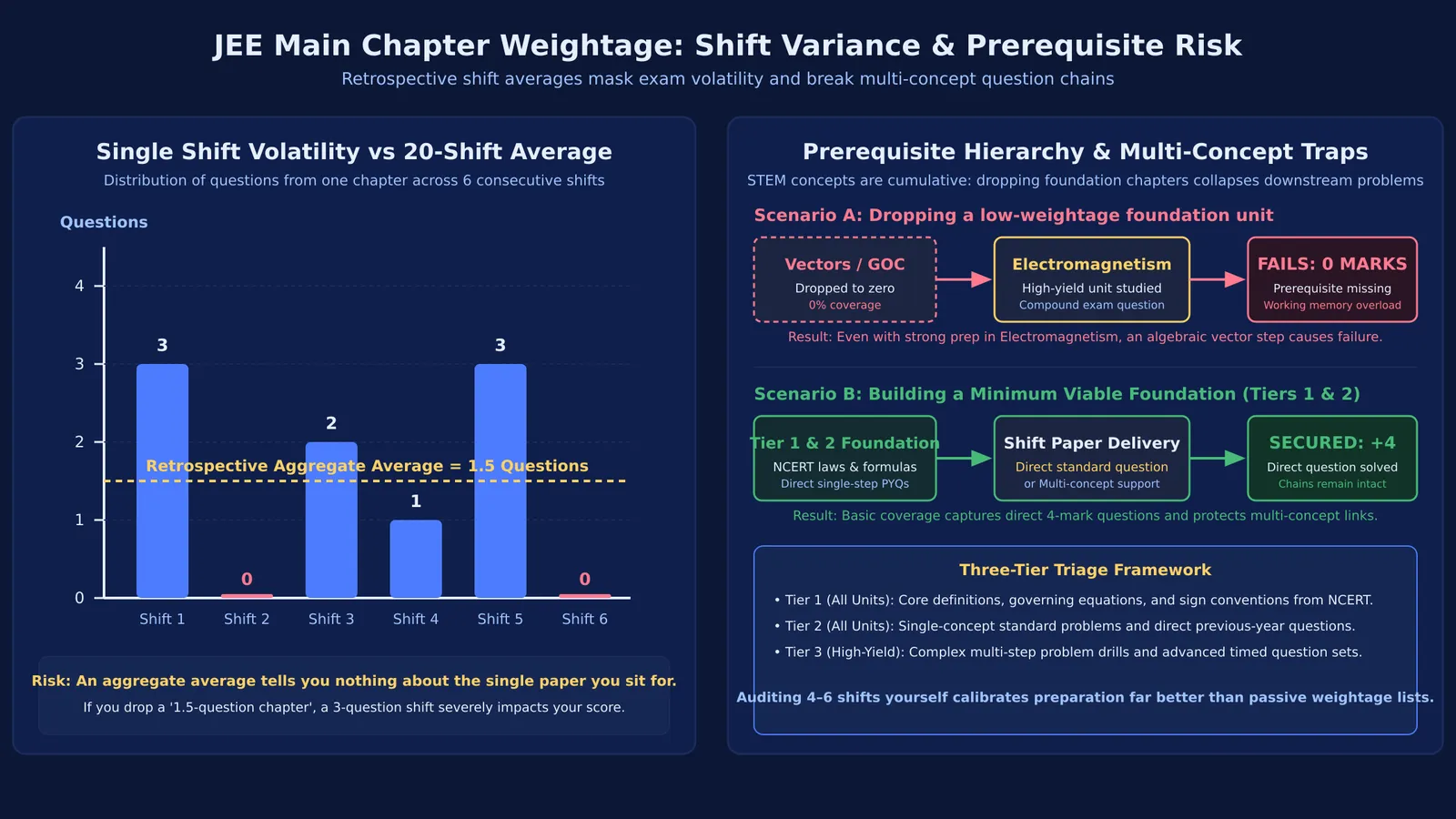
Because JEE Main spans multiple shifts across two sessions, questions rotate continually. Across 20 or more shifts, a chapter might average 1.5 questions. However, an individual student writes exactly one paper. In any single shift, random sampling means an average of 1.5 questions can easily appear 3 times or 0 times. If you wager your preparation on an aggregate average, a single shift can dismantle your plan.
Furthermore, the National Testing Agency discontinued optional questions in Section B starting from the 2025 cycle. Candidates must now attempt all 5 numerical questions per subject alongside 20 multiple-choice questions—75 questions in total with negative marking. You can no longer use Section B choices to bypass entire topics. When feeling behind on the syllabus, triaging your JEE backlog by conceptual structure works far better than gambling on unofficial weightage charts.
What happens when you skip an entire unit?
The most dangerous trap of chapter weightage is the urge to drop chapters down to zero. Students often look at a demanding topic like Rotational Motion or Ionic Equilibrium, notice it carries modest average weightage, and abandon it completely.
This strategy backfires because STEM subjects are cumulative hierarchies, not isolated silos. In a landmark 1962 study in *Psychological Review*, educational psychologist Robert M. Gagné demonstrated that mastering complex problem-solving requires a sequence of subordinate capabilities. If foundational prerequisites are missing, higher-order execution fails.
Cognitive load research by John Sweller in *Cognitive Science* explains the mechanism: working memory can process only limited novel information at once. Problem-solving relies on schemas in long-term memory. When an underlying prerequisite schema is absent, compound problems trigger immediate working memory overload.
When you need to diagnose prerequisite gaps without re-reading entire textbooks, the Fermi Concept Library covers every concept in physics, chemistry, biology, mathematics and computing, each with its own lesson and its place in the map.
In JEE Main, skipping chapters causes two specific failures:
Foundational prerequisites: Skipping Vectors or Work-Energy undermines Electrostatics and Magnetism. In Chemistry, abandoning General Organic Chemistry makes reaction mechanisms impossible to deduce. In Mathematics, ignoring Sequences and Series damages your ability to evaluate Definite Integrals and Limits.
Multi-concept questions: NTA test-setters regularly combine two chapters—such as simple harmonic oscillations in a magnetic field, or differential equations solved with matrix properties. Zeroing out one unit turns an accessible 4-mark question into an automatic loss.
How can you conduct your own past-paper audit?
Instead of consuming passive infographics, conduct your own past-paper audit across 4 to 6 recent official shift papers. A comprehensive review by John Dunlosky and colleagues in *Psychological Science in the Public Interest* showed that practice testing yields the highest utility for long-term retention and diagnostic calibration. Cognitive scientists Henry L. Roediger III and Jeffrey D. Karpicke similarly found that retrieving knowledge under test conditions strengthens memory far more than passive re-reading.
You can learn more about working through previous-year papers without memorising answers by turning each test into an active diagnosis. Analyzing shift variations also clarifies why many aspirants plateau when they restrict their practice to isolated, single-chapter problem sets.
To run your audit:
Gather 4 to 6 recent shift papers. Download official papers from the NTA portal rather than simulated mock tests.
Tag each question by prerequisite depth. Identify whether a question tests an isolated concept (like Units and Dimensions or logic gates) or demands multi-chapter synthesis.
Spot high-efficiency chapters. Identify compact topics that consistently appear with low calculation overhead, such as Modern Physics, Vector Algebra, and Coordination Chemistry.
Separate concept gaps from execution slips. Distinguish between missing prerequisite knowledge and minor algebraic errors.
What is a minimum viable foundation for low-priority chapters?
When exam deadlines leave insufficient time to master every topic in exhaustive depth, the solution is not to drop units completely. Instead, build a minimum viable foundation across every chapter in the NTA syllabus.
A three-tier strategy protects you against shift variance:
Tier 1: Core definitions and governing equations. Spend one or two study sessions mastering fundamental laws, sign conventions, and core formulas directly from Class 11 and 12 NCERT textbooks.
Tier 2: Single-concept standard problems. Solve textbook numericals and direct previous-year questions. Many shift questions are straightforward formula applications designed to test basic syllabus coverage. Reaching Tier 2 secures these direct 4-mark questions.
Tier 3: Multi-step synthesis. Reserve advanced, multi-concept problem drills for your strongest, high-frequency units.
When practicing standard exam problems, the Fermi Problem Library provides worked problems with a step-by-step solver that explains the reasoning rather than printing an answer. If you get stuck mapping out an unfamiliar topic during revision, Fermi's AI tutor can work out what you already know and build a plan for the session so you sit down to a clear next step.


