On this page
If you are revising metallurgy for a Class 12 chemistry exam, "leaching of bauxite" is the question that checks whether you can write three equations in the right order and balance them. Below is each step, why it works, a worked mole example, and one balancing slip that appears in some printed notes. You will often see it searched as the "Baeyer process", but the chemist was Carl Josef Bayer, so the correct spelling is Bayer.
What is leaching of bauxite?
Leaching means dissolving the compound you want out of an ore with a suitable solvent, so the impurities stay behind as solids. Aluminium does not occur naturally as a metal; it is made by refining bauxite to alumina (Al₂O₃) in the Bayer process and then reducing the alumina to metal by electrolysis in the Hall-Héroult process, as the International Aluminium Institute's bauxite residue guidance explains. The same guidance says over 95% of the estimated 134 million tonnes of alumina produced worldwide in 2020 came from the Bayer process.
The trick is that alumina is amphoteric, so it dissolves in hot caustic soda, while iron oxide, the main impurity, does not. The IAI guidance describes this as dissolving alumina selectively as sodium aluminate, "leaving the bulk of other minerals undissolved". That undissolved solid is the red mud.
What are the equations of the Bayer process?
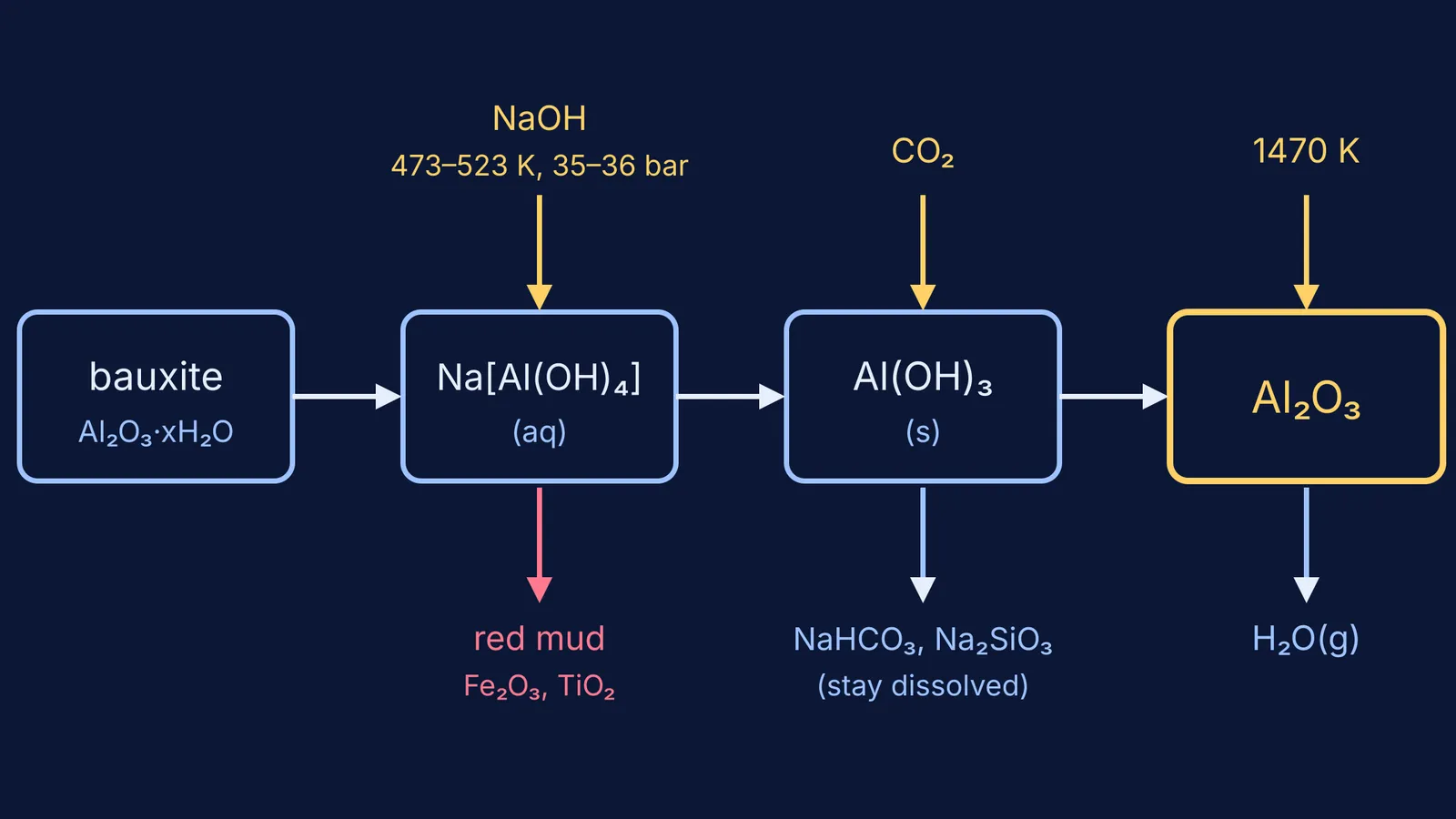
The textbook conditions, reproduced in this Plus Two chemistry summary of the NCERT chapter, are concentrated NaOH at 473–523 K and 35–36 bar pressure.
Digestion (leaching): Al₂O₃(s) + 2NaOH(aq) + 3H₂O(l) → 2NaAl(OH)₄
Side reaction: silica also dissolves, SiO₂(s) + 2NaOH(aq) → Na₂SiO₃(aq) + H₂O(l)
Filtration: the red mud is filtered off and the clear sodium aluminate solution goes on.
Neutralisation with CO₂: NaAl(OH)₄ + CO₂(g) → Al(OH)₃(s) + NaHCO₃(aq), which doubled reads 2Na[Al(OH)₄] + 2CO₂ → Al₂O₃·3H₂O + 2NaHCO₃
Ignition: Al₂O₃·xH₂O(s) → Al₂O₃(s) + xH₂O(g), which for the trihydrate is 2Al(OH)₃ → Al₂O₃ + 3H₂O
In the textbook scheme, sodium silicate stays in solution when the alumina precipitates, which is how silica is separated. The Bayer process article on Wikipedia gives the calcination temperature as about 1470 K (1200 °C).
Why does CO₂ make the alumina precipitate?
CO₂ is an acidic oxide, so it uses up hydroxide ions. The aluminate ion is in balance with aluminium hydroxide: [Al(OH)₄]⁻ ⇌ Al(OH)₃ + OH⁻. Remove OH⁻ and Le Chatelier's principle pushes the balance to the right, so Al(OH)₃ comes out of solution. Adding a few freshly made crystals of hydrated alumina gives the new solid something to grow on.
That second idea is Bayer's own contribution. Carbon dioxide precipitation came from an earlier process by Louis Le Chatelier in 1855, and Bayer found in 1887 that seeding with pure aluminium hydroxide gave a crystalline precipitate that was more economical, according to his Wikipedia biography. Modern refineries mostly rely on cooling and seeding. The IAI guidance shows digestion at 108–280 °C and calcination at about 1000 °C. It also gives a typical average of 1.23 tonnes of red mud for every tonne of alumina produced.
Worked example: following 10.2 g of alumina through every step
Take Al₂O₃ as 102 g/mol, so 10.2 g is 0.100 mol.
NaOH needed: 2 × 0.100 = 0.200 mol, which is 8.00 g.
Sodium aluminate formed: 0.200 mol of Na[Al(OH)₄].
CO₂ needed (NaHCO₃ route): 0.200 mol, which is 8.80 g, or 4.48 L at the old STP of 22.4 L/mol.
Precipitate: 0.200 mol of Al(OH)₃ at 78 g/mol, which is 15.6 g.
Ignition: 15.6 g of Al(OH)₃ gives back 10.2 g of Al₂O₃ and 0.300 mol (5.40 g) of water.
Check: 10.2 + 5.40 = 15.6 g, so the mass balances. The solid loses about 35% of its mass when it is ignited, a handy number to sanity-check a thermal decomposition question.
How do you write this answer in an exam?
Name the reagent and conditions first: concentrated NaOH, 473–523 K, 35–36 bar, as in the NCERT-based notes.
Write the leaching equation with state symbols, then the silica side reaction.
Say what is filtered off (red mud, mainly iron oxide) and what stays in solution.
Write the CO₂ or seeding step, and count C, Na and H before moving on.
End with ignition to pure Al₂O₃, at about 1470 K according to the Wikipedia Bayer process article.
Syllabi change between years, so check the current board or NTA syllabus to see whether metallurgy is listed for your exam. If amphoteric oxides or Le Chatelier's principle feel shaky, the Fermi Concept Library has a lesson for each concept in chemistry and shows its place in the map. If your equations keep coming out unbalanced, the Fermi Problem Library has worked problems with a step-by-step solver that explains the reasoning rather than printing an answer.