On this page
If a question says "neutral" or "faintly alkaline" and you still write Mn²⁺ with an n-factor of 5, every number after that is wrong. The medium decides where manganese stops, and it also changes what the reducing agent becomes.
Why does the medium change the n-factor of KMnO4?
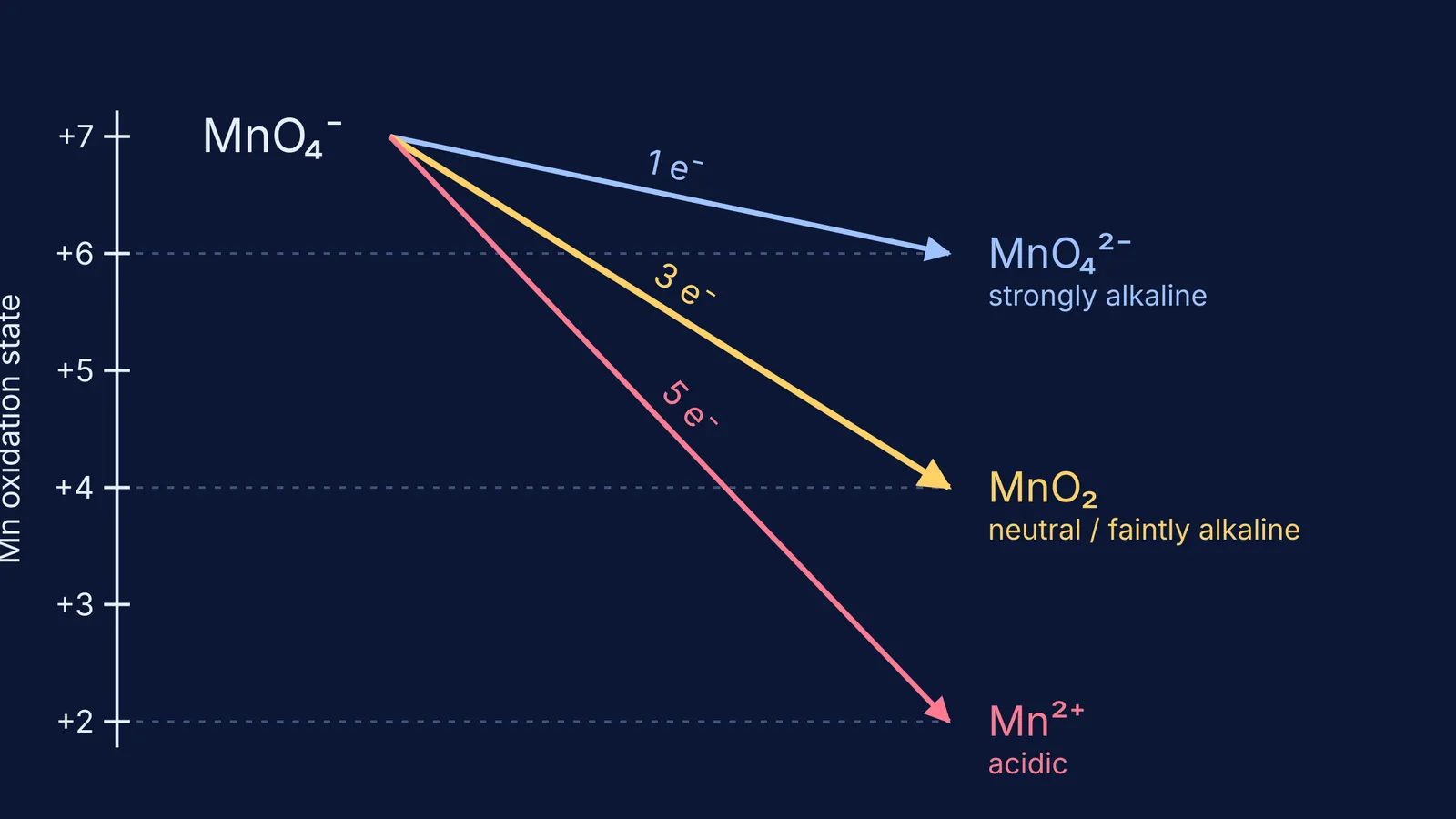
The n-factor of an oxidising agent is the number of electrons one formula unit gains in the reaction. Manganese in permanganate is +7, so the n-factor of KMnO4 is 7 minus the oxidation state of the manganese product.
The NCERT Class 12 chapter on the d- and f-block elements gives three reduction half-reactions for permanganate (NCERT Chemistry Part I, Unit 4):
To manganate: MnO4⁻ + e⁻ → MnO4²⁻, E° = +0.56 V (Mn goes from +7 to +6, so n = 1)
To manganese dioxide: MnO4⁻ + 4H⁺ + 3e⁻ → MnO2 + 2H2O, E° = +1.69 V (+7 to +4, so n = 3)
To manganese(II): MnO4⁻ + 8H⁺ + 5e⁻ → Mn²⁺ + 4H2O, E° = +1.52 V (+7 to +2, so n = 5)
The same chapter says that "the hydrogen ion concentration of the solution plays an important part in influencing the reaction." In acid, permanganate is reduced all the way to pale pink Mn²⁺; in neutral solution it stops at brown MnO2; in strongly alkaline solution it goes only to green manganate, MnO4²⁻ (Wikipedia: Permanganate). Written for neutral solution, the MnO2 half-reaction is 2H2O + MnO4⁻ + 3e⁻ → MnO2 + 4OH⁻, still 3 electrons. More on that in the colours of permanganate, manganate and MnO2.
What does KMnO4 give with iodide, thiosulphate and Mn²⁺ in neutral medium?
NCERT lists three reactions "in neutral or faintly alkaline solutions" (NCERT Chemistry Part I, Unit 4). In each, permanganate becomes MnO2 with an n-factor of 3.
First, iodide goes to iodate, not iodine:
2MnO4⁻ + H2O + I⁻ → 2MnO2 + 2OH⁻ + IO3⁻
Iodine goes from −1 in I⁻ to +5 in IO3⁻, so the n-factor of iodide here is 6. In acid, NCERT gives 10I⁻ + 2MnO4⁻ + 16H⁺ → 2Mn²⁺ + 8H2O + 5I2, where iodide only reaches 0 in I2 and its n-factor is 1.
Second, thiosulphate goes almost completely to sulphate:
8MnO4⁻ + 3S2O3²⁻ + H2O → 8MnO2 + 6SO4²⁻ + 2OH⁻
The average oxidation state of sulphur is +2 in S2O3²⁻ and +6 in SO4²⁻. Each sulphur loses 4 electrons and there are two per ion, so the n-factor of thiosulphate is 8. Do not carry over the iodometry value: with iodine, thiosulphate gives tetrathionate, S4O6²⁻ (Wikipedia: Iodometry), where average sulphur goes only from +2 to +2.5 and the n-factor is 1.
Third, Mn²⁺ and MnO4⁻ meet in the middle:
2MnO4⁻ + 3Mn²⁺ + 2H2O → 5MnO2 + 4H⁺
NCERT notes that zinc sulphate or zinc oxide catalyses this oxidation. Manganese arrives from both sides and lands at +4: permanganate gains 3 electrons (n = 3) and Mn²⁺ loses 2 (n = 2). The 2 : 3 mole ratio is just 2 × 3 = 3 × 2.
How much does the medium change a titration answer?
Take 25.0 mL of 0.100 M KI titrated with 0.0200 M KMnO4. How much KMnO4 is needed in acid, and how much in neutral solution?
Iodide present: 25.0 × 0.100 = 2.50 mmol.
In acid, n(I⁻) = 1, so 2.50 milliequivalents. KMnO4 at n = 5 is 0.100 N. Volume = 2.50 ÷ 0.100 = 25.0 mL.
In neutral solution, n(I⁻) = 6, so 15.0 milliequivalents. KMnO4 at n = 3 is 0.0600 N. Volume = 15.0 ÷ 0.0600 = 250 mL.
Same bottle, same iodide, ten times the volume. The mole ratios agree: 1 MnO4⁻ per 5 I⁻ in acid, but 2 MnO4⁻ per 1 I⁻ in neutral solution.
Now try thiosulphate: 10.0 mL of 0.0500 M Na2S2O3 in neutral solution is 0.0500 × 10.0 × 8 = 4.00 milliequivalents, which needs 4.00 ÷ 0.0600 = 66.7 mL of the same KMnO4. For another case where the n-factor surprises students, see why ferrous oxalate has an n-factor of 3 with KMnO4.
For more practice, the Fermi Problem Library has worked problems with a step-by-step solver that explains the reasoning rather than printing an answer, so you can see where each n-factor came from.
A five-step checklist for KMnO4 questions
Underline the medium: acidic means Mn²⁺, neutral or faintly alkaline means MnO2, strongly alkaline means MnO4²⁻.
Write the n-factor of permanganate: 5, 3 or 1.
Write the reductant's product for that medium: I⁻ gives I2 in acid but IO3⁻ in neutral solution.
Reductant n-factor = change in oxidation state × atoms that change.
Equate milliequivalents and check the electrons balance.
If oxidation states still feel shaky, the Fermi Concept Library covers every concept in chemistry, each with its own lesson. Then read why permanganate is a stronger oxidant than dichromate.