On this page
If you are revising redox for JEE Main or your CBSE boards, one comparison keeps coming back. Acidified potassium permanganate and acidified potassium dichromate are both strong oxidising agents, yet permanganate is stronger, and only permanganate oxidises chloride under standard conditions. The reason is three numbers from the electrochemical series. Once you can read them, you can answer every version of this question.
What does a higher standard electrode potential tell you?
A standard reduction potential (E°) measures how strongly a half-cell pulls electrons towards itself under standard conditions, so the higher the E°, the stronger the oxidising agent on the left of the half-equation.
The standard electrode potential data table lists these three couples in acid solution:
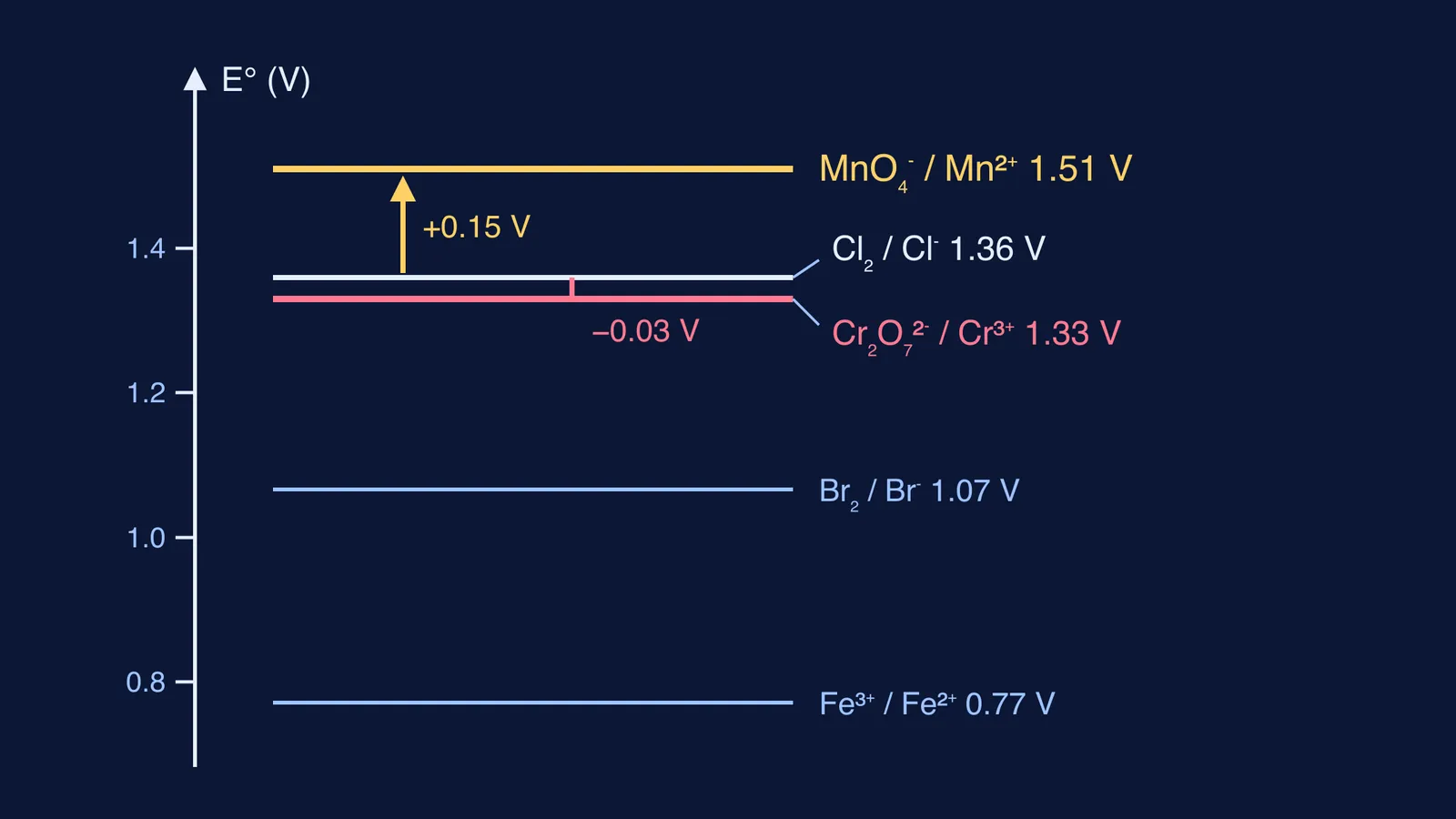
MnO4− + 8H+ + 5e− → Mn2+ + 4H2O, E° = +1.51 V
Cl2 + 2e− → 2Cl−, E° = +1.36 V
Cr2O7 2− + 14H+ + 6e− → 2Cr3+ + 7H2O, E° = +1.33 V
Tables differ slightly in the second decimal place. The Chemistry LibreTexts table of reduction potentials gives 1.36 V for dichromate and 1.396 V for chlorine, but the order is the same: permanganate on top, chlorine in the middle, dichromate just below. In an exam, use the values the question gives you.
Why is permanganate a stronger oxidising agent than dichromate?
Because 1.51 V is higher than 1.33 V, a gap of 0.18 V on the data table. MnO4− has the greater tendency to be reduced, so it can take electrons from species that dichromate cannot.
Watch for a trap. Dichromate accepts 6 electrons per ion and permanganate only 5, so some students conclude that dichromate must be stronger. The number of electrons tells you how much reducing agent one ion can deal with, which is stoichiometry. It does not tell you how hard the ion pulls on each electron. E° is an intensive property: it stays the same when you multiply a half-equation by 2 or 3. Read strength from E°, never from n.
Why does KMnO4 oxidise chloride but dichromate does not?
Treat each pair as a cell. The oxidant's couple is the cathode, the chloride couple is the anode, and E°cell = E°(cathode) − E°(anode). A positive E°cell means the reaction is feasible under standard conditions. With the values from the data table:
Permanganate and chloride: 2MnO4− + 16H+ + 10Cl− → 2Mn2+ + 5Cl2 + 8H2O. E°cell = 1.51 − 1.36 = +0.15 V. Positive, so chloride is oxidised to chlorine gas.
Dichromate and chloride: Cr2O7 2− + 14H+ + 6Cl− → 2Cr3+ + 3Cl2 + 7H2O. E°cell = 1.33 − 1.36 = −0.03 V. Negative, so not feasible under standard conditions.
Now convert to Gibbs energy with ΔG° = −nFE°, using the Faraday constant, 96 485 C mol−1, from NIST. For the permanganate equation n = 10, so ΔG° = −10 × 96 485 × 0.15 ≈ −145 kJ per mole of reaction as written. For dichromate n = 6, so ΔG° = −6 × 96 485 × (−0.03) ≈ +17 kJ, which is uphill.
This matters in the lab. The analytical reference titrations.info warns that in hydrochloric acid, permanganate can oxidise chloride to chlorine and give results that are too high, and that the best results come with sulfuric acid. Its iron(II) titration page adds that Mn2+ is added to lower the permanganate potential until chloride oxidation is impossible, which is the job of the Reinhardt-Zimmermann solution. Dichromate sits below the chlorine couple, and an assay guide to estimating iron with dichromate calls that method preferable to permanganate because HCl is a more common solvent than H2SO4.
How do you answer this question in JEE or board exams?
Use this four-step check for any question of the form "can X oxidise Y?":
Write both reduction half-equations with their E° values.
Make the would-be oxidant the cathode and the species being oxidised the anode.
Compute E°cell = E°(cathode) − E°(anode). Positive means feasible under standard conditions.
State the consequence in one line, for example "so KMnO4 titrations use H2SO4, not HCl".
Try it on Fe2+. The data table lists Fe3+/Fe2+ at 0.771 V, so permanganate gives 1.51 − 0.771 = +0.74 V and dichromate gives 1.33 − 0.771 = +0.56 V. Both oxidise Fe2+, which is why both are used to titrate it.
If you keep reaching for the wrong method on redox numericals, the Fermi Problem Library has worked problems with a step-by-step solver that explains the reasoning rather than printing an answer. If the shaky part is electrode potential itself, the Fermi Concept Library gives each concept its own lesson and its place in the map.
For more practice, read our guide on using the electrochemical series to predict redox reactions, the titration story in why potassium dichromate is a primary standard but KMnO4 is not, and why you add ΔG°, not E°, when combining two couples.
Next time KMnO4 and HCl share a question, subtract 1.36 from 1.51 first.