

On this page
What makes a chemical substance a primary standard?
In analytical chemistry, volumetric analysis depends on titrant solutions of known concentration. The IUPAC Compendium of Chemical Terminology defines a primary standard solution as one prepared by dissolving an accurately weighed quantity of a substance of known high purity in a calibrated volume of solvent. Established directly from mass and volume, the primary standard acts as the foundational reference.
According to the NCERT Laboratory Manual in Chemistry, a substance must meet five criteria to qualify as a primary standard:
Purity: Obtainable at 99.9% purity or higher.
Definite composition: Has a known formula without variable hydration water.
Stability: Non-hygroscopic, stable in air, and tolerant of drying at 110 °C.
High equivalent mass: Minimizes weighing error on an analytical balance.
Stoichiometry: Reacts rapidly and quantitatively with the analyte.
Substances that fail these conditions are classified as secondary standards and must be standardized against a primary standard before use.
Why does potassium dichromate qualify as a primary standard?
Potassium dichromate (K₂Cr₂O₇) satisfies every requirement of a primary oxidimetric standard. It is commercially available in crystalline purities exceeding 99.95%, including certified reference materials from the National Institute of Standards and Technology (NIST SRM 136f).
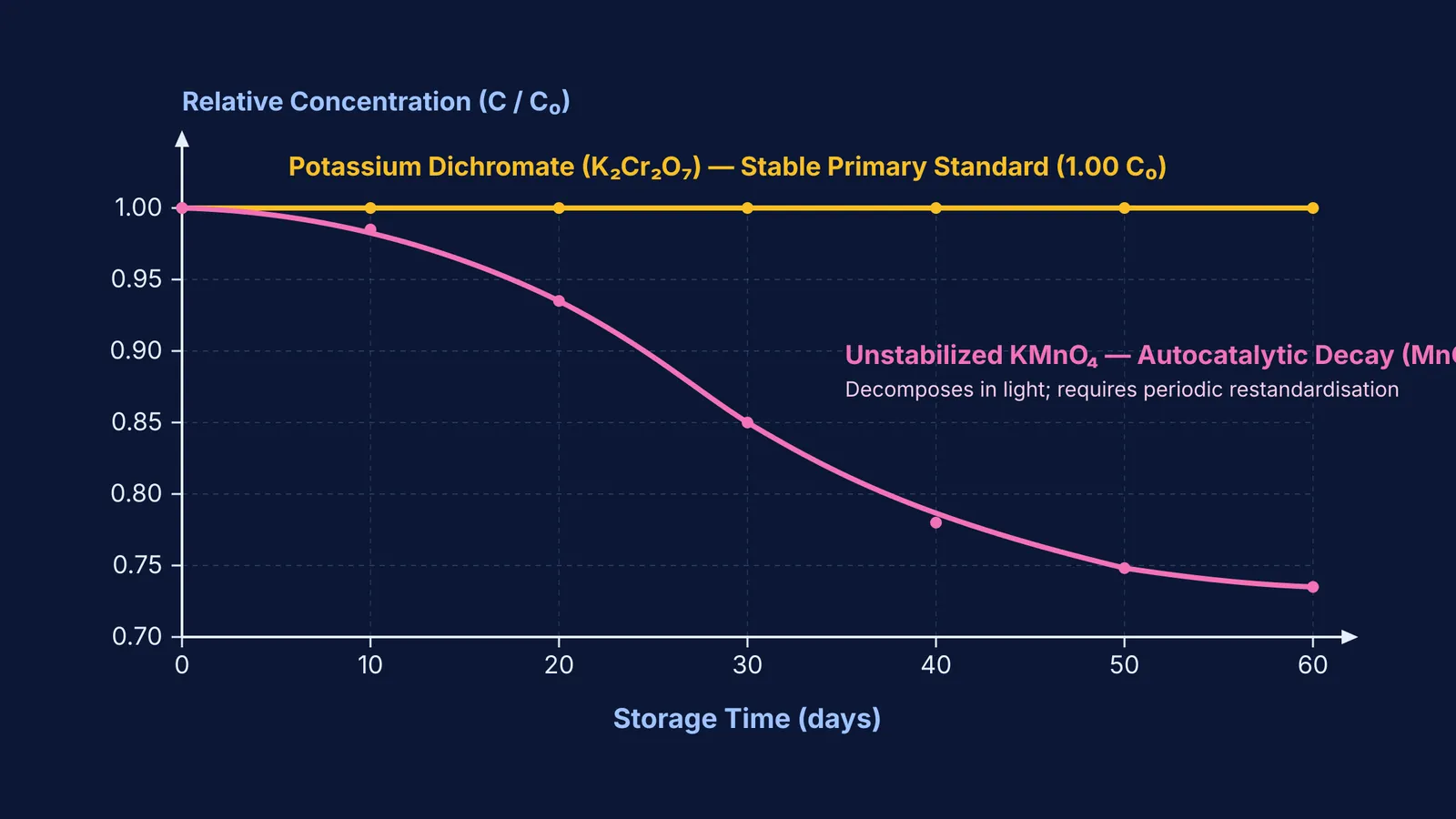
Unlike many transition metal salts, potassium dichromate is non-hygroscopic and does not absorb water vapour during weighing. Solid K₂Cr₂O₇ is chemically stable up to its melting point of 398 °C, as documented in its PubChem compound summary. Analysts can dry the orange crystals at 110 °C without decomposition.
Its molar mass of 294.18 g/mol (PubChem) offers another advantage. In acidic media, dichromate undergoes a 6-electron reduction: Cr₂O₇²⁻ + 14H⁺ + 6e⁻ → 2Cr³⁺ + 7H₂O
As noted in the NCERT Class 12 Chemistry textbook, its equivalent weight is 49.03 g/equiv (294.18 divided by 6). Preparing 1.0 L of 0.1 N solution requires 4.903 g of salt, keeping weighing uncertainty below 0.05%. Aqueous dichromate solutions remain stable indefinitely if sealed against evaporation.
Why is potassium permanganate not a primary standard?
Although potassium permanganate (KMnO₄) is a versatile oxidant, it cannot serve as a primary standard due to four vulnerabilities:
Impurities: Commercial crystals almost always contain manganese dioxide (MnO₂) formed during manufacture (PubChem compound summary).
Photochemical breakdown: Permanganate solutions decompose when exposed to light:
4MnO₄⁻ + 2H₂O → 4MnO₂ + 3O₂ + 4OH⁻
Autocatalysis: Precipitated MnO₂ acts as a catalyst for further permanganate decomposition. This breakdown accelerates autocatalytically, as shown by Thomas Rees in the Journal of Chemical Education.
Water impurities: Trace organic matter in distilled water reduces permanganate, generating more MnO₂ and altering titrant concentration over time.
Solid KMnO₄ also decomposes thermally above 200 °C into potassium manganate, MnO₂, and oxygen (PubChem), preventing oven drying. For related reaction mechanisms, see our guide to the preparation and reactions of KMnO4 and K2Cr2O7.
How should a secondary standard like KMnO4 be standardized?
Preparing a reliable KMnO₄ solution requires a multi-step sequence outlined in the NCERT Laboratory Manual in Chemistry:
Dissolve an approximate quantity of KMnO₄ (around 3.16 g for 1.0 L of ~0.1 N solution) in distilled water and heat near boiling for 1 hour to oxidize organic contaminants.
Filter through sintered glass to remove all catalytic MnO₂. Never use filter paper, as cellulose reduces permanganate.
Store the solution in dark amber glass bottles away from sunlight.
Standardize against a primary standard like oxalic acid dihydrate (H₂C₂O₄·2H₂O) or sodium oxalate (Na₂C₂O₄) heated to 60 °C to 70 °C.
You can follow the full practical in our guide to standardizing KMnO4 against oxalic acid. To connect normality and molarity calculations across these reactions, review our guide to n-factor and equivalent concepts in redox titrations.
KMnO₄ compensates for standardisation by acting as a self-indicator (NCERT). The purple MnO₄⁻ ion is reduced to nearly colourless Mn²⁺, leaving a persistent pink end point at concentrations down to 10⁻⁶ M. In contrast, K₂Cr₂O₇ reduces from orange to green (Cr³⁺), requiring a redox indicator like sodium diphenylamine sulfonate.
Why can K2Cr2O7 be used with hydrochloric acid when KMnO4 cannot?
In acidic titrations, the choice of acid is critical. Potassium permanganate has a standard reduction potential of +1.51 V (NCERT): MnO₄⁻ + 8H⁺ + 5e⁻ → Mn²⁺ + 4H₂O
Because this exceeds the +1.36 V reduction potential of chlorine (NCERT; Cl₂ + 2e⁻ → 2Cl⁻), KMnO₄ oxidises hydrochloric acid: 2MnO₄⁻ + 16H⁺ + 10Cl⁻ → 2Mn²⁺ + 5Cl₂ + 8H₂O
This consumes extra titrant and skews the titre. Permanganate titrations must therefore use dilute sulfuric acid (H₂SO₄).
By contrast, the reduction potential of dichromate is +1.33 V (NCERT). Because +1.33 V is below the +1.36 V threshold, potassium dichromate does not oxidise dilute hydrochloric acid (up to 1 to 2 M) at room temperature. This permits direct titration of iron(II) in hydrochloric acid ore extracts.
If you struggle with equivalent weights or multi-electron redox calculations, the Fermi Problem Library has worked problems with a step-by-step solver that explains the reasoning rather than printing an answer. For standard reduction potentials and transition metal chemistry, visit the Fermi Concept Library, which covers every concept in physics, chemistry, biology, mathematics and computing, each with its own lesson and its place in the map.


