

On this page
A common JEE and board-exam question gives you two electrode potentials and asks for a third. The usual trap is to add the two E° values. The fix takes four lines and works for any element with more than two oxidation states.
Why can't you just add electrode potentials?
An electrode potential is energy per unit of charge, so it does not depend on how many electrons are transferred. Gibbs energy does: it scales with the amount of reaction. The two are linked by ΔG° = −nFE°, where n is the number of electrons in the half-reaction and F is the Faraday constant, 96 485 C mol⁻¹ (NIST CODATA).
Because ΔG° is a state function, the ΔG° values of two steps add to give the ΔG° of the overall change. E° values never simply add for a combined half-reaction, because its n is the sum of the steps' n values; even when every step moves one electron, the result is a weighted average, not a sum. Inorganic chemistry texts make the same point for Latimer diagrams: to get the potential of a non-adjacent couple, convert to free energies, combine them, then convert back (LibreTexts, Latimer diagrams).
How do you find E° of Fe³⁺/Fe from Fe³⁺/Fe²⁺ and Fe²⁺/Fe?
The standard values in a common reference table are E°(Fe³⁺/Fe²⁺) = +0.771 V, E°(Fe²⁺/Fe) = −0.44 V and E°(Fe³⁺/Fe) = −0.037 V (LibreTexts standard reduction potentials). Let us pretend you only know the first two.
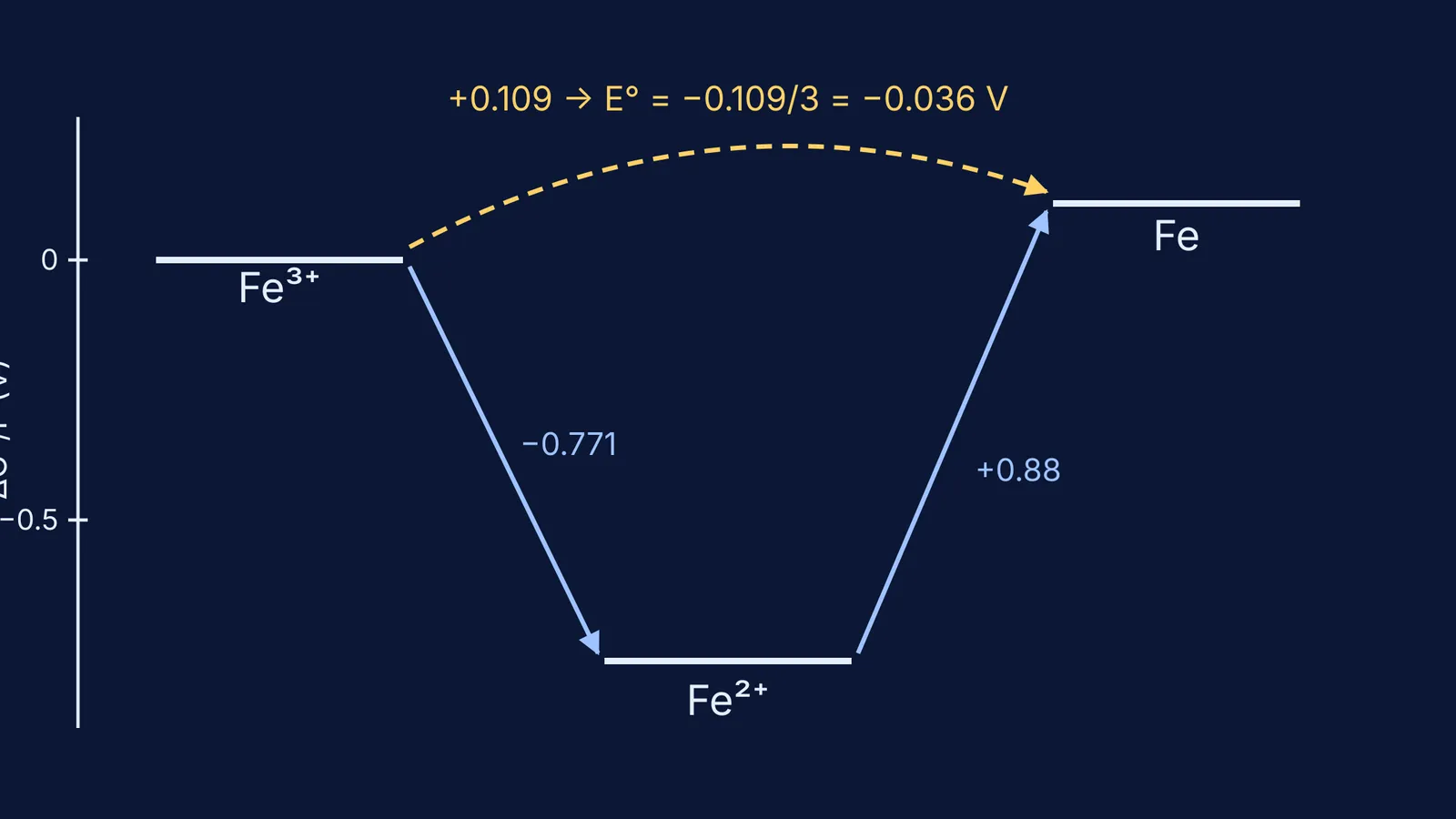
Write the steps so they add up to the target. Fe³⁺ + e⁻ → Fe²⁺ (n = 1), then Fe²⁺ + 2e⁻ → Fe (n = 2). Together: Fe³⁺ + 3e⁻ → Fe (n = 3).
Convert each step. ΔG°₁ = −1 × F × 0.771 = −0.771F. ΔG°₂ = −2 × F × (−0.44) = +0.88F.
Add. ΔG°₃ = −0.771F + 0.88F = +0.109F.
Convert back. E°₃ = −ΔG°₃ ÷ 3F = −0.109 ÷ 3 = −0.036 V.
The tabulated value is −0.037 V, so the method checks out to within rounding. Notice that F cancels. You never need its number, so in an exam you can write everything "in units of F" and save time.
The wrong shortcut, 0.771 + (−0.44), gives +0.331 V. That is not even the right sign.
How does the copper case work?
The same reference gives E°(Cu²⁺/Cu⁺) = +0.159 V, E°(Cu⁺/Cu) = +0.520 V and E°(Cu²⁺/Cu) = +0.3419 V (LibreTexts standard reduction potentials). Find Cu²⁺/Cu from the first two.
Steps: Cu²⁺ + e⁻ → Cu⁺ (n = 1), then Cu⁺ + e⁻ → Cu (n = 1). Target: Cu²⁺ + 2e⁻ → Cu (n = 2).
ΔG°₁ = −0.159F. ΔG°₂ = −0.520F.
ΔG°₃ = −0.679F.
E°₃ = 0.679 ÷ 2 = +0.340 V, against a tabulated +0.3419 V.
Adding directly gives +0.679 V, twice the right answer. Here both steps have n = 1, yet the target has n = 2, so the shortcut still fails.
There is a second question hiding in these numbers. For 2Cu⁺ → Cu²⁺ + Cu, one Cu⁺ is reduced (+0.520 V) and one is oxidised (the Cu²⁺/Cu⁺ couple, +0.159 V). This is a full cell, so you subtract: E°cell = 0.520 − 0.159 = +0.361 V. It is positive, so under standard conditions Cu⁺ is unstable in water and tends to disproportionate. Subtracting is safe for a cell because the same electrons pass through both halves, so n cancels. For the wider picture of why copper sits on the positive side, see our post on why copper has a positive E° among the 3d metals.
When do you add, and when do you subtract?
Combining two half-reactions into a new half-reaction (electrons left over): add n × E°, then divide by the new n.
Combining two half-reactions into a full cell (no electrons left over): E°cell = E°cathode − E°anode, no weighting.
Checking spontaneity: a positive E°cell means a negative ΔG°.
If you want the next step, turning E°cell into ΔG° and K, our walkthrough of from cell EMF to ΔG° and K picks up from here. And for reading reactions straight off the table, see using the electrochemical series to predict redox reactions.
If you keep slipping on which case you are in, try a few versions in the Fermi Problem Library, where the step-by-step solver explains the reasoning rather than printing an answer. For a refresher on Gibbs energy itself, the Fermi Concept Library has a lesson for each idea and shows where it sits in the map.


