

On this page
Ferrous oxalate is a favourite redox question because it checks one habit: do you look at every part of a compound, or only the metal? Students who look only at iron write n = 1 and get the wrong answer. Permanganate oxidises both the Fe2+ ion and the oxalate ion, and the n factor has to count both.
Why is the n factor of ferrous oxalate 3?
The n factor of a reducing agent is the number of electrons one formula unit loses in the reaction. Ferrous oxalate is FeC₂O₄, listed by PubChem as iron(2+) oxalate with a molar mass of 143.86 g/mol.
Two things in that formula change when acidified KMnO4 is added:
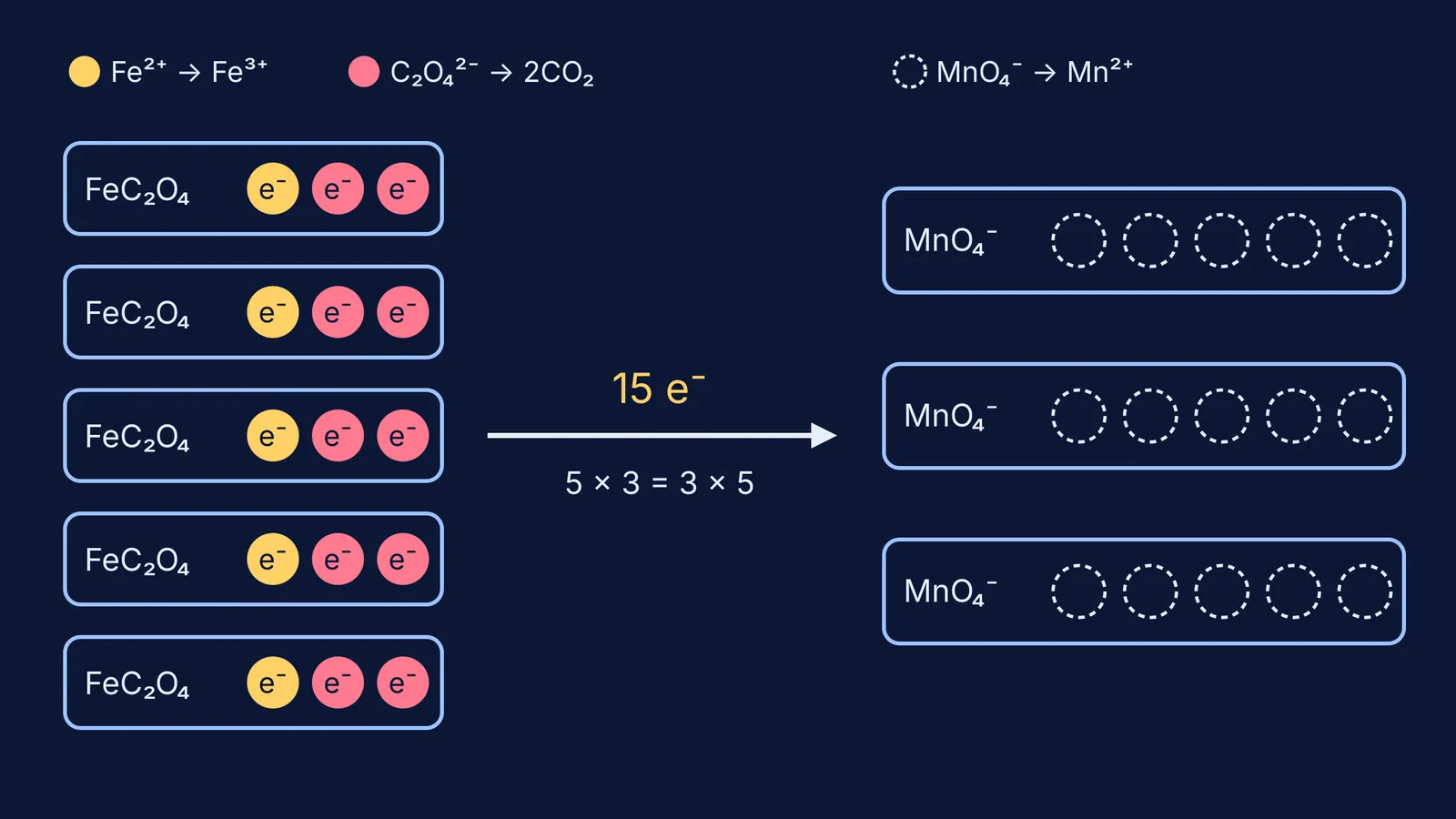
Iron: Fe goes from +2 to +3, so it loses 1 electron.
Oxalate: each carbon goes from +3 to +4 as C₂O₄²⁻ becomes 2CO₂. There are two carbons, so oxalate loses 2 electrons.
Add them and one FeC₂O₄ loses 1 + 2 = 3 electrons. That is the n factor: 3.
You can confirm both parts from the balanced equations in this Cerritos College lab handout on analysing an iron oxalate compound. For iron it gives 5Fe²⁺ + MnO₄⁻ + 8H⁺ → 5Fe³⁺ + Mn²⁺ + 4H₂O, so five Fe²⁺ ions hand their electrons to one permanganate ion. For oxalate it gives 2MnO₄⁻ + 5C₂O₄²⁻ + 16H⁺ → 10CO₂ + 2Mn²⁺ + 8H₂O, so five oxalate ions supply the electrons for two permanganate ions.
How many moles of KMnO4 react with one mole of FeC2O4?
In acid, manganese in MnO₄⁻ goes from +7 to +2, so the n factor of KMnO4 is 5. This matches the iron equation in the Cerritos College handout: one MnO₄⁻ takes the five electrons released by five Fe²⁺.
At the end point, electrons lost equal electrons gained. So moles × n factor is the same on both sides:
1 × 3 = x × 5, which gives x = 3/5 = 0.6 mole of KMnO4 per mole of FeC₂O₄.
You can check this by adding the two half-reactions into one equation: 5FeC₂O₄ + 3MnO₄⁻ + 24H⁺ → 5Fe³⁺ + 10CO₂ + 3Mn²⁺ + 12H₂O. Count the atoms and the charge (+21 on each side) and it balances.
Worked example: what titre should you expect?
Say 0.1439 g of FeC₂O₄ is dissolved in dilute sulphuric acid and titrated with 0.0200 M KMnO4. What volume reaches the end point?
Moles of FeC₂O₄ = 0.1439 g ÷ 143.86 g/mol (molar mass from PubChem) = 1.000 × 10⁻³ mol.
Electrons lost = 3 × 1.000 × 10⁻³ = 3.000 × 10⁻³ mol.
Moles of KMnO4 = 3.000 × 10⁻³ ÷ 5 = 6.00 × 10⁻⁴ mol.
Volume = 6.00 × 10⁻⁴ mol ÷ 0.0200 mol/L = 0.0300 L = 30.0 mL.
Compare the two common slips. Counting only iron (n = 1) gives 10.0 mL. Counting only oxalate (n = 2) gives 20.0 mL.
For more practice, the Fermi Problem Library has worked problems with a step-by-step solver that explains the reasoning rather than printing an answer, so you can see where your n factor went wrong.
What changes for ferric oxalate, Mohr's salt and oxalic acid?
The method stays the same; only the list of things that get oxidised changes.
Mohr's salt or FeSO4: only Fe²⁺ is oxidised, so n = 1. Our post on the KMnO4 titration with Mohr's salt works through it.
Oxalic acid or sodium oxalate: only oxalate is oxidised, so n = 2.
Ferric oxalate, Fe₂(C₂O₄)₃: iron is already +3, so only the three oxalate ions count, and n = 6. One mole then needs 6/5 = 1.2 mole of KMnO4.
The Cerritos College handout shows a related iron(III) compound, K₃[Fe(C₂O₄)₃], in practice. Direct titration with permanganate measures only its oxalate. To measure the iron, the oxalate is first destroyed with concentrated sulphuric acid and Fe³⁺ is reduced to Fe²⁺ with zinc. Because the oxalate reaction is slow at room temperature, the handout titrates it hot.
A five-step checklist for any n factor question
Write the oxidation state of every element in the reducing agent.
Write what each one becomes after the reaction (Fe³⁺, CO₂, Mn²⁺).
Multiply each change by the number of those atoms in one formula unit.
Add the changes to get n for the reducing agent; do the same for the oxidising agent.
Set moles × n equal on both sides, then check against a balanced equation.
If step 1 is the shaky one, the Fermi Concept Library gives every chemistry concept, oxidation numbers included, its own lesson. For the general idea, read n-factor and the equivalent concept in redox titrations; for writing the combined equation yourself, see balancing redox reactions with oxidation numbers and half-reactions.
Next time you see FeC₂O₄ with KMnO4, count three electrons, divide by five, and write 0.6.


