On this page
Wave Optics is the second part of the Optics unit, and it asks for a different habit from ray diagrams: thinking in path difference and phase. Below are the syllabus, four worked examples with units, the usual traps and a one-week plan.
What does the JEE Main 2027 syllabus include in Wave Optics?
Unit 16 (Optics) of the official Syllabus for JEE (Main) - 2027 from NTA lists wavefronts and Huygens principle, reflection and refraction using Huygens principle, Young's double-slit experiment and the expression for fringe width, coherent sources and sustained interference, diffraction due to a single slit and the width of the central maximum, and polarisation: plane-polarised light, Brewster's law, and uses of plane-polarised light and Polaroids.
Your main text is Chapter 10, Wave Optics, of NCERT Class 12 Physics Part II (Reprint 2026-27), sections 10.2 to 10.7. It covers Malus's law and the fact that one Polaroid passes half the intensity of unpolarised light. Brewster's law is in the NTA list but not in this NCERT chapter, so learn it separately: for light from air into a medium of index n, tan θB = n at the Brewster angle, and the reflected light is fully plane-polarised.
How do you solve YDSE fringe width and path difference problems?
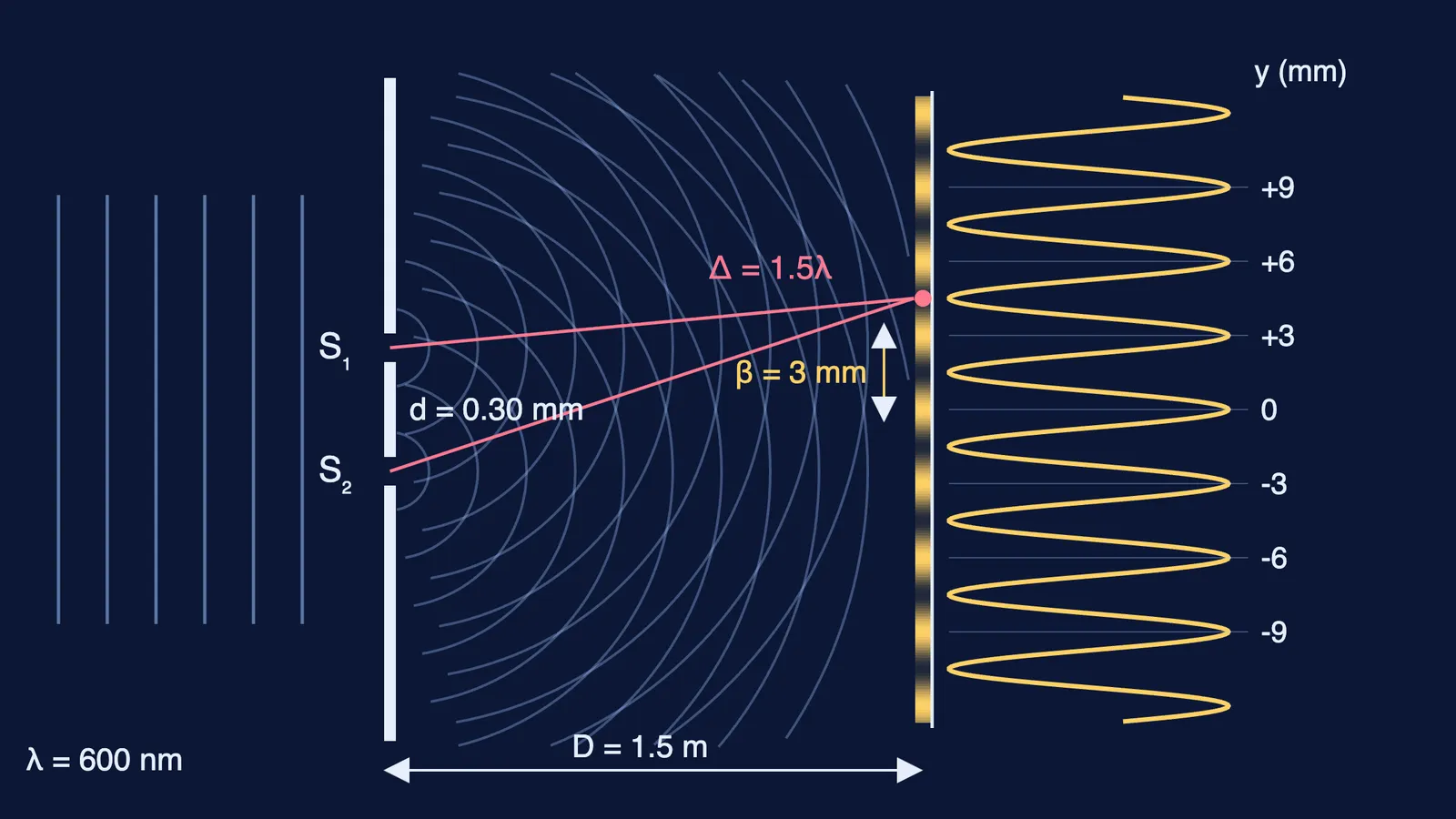
NCERT gives bright fringes at x = nλD/d and dark fringes at x = (n + 1/2)λD/d, so the fringe width is β = λD/d.
Worked example 1. Light of wavelength 600 nm falls on two slits 0.30 mm apart, with the screen 1.5 m away.
β = (600 × 10⁻⁹ m)(1.5 m) / (0.30 × 10⁻³ m) = 3.0 × 10⁻³ m = 3.0 mm.
The third dark fringe is n = 2: x = 2.5 × 3.0 mm = 7.5 mm from the centre.
Worked example 2. Same set-up: what happens at y = 4.5 mm? Path difference = yd/D = (4.5 × 10⁻³ m)(0.30 × 10⁻³ m) / (1.5 m) = 9.0 × 10⁻⁷ m = 900 nm = 1.5λ. An odd multiple of λ/2 means a dark fringe: n = 1 in (n + 1/2)λ, so the second dark fringe (the first is at 1.5 mm).
Common traps:
Immersing the apparatus in water (n = 1.33) shortens the wavelength, so β = 3.0 mm / 1.33 ≈ 2.26 mm. Fringes squeeze; they do not widen.
"Third dark fringe" means n = 2, not n = 3. List the n values before substituting.
Two independent bulbs are not coherent sources, so they give no sustained pattern.
How do you find single-slit minima and the central maximum width?
For a single slit of width a, NCERT puts the minima at θ ≈ nλ/a, with n = ±1, ±2 and so on. The central maximum stretches between the two first minima, so its width on a screen at distance D is 2λD/a.
Worked example 3. Light of 480 nm passes through a slit 0.12 mm wide onto a screen 2.0 m away.
First minimum: θ = (480 × 10⁻⁹ m) / (0.12 × 10⁻³ m) = 4.0 × 10⁻³ rad, which sits 4.0 × 10⁻³ × 2.0 m = 8.0 mm from the centre.
Central maximum width = 2 × 8.0 mm = 16 mm.
A narrower slit gives a wider central maximum. The Fermi Simulation Lab has interactive simulations for ideas that are easier to see than to read.
How does Malus's law work with two Polaroids?
NCERT states Malus's law as I = I₀cos²θ, where θ is the angle between the pass axes, and notes that a single Polaroid passes half of unpolarised light.
Worked example 4. Unpolarised light of intensity 64 W/m² meets two Polaroids whose axes are 60° apart.
After the first: 64 / 2 = 32 W/m².
After the second: 32 × cos²60° = 32 × 0.25 = 8.0 W/m².
Trap: cos²θ applies only to light that is already polarised. Do not apply it at the first sheet. For Brewster's law, practise one quick case: glass with n = 1.5 gives θB = tan⁻¹(1.5) ≈ 56.3°.
A seven-day plan for Wave Optics
Day 1: read NCERT 10.1 to 10.3; draw the Huygens construction for refraction yourself.
Day 2: derive β = λD/d from the path difference yd/D without the book.
Day 3: ten YDSE problems with your own numbers, including one in water and one with fringe counting.
Day 4: single slit, sections 10.6 and 10.6.1, plus five central-maximum problems.
Day 5: polarisation, section 10.7, Malus's law and Brewster's law.
Day 6: a timed mixed set of previous years' questions; our guide to using previous year questions for JEE and NEET shows how to log every error.
Day 7: redo every wrong question and note whether it was a units slip, a wrong n or the wrong condition.
If you have done Ray Optics for JEE Main, revise the two together as one Optics unit.
When a solution goes wrong and you cannot see where, the Fermi Problem Library has worked problems with a step-by-step solver that explains the reasoning rather than printing an answer.