On this page
This guide is for the CBSE board paper; for entrance-style numericals, see our guide to Moving Charges and Magnetism for JEE Main.
How many marks is Moving Charges and Magnetism in Class 12 boards?
The CBSE Class XII Physics curriculum for 2026-27 places Chapter 4, Moving Charges and Magnetism, in Unit III with Chapter 5, Magnetism and Matter. Its marks table prints one 17-mark cell for Units III and IV together (Chapters 4 to 7) out of 70 theory marks. There is no separate figure for this chapter.
The CBSE 2026-27 sample question paper mixes MCQs and assertion-reason items with 2- and 3-mark short answers, 4-mark case studies and 5-mark long answers. Calculators are not allowed.
Which derivations and diagrams does NCERT expect?
Work from NCERT Class 12 Physics Chapter 4 (2026-27 reprint). Its derivations:
Biot-Savart law on the axis of a circular loop, B = µ0IR²/2(x² + R²)^(3/2), which becomes µ0I/2R at the centre.
Ampère's circuital law for a long straight wire, B = µ0I/2πr, and for a long solenoid, B = µ0nI.
Force per unit length between parallel wires, µ0IaIb/2πd, and the definition of the ampere from it.
Torque on a rectangular loop, τ = m × B with m = NIA.
The moving coil galvanometer: kφ = NIAB, current sensitivity NAB/k, and conversion to an ammeter (small shunt in parallel) or a voltmeter (large resistance in series).
The curriculum lists the straight solenoid for "only qualitative treatment", so know B = µ0nI and the field picture first. The cyclotron has no section of its own; NCERT names it in the introduction, Section 4.3 and the Summary, to show that the orbit frequency qB/2πm does not depend on speed.
Draw until automatic: field lines round a wire and a solenoid, parallel wires with B and force arrows, a loop in a field, and the shunt and series circuits. For directions near crossed wires, see our example on the field of two perpendicular wires.
How do you set out 2-, 3- and 5-mark answers?
2 marks: the law or formula, one line of reasoning, the answer with its unit.
3 marks: a sketch, the starting law, a few lines of working, the result underlined.
5 marks: a labelled diagram, then numbered steps that each name the law used (Biot-Savart, Ampère, F = IL × B), then the final expression and its special case.
Whenever B or F is asked, give the direction as well as the size: "into the page", "towards wire a".
Worked numerical: galvanometer to ammeter and voltmeter
A galvanometer has resistance G = 12 Ω and full-scale deflection at Ig = 3 mA. Convert it into (a) an ammeter of range 0-6 A and (b) a voltmeter of range 0-18 V.
First pass: the board answer.
(a) NCERT's ammeter puts a small shunt S in parallel with the coil, so both share one voltage: Ig G = (I − Ig) S. So S = (0.003 × 12)/(6 − 0.003) = 0.036/5.997 ≈ 6.0 × 10⁻³ Ω, in parallel.
(b) NCERT's voltmeter puts a large R in series, so Ig flows through both: V = Ig (G + R). So R = 18/0.003 − 12 = 5988 Ω, in series.
Second pass: check it another way.
(a) At full scale the coil has 0.003 × 12 = 0.036 V across it. The shunt carries 5.997 A, and 5.997 × 0.006 ≈ 0.036 V. The voltages match.
(b) Total resistance is 12 + 5988 = 6000 Ω, and 18/6000 = 0.003 A, exactly full scale.
If a step went wrong, the Fermi Problem Library has worked problems with a step-by-step solver that explains the reasoning rather than printing an answer.
What are the assertion-reason and case-study traps?
"The magnetic force does work." The force q(v × B) is always perpendicular to the velocity, so it does no work.
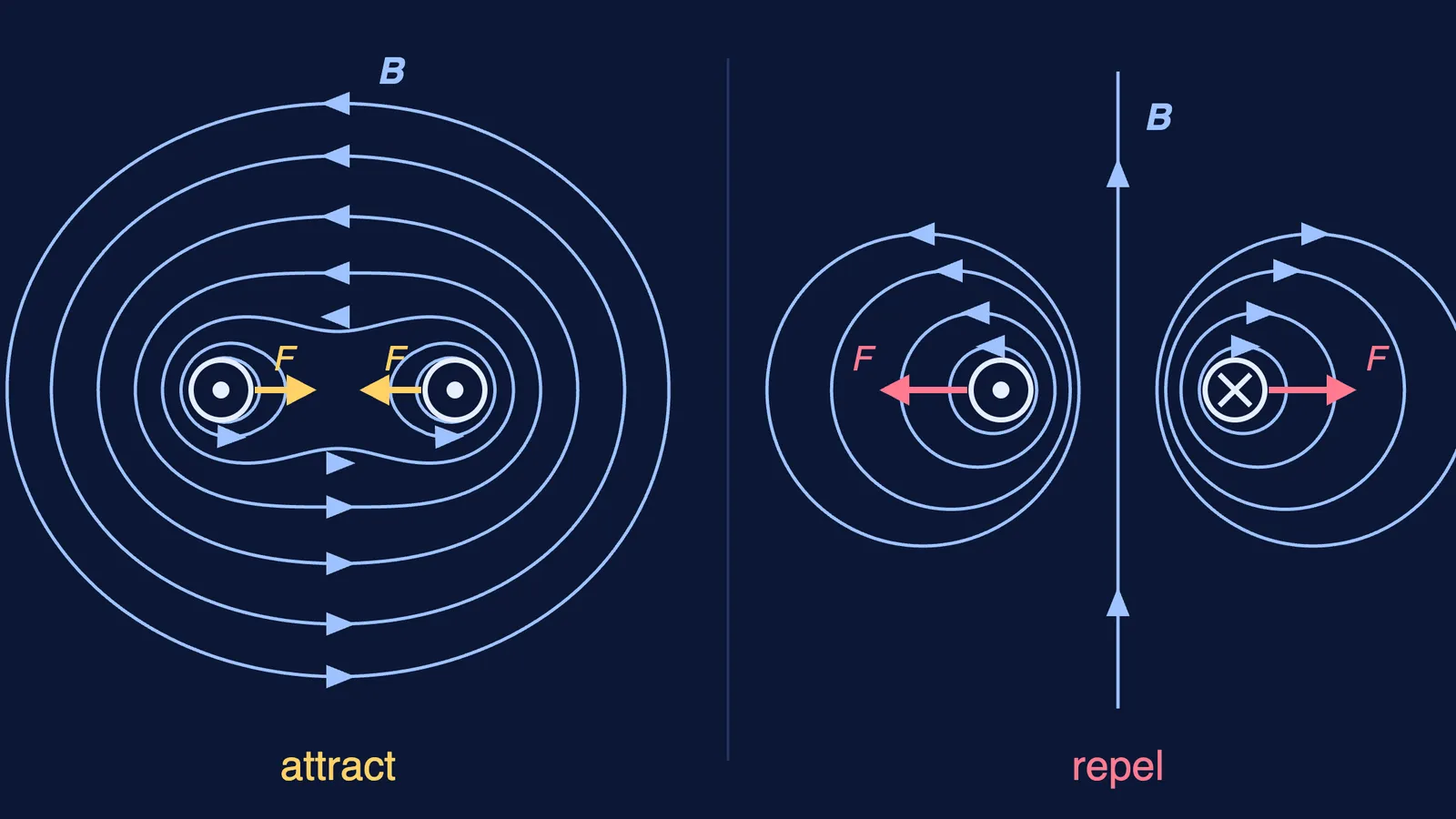
"Parallel currents repel." The reverse: currents in the same direction pull together; opposite currents push apart.
Loop in a uniform field. The net force is zero; the torque need not be.
"More turns raise both sensitivities." NCERT shows doubling N doubles current sensitivity, but voltage sensitivity can stay the same because the coil's resistance is likely to double too.
Charged-particle cases. The radius r = mv/qB grows with momentum; the frequency stays fixed.
If parallel currents attracting still feels backwards, the Fermi Simulation Lab has interactive simulations for the ideas that are easier to see than to read.
A two-week revision plan for this chapter
Days 1-2: NCERT 4.1-4.3; Lorentz force and r = mv/qB from memory; Exercises 4.11-4.12.
Days 3-4: the circular loop derivation, twice from a blank page; Exercise 4.1.
Days 5-6: Ampère's law for wire and solenoid; Exercises 4.2-4.4 and 4.8.
Days 7-8: parallel wires and the ampere; Exercise 4.7.
Days 9-10: torque and the galvanometer; Exercises 4.9, 4.10, 4.13; redo the conversion with new numbers.
Days 11-14: the sample paper's questions on this unit, timed; redo derivations you got wrong; then revise Magnetism and Matter.
If the clock beats you on paper day, our 20-minute triage plan for a board paper shows what to attempt first.