On this page
Two long straight wires cross at right angles, and you are asked for the magnetic field at a point P in the same plane. It looks harder than it is. Assume the wires are insulated where they cross, so each carries only its own current.
What is the magnetic field of one long straight wire?
The field of a long straight wire at perpendicular distance r is B = μ0I/2πr, as derived in OpenStax University Physics, Volume 2.
The permeability of free space is μ0 = 1.25663706127 × 10⁻⁶ N A⁻² (CODATA 2022), according to NIST. That matches 4π × 10⁻⁷ T m/A to ten significant figures, so for exam work μ0/2π = 2 × 10⁻⁷ T m/A.
Here r is the perpendicular distance from P to that wire, not the distance to the crossing point; see why a straight wire's field falls as 1/r.
For direction, OpenStax gives the right-hand rule: thumb along the current, fingers wrap around the wire in the sense of B. Practise it with our guide to the right-hand thumb rule for magnetic fields.
Which way does each wire's field point at P?
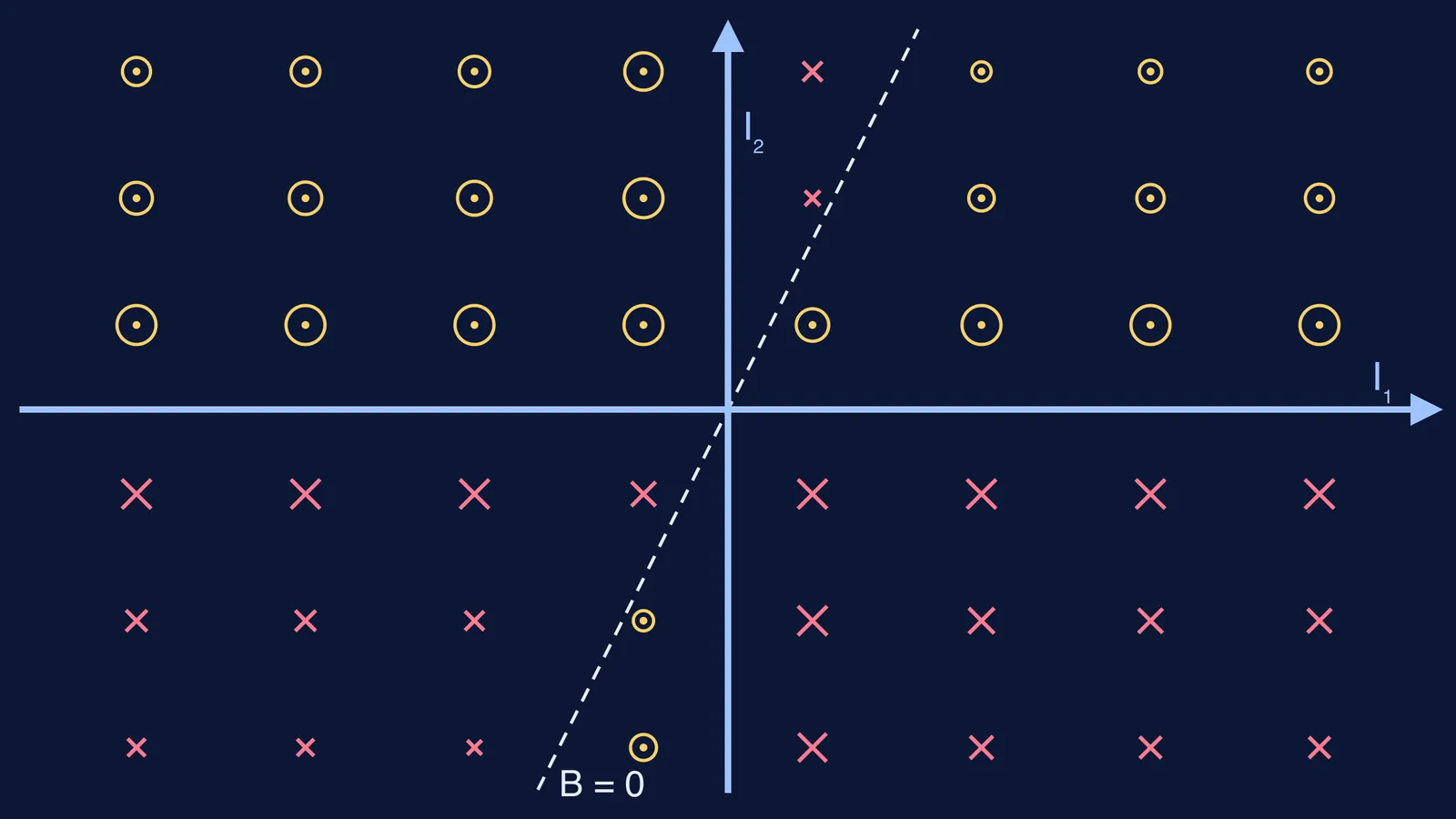
Set up axes. Wire 1 lies along the x-axis with current I1 flowing in the +x direction. Wire 2 lies along the y-axis with current I2 flowing in the +y direction. P = (x, y).
The distance from P to wire 1 is |y|; the distance to wire 2 is |x|.
Wire 1: above it (y > 0) its field comes out of the page; below it, into the page.
Wire 2: to its right (x > 0) its field goes into the page; to its left, out of the page.
Put those together, quadrant by quadrant:
Quadrant I (x > 0, y > 0): out and into, so subtract.
Quadrant II (x < 0, y > 0): out and out, so add.
Quadrant III (x < 0, y < 0): into and out, so subtract.
Quadrant IV (x > 0, y < 0): into and into, so add.
How do you find the net field at a point? A worked example
Take I1 = I2 = 5 A and P = (3 cm, 4 cm), using B = μ0I/2πr from OpenStax and μ0/2π = 2 × 10⁻⁷ T m/A.
Distance to wire 1 is 4 cm = 0.04 m. B1 = (2 × 10⁻⁷)(5)/0.04 = 2.5 × 10⁻⁵ T, out of the page.
Distance to wire 2 is 3 cm = 0.03 m. B2 = (2 × 10⁻⁷)(5)/0.03 = 3.33 × 10⁻⁵ T, into the page.
The fields oppose, so subtract: Bnet = 0.83 × 10⁻⁵ T, about 8.3 μT, into the page, because the larger field wins.
Now move to Q = (−3 cm, 4 cm) in quadrant II. Same distances, but both fields point out of the page, so Bnet = 5.8 × 10⁻⁵ T, out of the page: about seven times larger, from the quadrant alone. This is the superposition rule from OpenStax's Biot-Savart law chapter, with the vectors lined up.
Where is the magnetic field zero near two perpendicular wires?
The field can only vanish where the two contributions oppose, which is quadrants I and III. Set the magnitudes from the OpenStax straight-wire formula equal: μ0I1/2π|y| = μ0I2/2π|x|, so |y|/|x| = I1/I2. The zero-field points form a straight line through the crossing point: y = (I1/I2)x.
Take I1 = 4 A and I2 = 2 A. The line is y = 2x. Check P = (1 cm, 2 cm):
B1 = (2 × 10⁻⁷)(4)/0.02 = 4 × 10⁻⁵ T, out of the page.
B2 = (2 × 10⁻⁷)(2)/0.01 = 4 × 10⁻⁵ T, into the page.
Bnet = 0.
The point (−1 cm, −2 cm) also gives zero. The line sits closer to wire 2, the weaker wire: to balance a smaller current, you stand nearer to it. With equal currents it becomes y = x, the 45° bisector.
What mistakes cost marks on this question?
Using the distance OP from the crossing point instead of each wire's perpendicular distance.
Adding magnitudes everywhere without checking the quadrant.
Writing y = x for the zero line when the currents are unequal.
Leaving distances in centimetres inside μ0I/2πr.
The same add-the-contributions method carries over to loops and solenoids; see Biot-Savart and Ampère's law.
If your sign keeps coming out wrong, the Fermi Problem Library has worked problems with a step-by-step solver that explains the reasoning rather than printing an answer, so you can find the step where a direction flipped.
Next time you meet crossed wires, sketch the four quadrants before you write a single number.