

On this page
In 1820 Hans Christian Oersted saw a compass needle swing when current flowed through a nearby wire, as the NCERT Class 10 Science chapter on magnetic effects of electric current recounts. The right-hand thumb rule turns that observation into a direction you can draw. It has two versions, and it is easy to confuse with Fleming's rules.
How do you use the right-hand thumb rule for a straight wire?
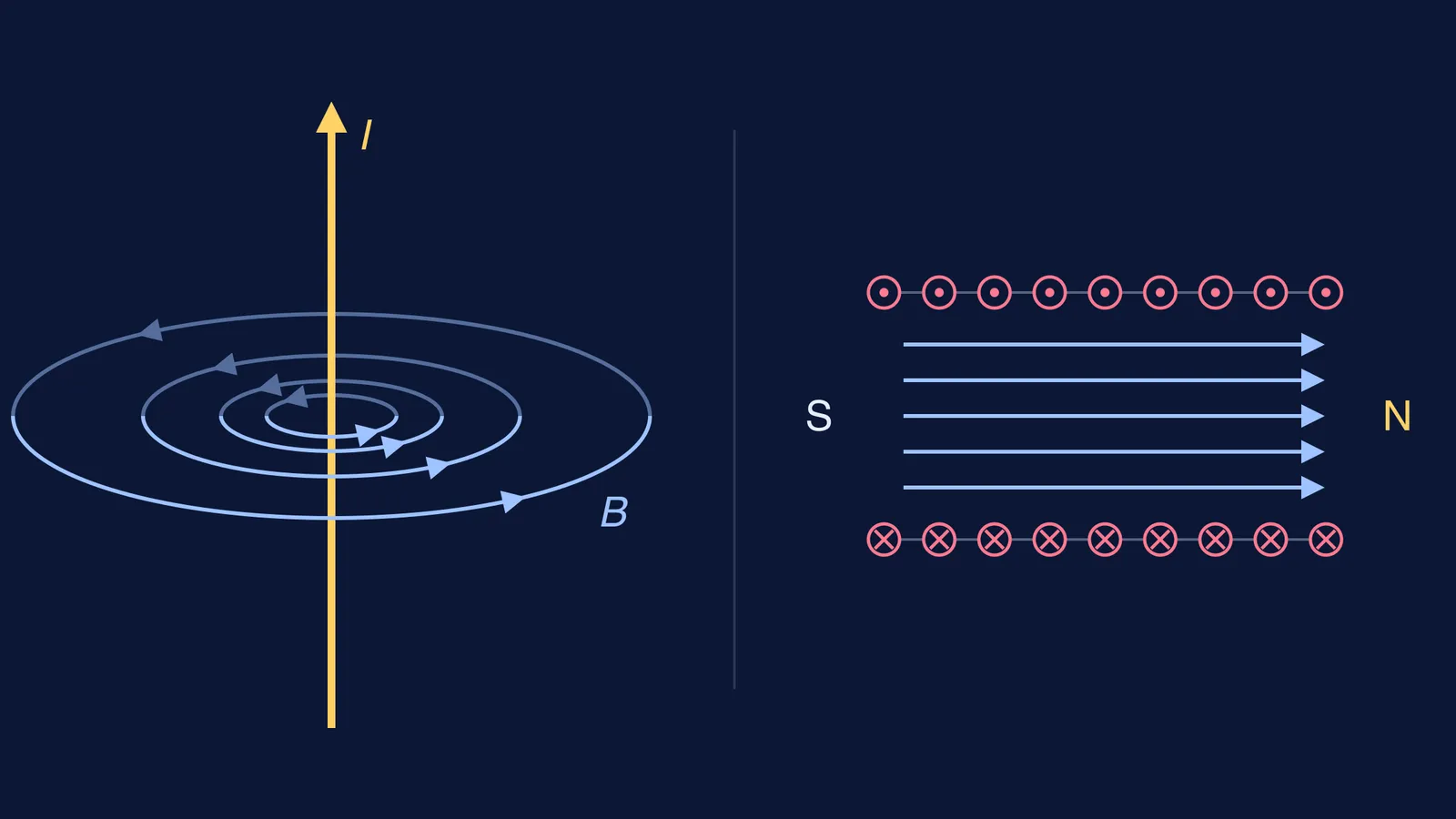
NCERT puts it this way: hold the current-carrying wire in your right hand with your thumb pointing along the current, and your fingers wrap around it in the direction of the magnetic field lines (NCERT Class 10, Chapter 12). The lines are concentric circles centred on the wire.
To use it on a diagram:
Find the current arrow. Current is taken opposite to the direction electrons move.
Point your right thumb along it.
Read the curl of your fingers at the point the question asks about.
Draw the field as a tangent to the circle there.
On paper, a dot means current coming out at you, so the field runs anticlockwise. A cross means current going into the page, so it runs clockwise.
What changes for a circular loop and a solenoid?
For a loop the roles swap. NCERT Class 12 Physics, Chapter 4 says to curl the palm of your right hand around the loop with your fingers pointing along the current; your thumb then gives the direction of the magnetic field. A footnote in that chapter notes that these are two distinct right-hand rules, in which fingers and thumb play different roles.
A solenoid is many loops side by side, so the same version works. The Class 10 chapter notes that the field inside a solenoid is uniform and that its pattern resembles a bar magnet's, with one north end and one south end. Your thumb points to the north end, where the field lines come out. The clock rule for finding a solenoid's poles gives the same answer from an end-on view.
Worked example: which way is the field of a loop lying on a table?
This is an in-text question in the NCERT Class 10 chapter: a circular loop lies flat on a table and carries a current clockwise (take that as seen from above). Which way does the field point inside and outside the loop?
The current goes round, so use the loop version: fingers follow the current.
Curl the fingers of your right hand clockwise as you look down. Your thumb points into the table.
So inside the loop, the field points down.
Field lines are closed curves, so outside the loop they come back up: the field there points up, out of the table.
Cross-check with the straight-wire version on the edge nearest you, where the current runs to your left: thumb left, and your fingers go down towards the centre and up on the outside. Both versions agree.
One step further: the field leaves through the underside, so the bottom face acts as a north pole and the top face, where you see clockwise current, acts as a south pole.
How is it different from Fleming's left-hand and right-hand rules?
The thumb rule needs only a current. Both of Fleming's rules start with a magnetic field already there and use three fingers at right angles.
Fleming's left-hand rule gives the force on a current-carrying conductor in a field, the idea behind motors: first finger along the field, second finger along the current, thumb along the force or motion (NCERT Class 10, Chapter 12).
Fleming's right-hand rule gives the induced current when a conductor moves through a field, as in generators: thumb for motion, first finger for field, second finger for induced current (overview of Fleming's right-hand rule).
To decide which rule a question needs:
Asked for the field made by a current? Right-hand thumb rule.
Given a field and a current, asked for force or motion? Fleming's left hand.
Given a field and motion, asked for current? Fleming's right hand.
For a worked motor-and-generator example, read Fleming's left vs right hand rule: when to use which.
How can you practise until it is automatic?
Take five textbook diagrams. Put your hand in position and say the rule aloud before each answer, then reverse the current and check that every arrow flips.
The Fermi Simulation Lab has interactive simulations for ideas that are easier to see than to read, and our guide on how to visualise the magnetic field of a wire, loop and solenoid walks through all three shapes. If you keep using the wrong method in numericals, the Fermi Problem Library has worked problems with a step-by-step solver that explains the reasoning rather than printing an answer.
Next time you see a dot or a cross in a diagram, put your right thumb on it first.


